Image

This website uses cookies to understand how you use the website and to improve your experience. By continuing to use the website, you accept the University of New England’s use of cookies and similar technologies. To learn more about our use of cookies and how to manage your browser cookie settings, please review our Privacy Notice.
Collaboration across branches of knowledge comes naturally at the P.D. Merrill Makerspace, where students from all corners of UNE meet and explore new ideas — with more innovative results.
The fall day when Milo Lypps, B.S. ’25, found himself elbow-deep in a bin full of equipment in the P.D. Merrill Makerspace, he had no idea he was about to stumble into his next adventure.
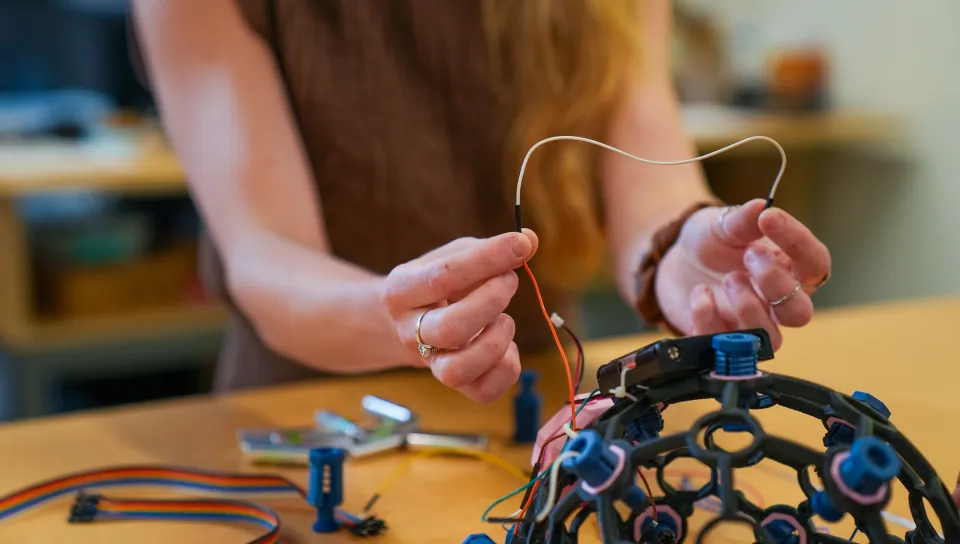
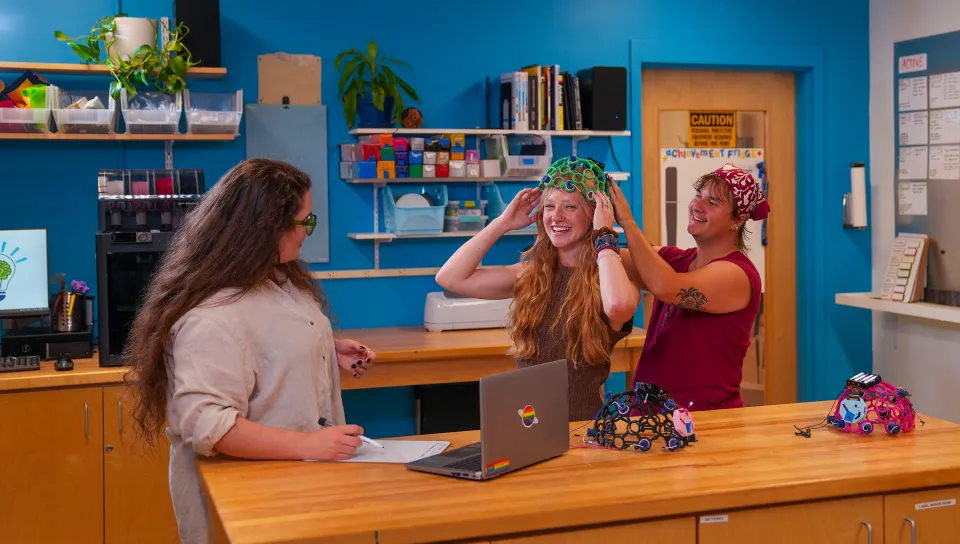
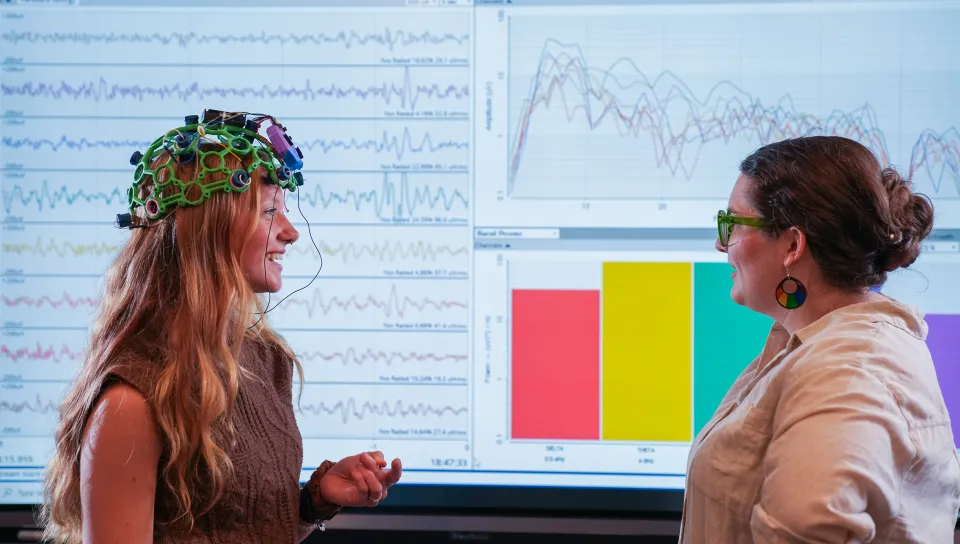
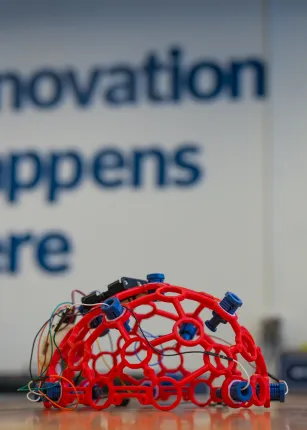
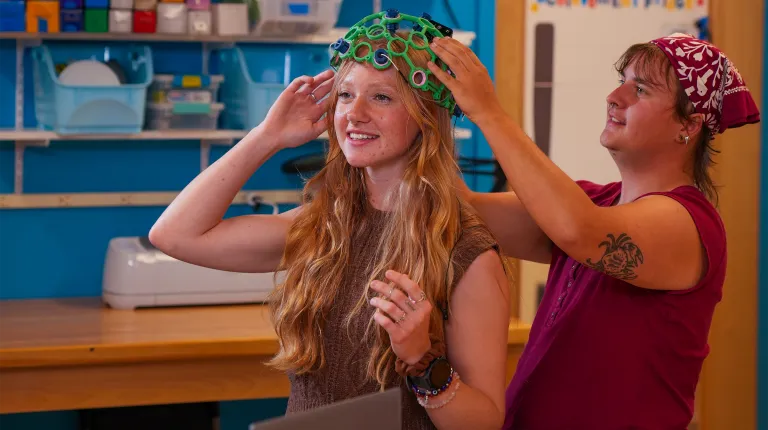
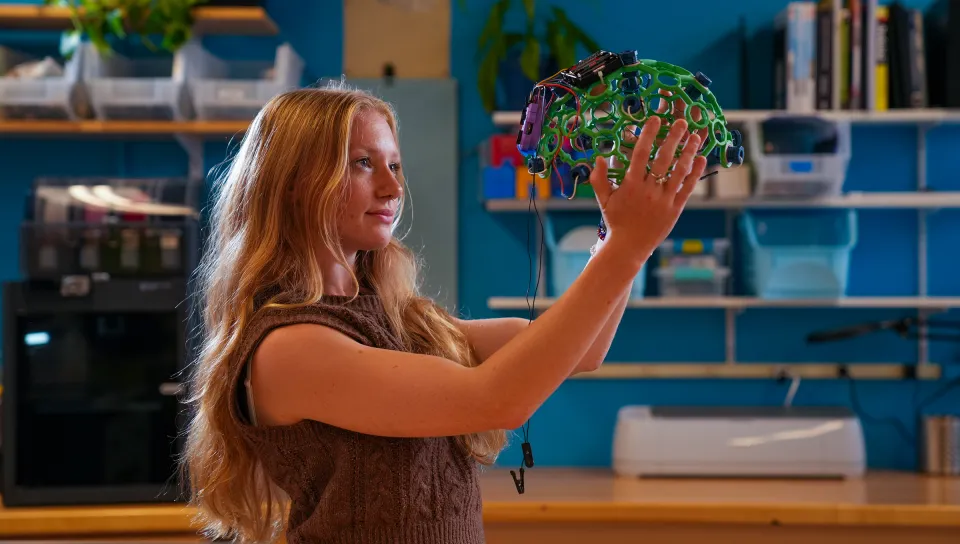
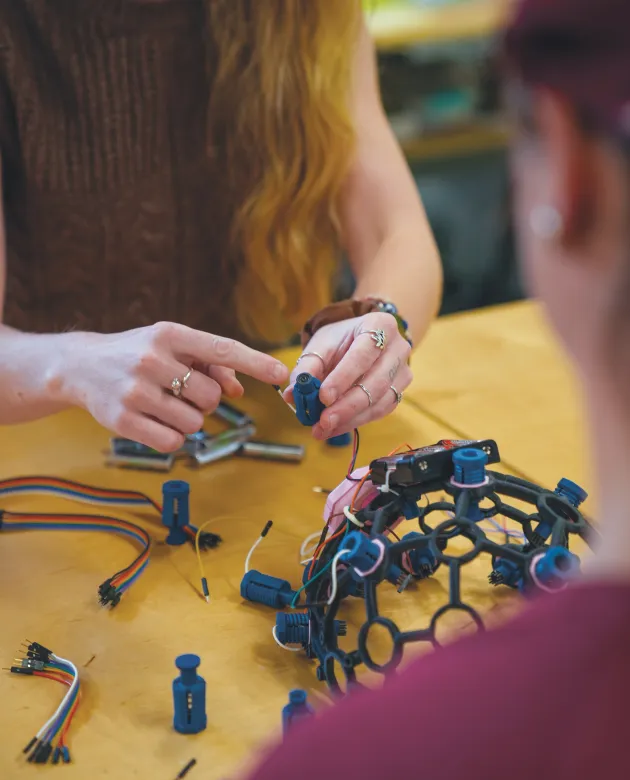
The marine science major was doing what seemed like a mundane task for his work-study job as a Makerspace technician, sorting through 3D-printed skullcaps and wires for an electroencephalogram (EEG), a device that detects electrical signals in the brain.
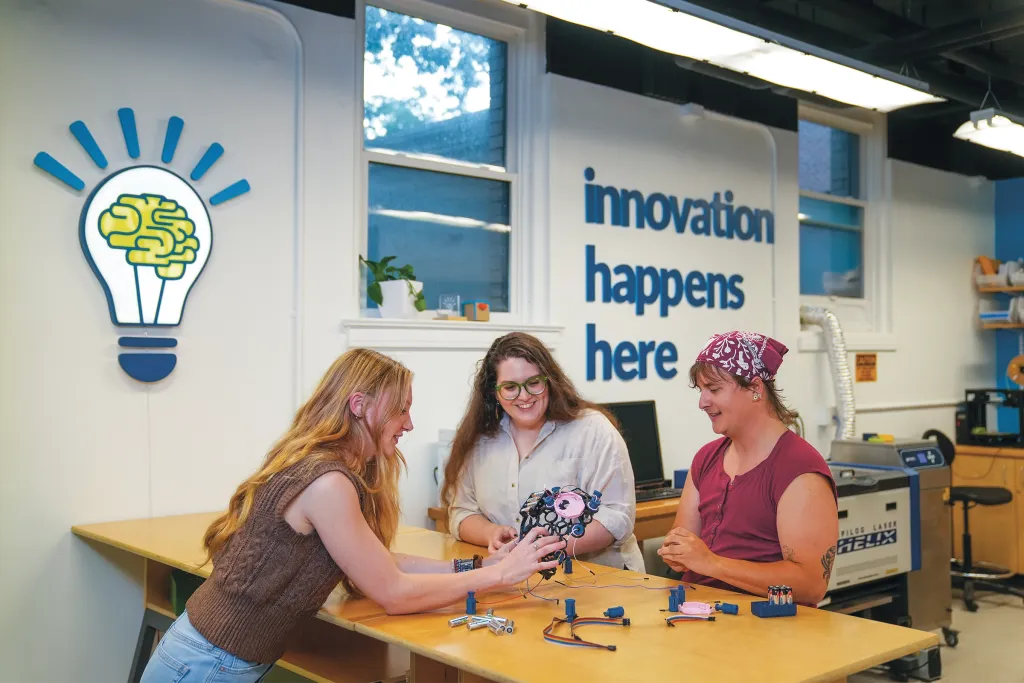
But when his casual observations caught the attention of Jessica Howard, B.S. ’25, a neuroscience major working nearby, that ordinary inventory became the spark for an extraordinary collaboration.
“I heard Milo in the back room say, ‘Oh, these are neuroscience-related.’ And I said: ‘Neuroscience? Did someone say my magic word?’” Howard recalled.
In the moment the two students connected, Lypps and Howard were pursuing different majors in different UNE schools, unlikely to ever work together on a research project. They were practically strangers. But when they bonded in the Makerspace over a pile of cords and software, they found themselves on the same team. And they picked up that ball and ran with it.
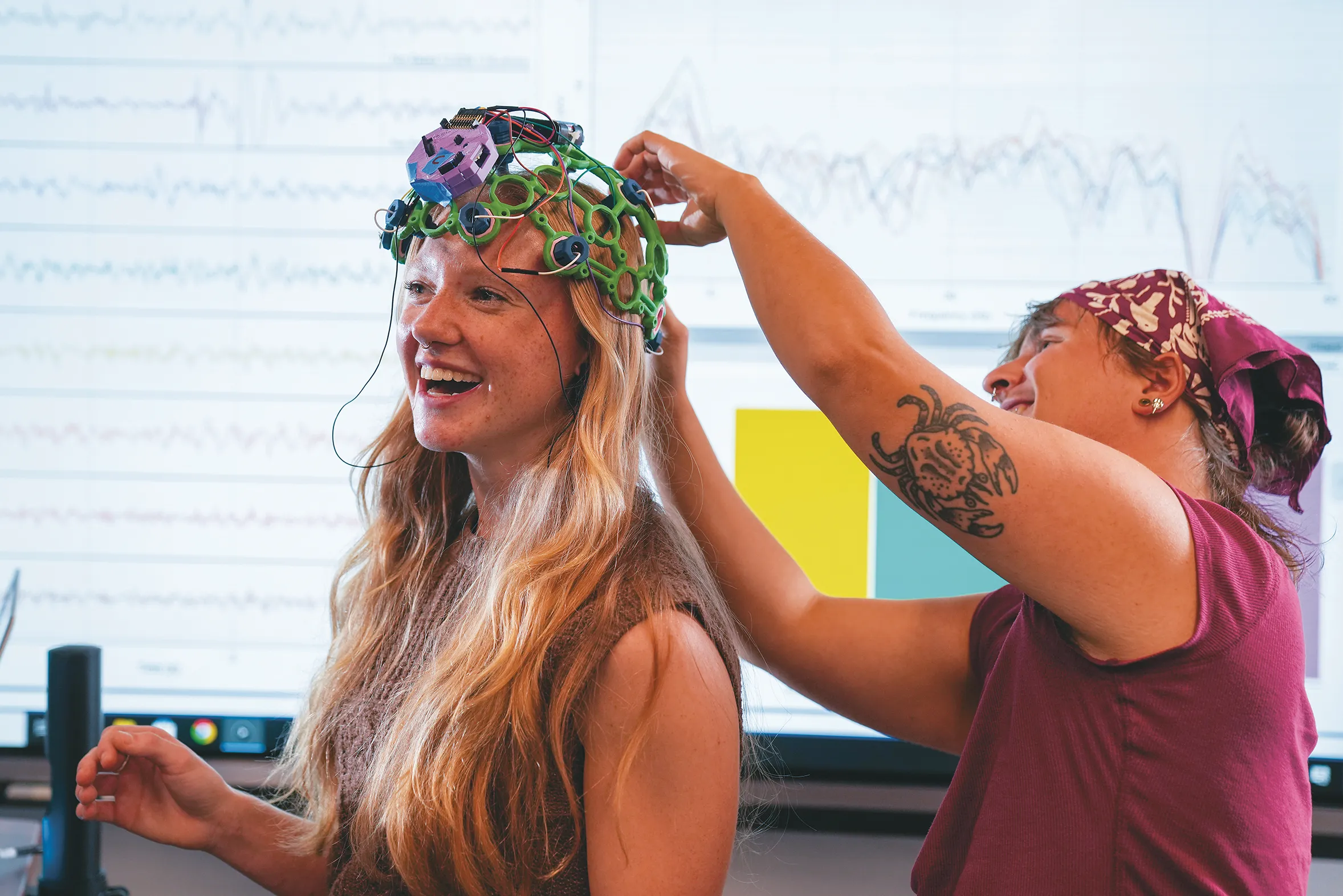
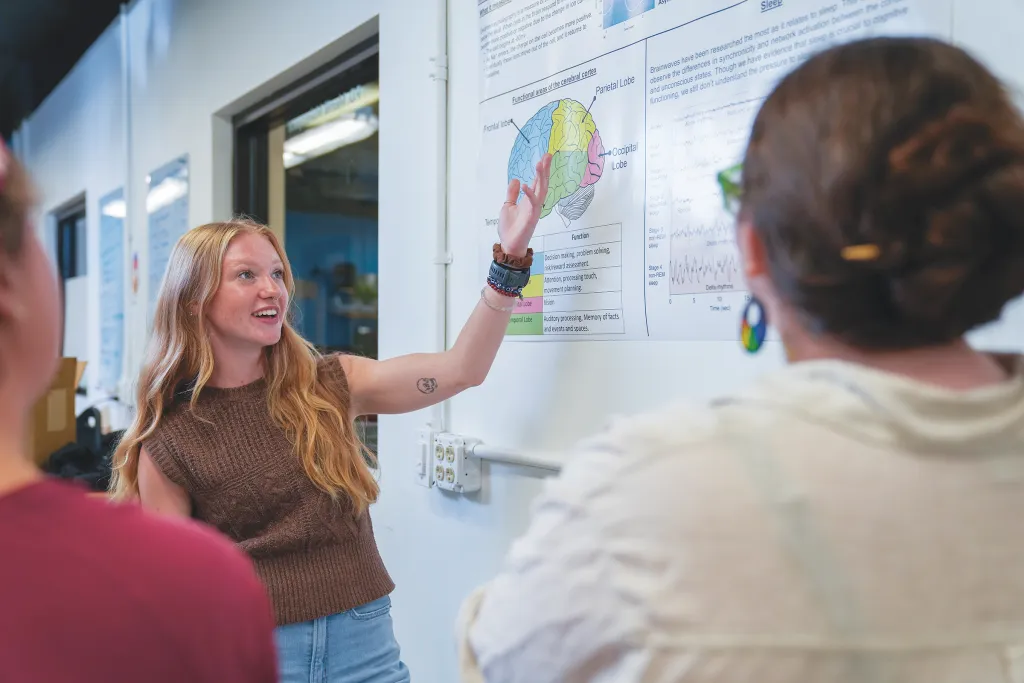
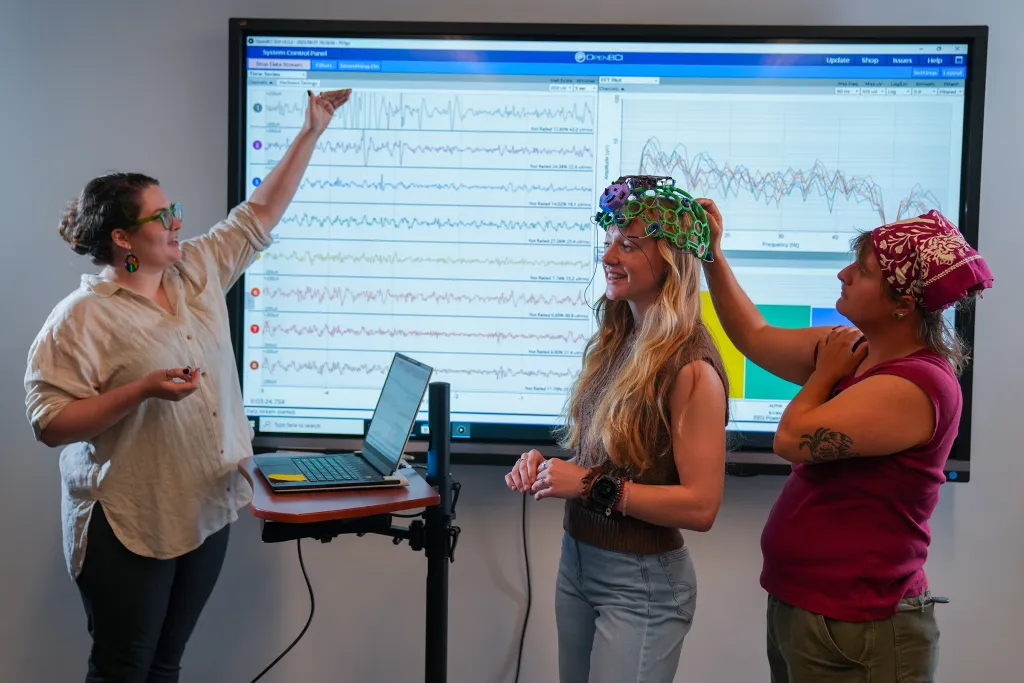
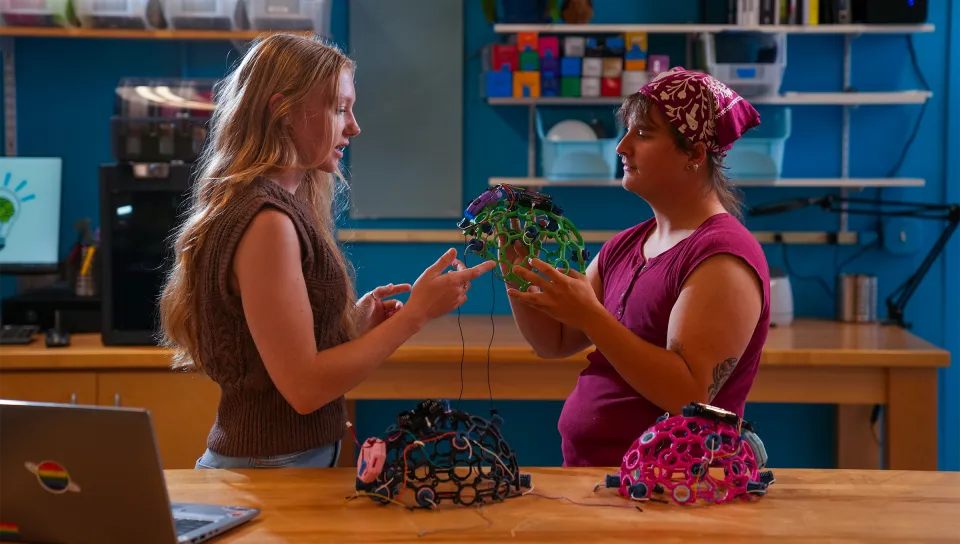
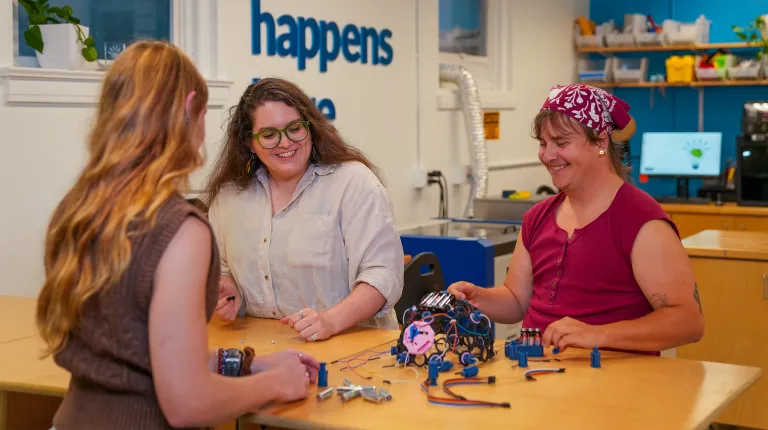
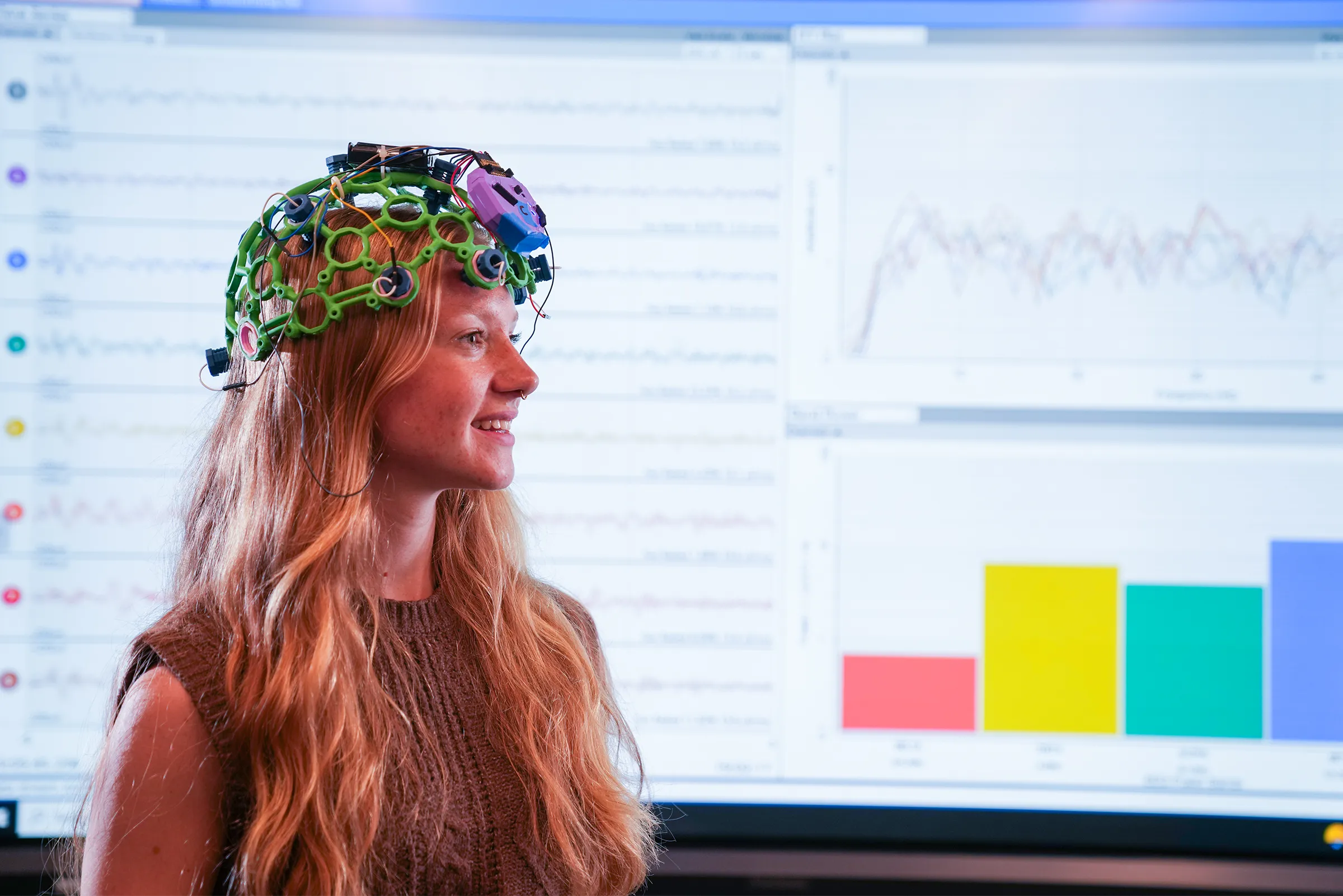
Together, they developed an exhibit that taught children and adults how the brain works, using skullcaps they manufactured in-house and electrical activity sensor software they mastered together, and presented it at the UNE Brain, Body, and Wellness Fair the following spring. The two students had little experience in community education, yet Lypps and Howard were able to make science fun and accessible for those as young as 8 and as old as 90.
And, both said, they couldn’t have done it alone.
“I was someone who had experience in 3D printing and understanding technology, and Jess had experience in neuroscience. So together, we made a technology that did neuroscience,” Lypps said. “It was a learning opportunity that I wouldn’t have had otherwise. It was a way to stretch other muscles. The Makerspace created that opportunity.”
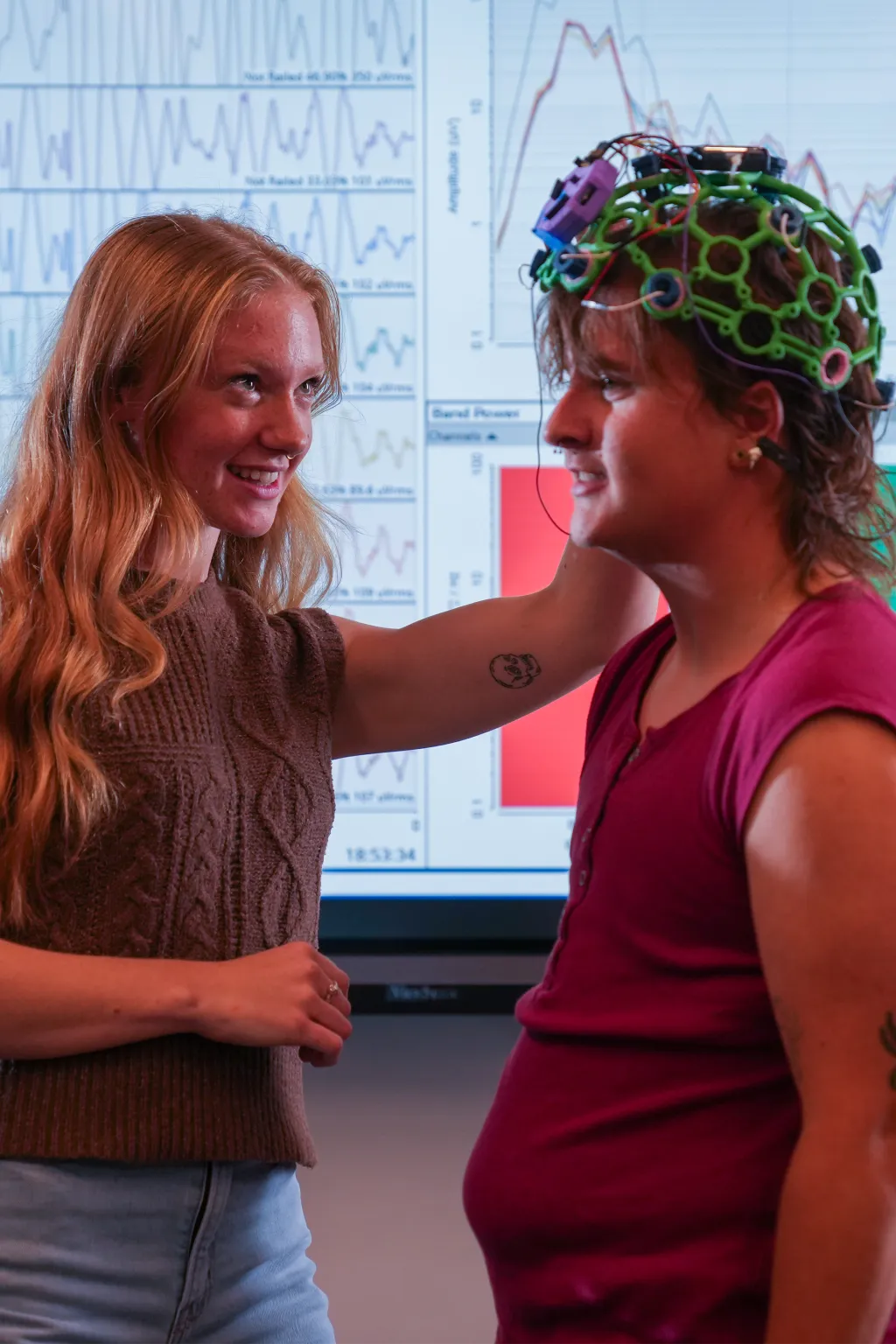
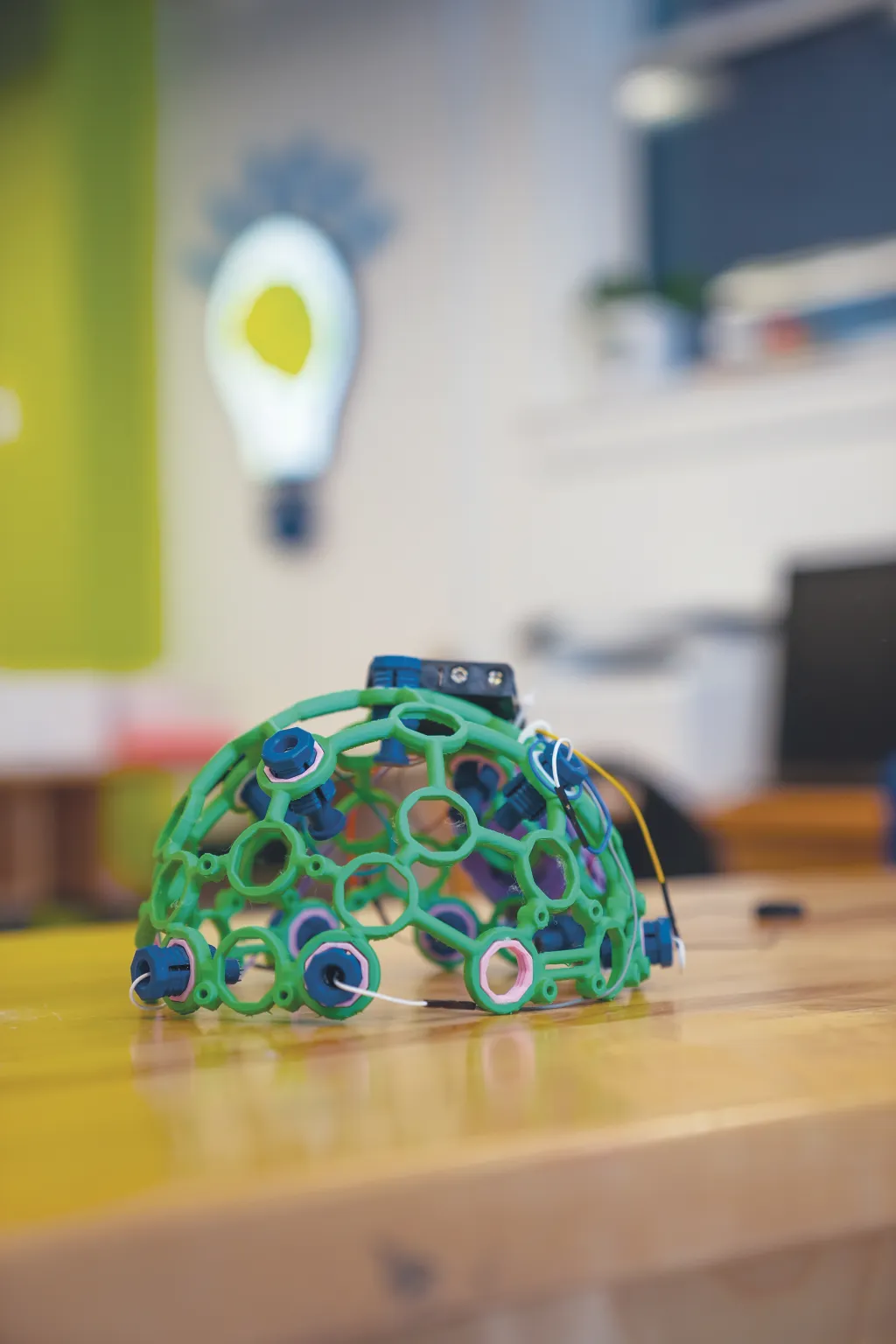
After their fair booth drew hundreds of members of the public in 2024, they returned to the fair in 2025 with more advanced exercises for attendees, all aimed at celebrating the wonders of the brain — and inspiring children to explore the mysteries of science. That joint project wasn’t for class credit or for faculty research. Lypps and Howard made time for the project, they said, because it brought them joy.
“It was such a huge hit. Everybody loved it,” Howard said.
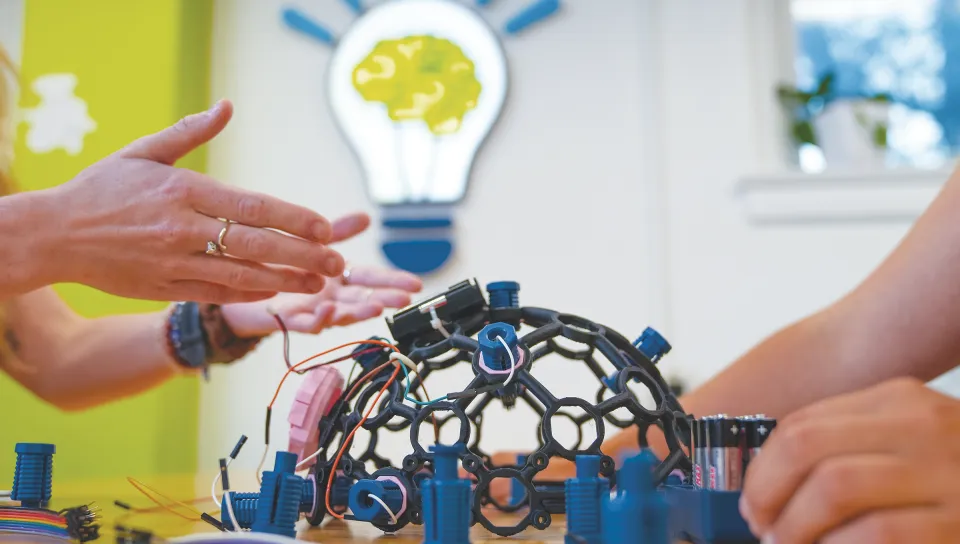
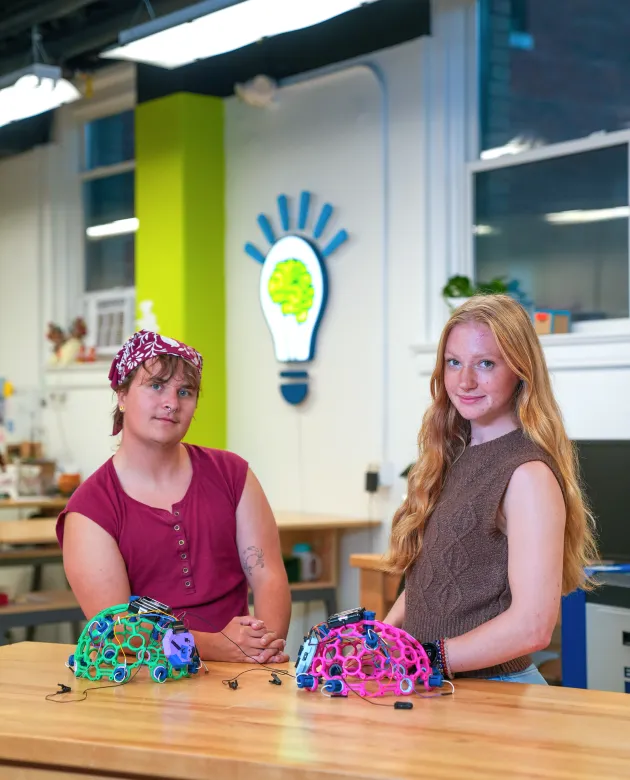
As Howard deepened her understanding of EEG through her coursework, she shared this knowledge with Lypps and Sophia Crockett-Current, M.S., Makerspace coordinator. Together, the three brainstormed innovative applications for the brain-monitoring device.
“My favorite thing that we did was to have people at the Brain Fair hold their partner’s hand, because you could really see a change in what was showing in the brain. We did not expect that,” Howard said.
Named in memory of prominent Portland businessman and former chair of the UNE Board of Trustees P.D. Merrill, the Makerspace — first established in the fall of 2016 and reimagined through a significant expansion in 2022 — was designed with this kind of cross-pollination in mind.
The center does more than produce innovative projects for class assignments or grant-funded research, although it does that, too. The creative space in the lower level of 75-year-old Decary Hall welcomes everyone and exudes an unshakeable optimism that, Lypps said, altered his outlook on his future, coloring it with a can-do spirit he plans to carry forward.
“By having a place that is entirely dedicated to expanding your knowledge, no matter if you come in with an idea or not, it completely changed the trajectory of my time at UNE,” Lypps said. “I got more out of the experience of being a student here than I would have otherwise, because I would have very much stayed in my lane. Instead, it opened the door to letting me get over things, like the fear of failure.”
When students pursuing different majors in different academic disciplines engage in coursework grounded in different colleges and schools, it’s easy for them to become siloed and never cross paths, said Lisa Herschbach, Ph.D., director of the Center for Innovation and Entrepreneurship, which oversees the Makerspace and other innovation centers and fellowships at UNE.
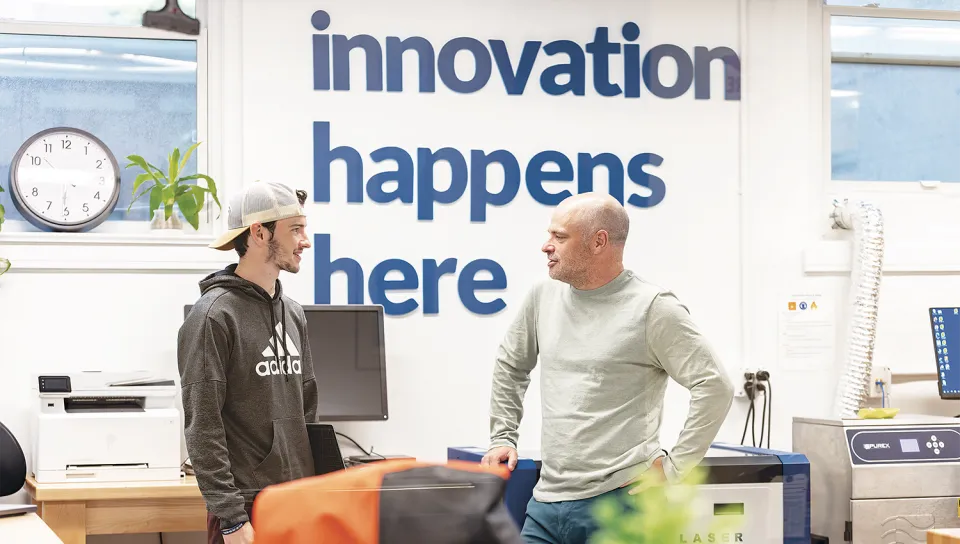
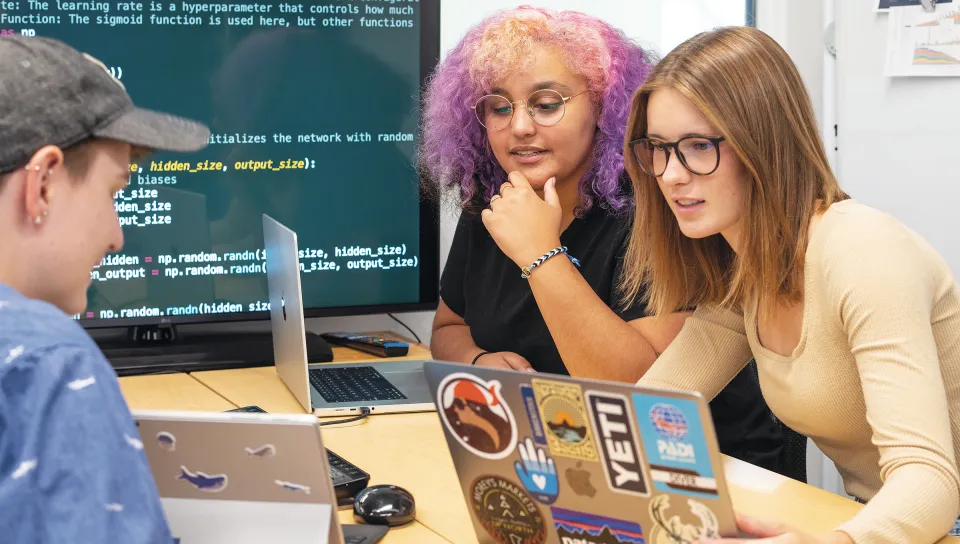
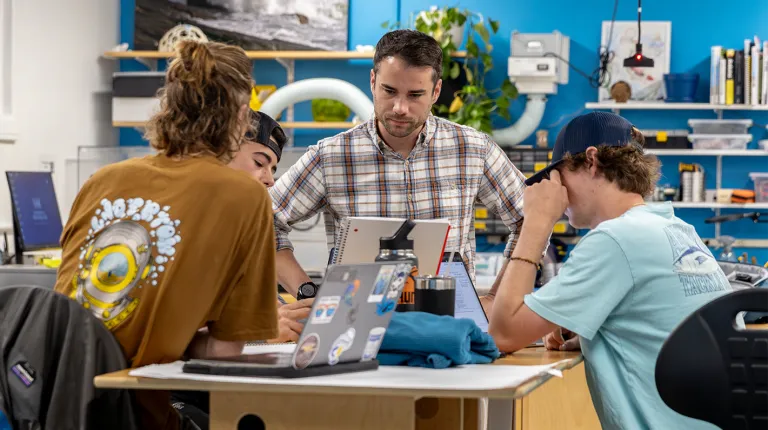
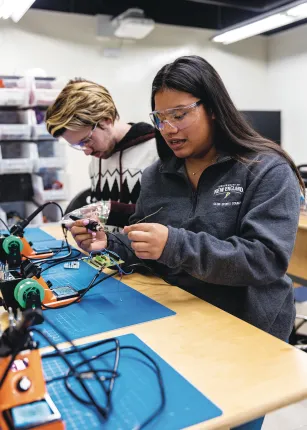
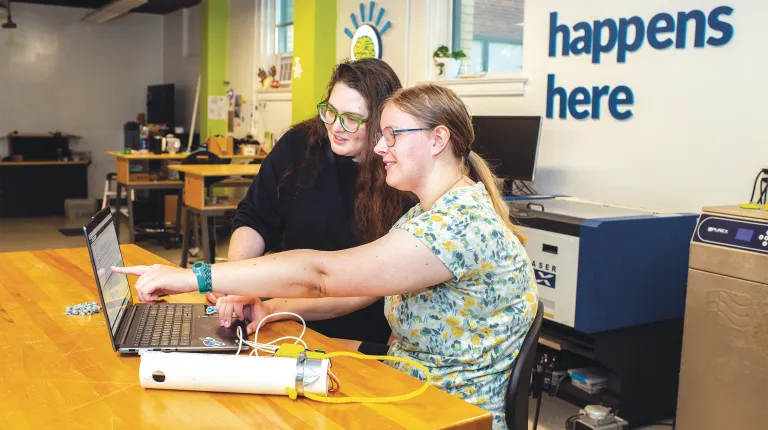
The P.D. Merrill Makerspace and other innovative gathering spaces at UNE toss that traditional academic framework out the window, because these creative spaces are intentionally designed to encourage cross-disciplinary curiosity, said Herschbach, who is also assistant dean for innovation and entrepreneurship in the UNE College of Business.
The prevailing ethos in these centers, Herschbach said, is clear: Try, fail, and embrace the lessons, ideally in partnership with others.
“Many projects have fits and starts, and students have to begin again,” Herschbach said. “But if you talk to scientists, they’ll tell you that’s the nature of science. If you talk to writers, they’ll tell you that’s the nature of artistic work. One of the real values of Makerspace pedagogy is that it teaches students resilience, persistence, and how to think outside the box.”
The P.D. Merrill Makerspace is made up of three rooms: the fabrication lab and the adjoining workshop, which contains tools and technology, like a laser cutter, 3D printer, and sewing machine, and across the hall, the design lab, in which flexible huddle spaces around computers allow work by four teams of various sizes.
Crockett-Current, who manages the Makerspace, works with faculty members in all three spaces to help introduce technology in classes where it may not typically be found, helping meld science with the humanities and vice versa.
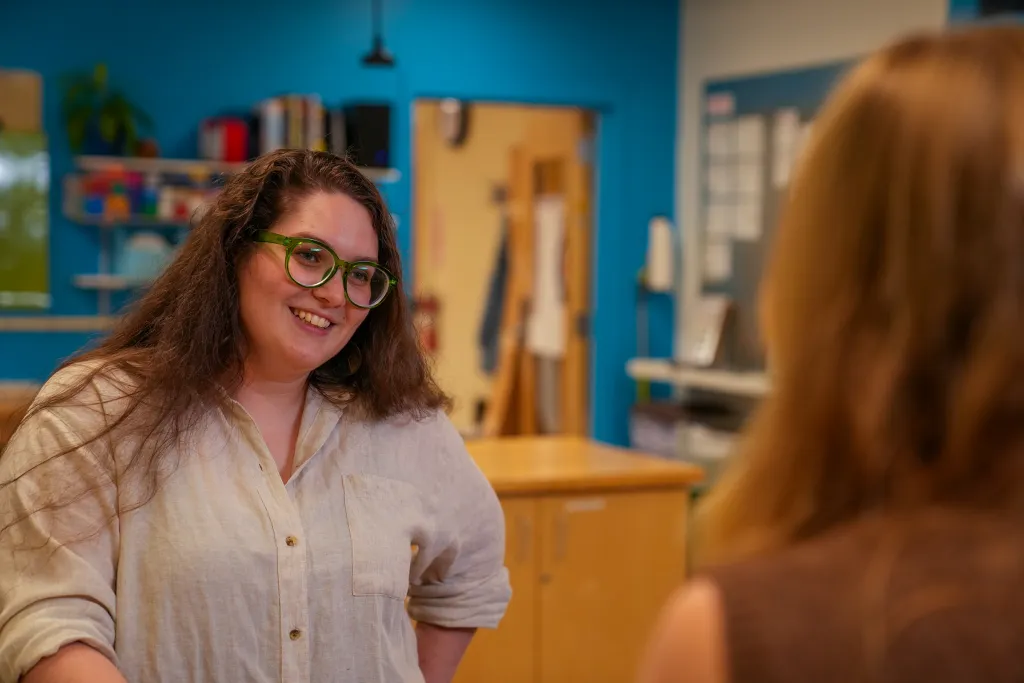
Students wander in during their free time to tap into their creativity, ingenuity, and imagination. On any given day, students from different majors, different disciplines, and different world views stop in the collaborative, shared space where the sparks of invention fly — and frequently catch fire.
Undergraduate and graduate students come to 3D-print or laser-print, to learn to code, or pound at the workbench, building a bird feeder or drama set. Increasingly, faculty also are using the space to expand and enrich their classroom lessons.
Last year, Crockett-Current assisted Jonathan DeCoster, Ph.D., an associate teaching professor in the School of Arts and Humanities, in using the laser cutter to make devices used by scientists for night navigation in the Middle Ages, called astrolabes. The devices demonstrated the ingenuity of ancient astronomers and mariners who sought to determine time, calculate the altitude of stars, and find latitude.
“As modern scientists, we’re used to seeing information about the natural world in certain ways,” Herschbach said. “We might presume that that’s always been how people have viewed and understood our planet. Professor DeCoster’s activity gave students sight lines, literally, into how people acquired knowledge about the natural world before the Scientific Revolution.”
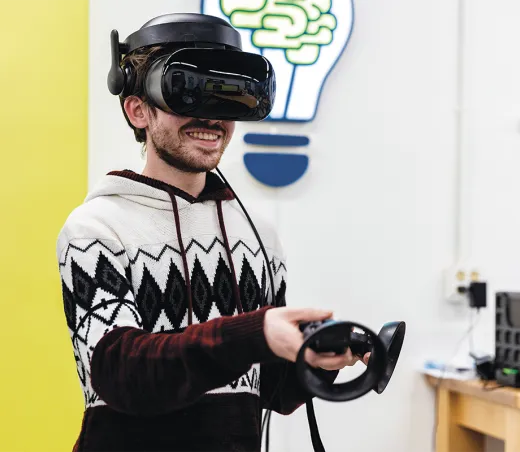
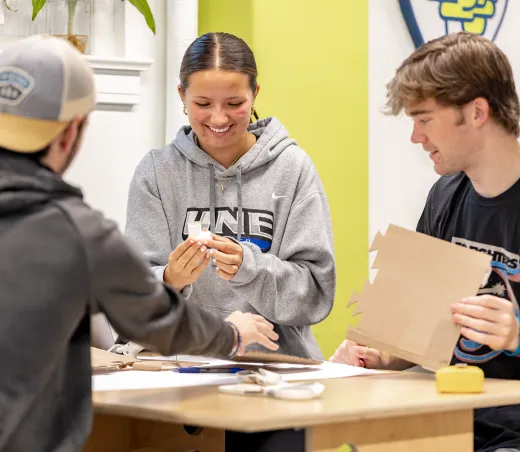
Sometimes, Crockett-Current leads classes and skills workshops in the Makerspace for professors’ classes. Other times, students come to the Makerspace to improve or develop a professor’s research instrument.
That’s what brought Lillian Westerberg (Marine Science and Applied Mathematics, ’27) to the Makerspace in August 2024 when she began work on a research project for Tricia Thibodeau, Ph.D., and Will Kochtitzky, Ph.D., both assistant professors in the School of Marine and Environmental Programs.
Westerberg’s research project was to design and build a device that measured the ocean’s conductivity, temperature, and depth — an instrument called a CTD sensor.
If successful, her iteration of the sensor, built using open-source websites and materials funded through a Maine Space Grant, would save Thibodeau and Kochtitzky thousands of dollars, allowing them to use multiple homemade CTDs to better explain changes in the ocean due to a warming climate.
After a year of soldering, programming, and applying epoxy, Westerberg tested her Makerspace-made device in the ocean and compared it to the pricey, store-bought CTDs. The result: Her homemade CTD sensor was an overwhelming success.
“I’ve been taking a lot of ocean classes and a lot of math classes, but this project is the first time I was able to make them both merge,” said Westerberg, noting that working with her math and oceanography mentors allowed her to bridge two areas of interest and that Crockett-Current helped guide her through the CTD-building process.
“With basically no real knowledge of how circuits work, I learned about circuits and coding, and how to solder, to adhere pieces of metal wire together, which is a lot of fun,” she said.
While Westerberg is done with the summer research project, she isn’t done with the Makerspace.
“Even though I’m no longer building the CTD, I’ve roped a lot of my friends into going to the Makerspace because it offers a good chance to get hands-on experience building things,” she said.
Westerberg’s Makerspace experience is but one example of a student who found a home in the creative, eclectic space. Crockett-Current can rattle off dozens of stories of student-driven and grant-funded devices and instruments built in the center.
Students in UNE College of Osteopathic Medicine, which is Maine’s only medical school, have routinely used the space to enhance their studies. A medical student created a 3D human thigh with nerves and blood vessels to teach their peers about the injection methods that are commonly used for ultrasound, and in her spare time, another student printed a 3D pelvis model with ligaments to augment what she was learning in her classes.
Such elaborate projects are common. But students often stop into the Makerspace to pursue one-off projects, including members of student groups like the UNE Players theater club, who frequently use the laser cutter and workshop to build stage sets for their productions. Through her thoughtful oversight, Crockett-Current provides a low-stakes environment focused on authenticity, kindness, and exploration.
“Students will just come in here, do homework, and just spend time here,” she said.
The P.D. Merrill Makerspace has made a powerful interdisciplinary hub in Decary Hall, but it’s not alone, Herschbach noted.
Just down the hall, the Nor’easter Production Studio, launched in 2024, hones the skills of those studying the media arts and budding journalists crafting news stories. Through the nearby glass doors around the corner lies the UNE Teaching Kitchen, a multidisciplinary incubator where a team of students from several academic departments will soon mass-produce, market, and sell the University’s new seaweed nutrition bar.
“We’ve started calling the lower level of Decary the ‘Maker-Neighborhood,’” Herschbach said. “We want these to be complementary spaces that people move between, depending on what stages they are at in their projects or what their particular projects are about.”
Such cross-discipline projects are common at UNE, such as in the Harold and Bibby Alfond Center for Health Sciences in Portland, where students pursuing different health care professions work in teams in intentionally designed collaborative spaces, and the Sustainable Innovation Center in the Arthur P. Girard Marine Science Center that opened in April on the Biddeford Campus. There, with vast, bird-safe picture windows overlooking the Maine coast, different UNE schools and colleges join forces with the Center for Innovation and Entrepreneurship to create innovative outcomes that will benefit and engage the public.
Recently, a project called NOAA Voices at the National Oceanic and Atmospheric Administration, which houses nearly 3,000 oral history recordings of the human experience of climate change, inspired a new fellowship at UNE run out of the Sustainable Innovation Center.
Through the Shaw Innovation Fellowship, students will work with local oral historians and environmental science faculty to build a similar archive at the University. They’ll collect local photos and videos documenting the human impacts of the January 2024 storms in Saco and Biddeford, Maine.
Herschbach said the project will take UNE’s ocean sciences research in new directions by integrating people’s experiences with scientific data on coastal transformations.
“By bringing together data sets and GIS maps showing damage to coastal environments with stories from local residents and historical photos, we can offer an interdisciplinary picture of how both natural changes and human activities are being affected by climate change,” Herschbach said.
The information will be presented digitally and made accessible to scholars and students worldwide.
Herschbach and Crockett-Current are extending the reach of the Makerspace. Last year, Crockett-Current rolled out a pilot project that taught professional staff members to make 3D-printed UNE-blue planters, a program that drew UNE community members to the space. Now, she’s scaling up these classes to inform more people about the Makerspace, offering workshops on skills such as prototyping, 3D modeling, advanced fabrication, and animation in a new program, dubbed Maker University.
“The idea is to build out people’s toolkit for crafting and building while getting more people comfortable with using this space, lowering that barrier for entry,” Crockett-Current said. “If you think this is a cool space, and you want to interact with this space, and you don’t have a project, here’s a way. Just show up.”
Reflecting on his Makerspace experience, Lypps said the center taught him to embrace uncertainty, because when you do, he said, the results are sometimes better than you could have ever imagined.
“Sometimes, you feel very much in your own major. But through the Makerspace, we were able to bridge that gap and learn more about things we both didn’t know about,” Lypps said, adding that working with Howard taught him to “be a better student.”
“I would wholly suggest, if people wanted to expand their horizons, go to the Makerspace. Just spend time there,” Lypps said. “You don’t need to have an idea. For me, the collaboration was really what made it, because I wouldn’t have been able to do those things without Jess.”
Howard first came to the Makerspace to help UNE’s Histology and Imaging Core, which provides investigators from UNE’s two Centers of Biomedical Research Excellence (COBRE) with specialized instruments to process, section, and stain tissues.
She came to work on grant-funded research for her adviser, Tamara King, Ph.D., a professor of biomedical sciences in the College of Osteopathic Medicine and an investigator with the Center for Pain Research, one of the COBREs.
When she heard Peter Caradonna, B.S. ’13, the imaging core manager, lament how the mount plates used to hold tissue samples for the lab’s new microscope held only one sample at a time, Howard thought she could find a better way.
She went to the P.D. Merrill Makerspace, 3D-printed a prototype that would hold up to 10 samples at once, and consulted with Caradonna about the best material to use for a mount plate, since not every material would withstand the chemicals needed for the slides that went under the powerful microscope, an area where Caradonna’s expertise proved crucial.
“Jess took it to that next step,” Caradonna said. “I have a background in anatomy, biochemistry, and chemistry. She took the chemical concerns about dissolving plastics and applied her research background and problem-solving approach to create a tool we wouldn’t have otherwise.”
Howard produced a final slide holder made of resin, an invention that now saves UNE researchers time, material, and money. It was a display of collaborative innovation that Crockett-Current called a “biomedical engineering extravaganza.”
All of it whetted Howard’s appetite for a future in biomedical engineering.
Since graduating from UNE, Howard is pursuing a Ph.D. in biomedical science at the University of Maine. She started her doctoral work with a lab rotation at The Jackson Laboratory on Mount Desert Island this fall, and she will later return to her alma mater to do a different rotation.
Howard said the Makerspace set her on a path to success in a field she’s passionate about, so that she can, as she likes to say, pursue the UNE motto.
“I want to continue ‘innovating for a healthier planet’ throughout my rotations, and — hopefully — once I’m running my own lab,” Howard said.
Howard said she wants to increase laboratory sustainability to make a real difference in the scientific community. And the Makerspace helped show her how.
“UNE really gave me the opportunities with research. But the Makerspace, I think, was what made me stand out,” Howard said of her doctoral applications. “It was all those mini projects in the Makerspace to help professors and to work interdisciplinarily with other people, to hear their ideas and work together to solve problems.”
Crockett-Current said the center supports an unwritten culture of exploring and helping others, and spontaneous, cross-disciplinary innovation isn’t a lofty goal for the Makerspace’s future — it’s what’s happening there now.
“I see a lot of peer mentoring: older students helping younger students navigate classes, research, and exploratory projects,” she said. “This space has an amazing interdisciplinary component. On a daily basis, learning happens organically here.”