
Image

This website uses cookies to understand how you use the website and to improve your experience. By continuing to use the website, you accept the University of New England’s use of cookies and similar technologies. To learn more about our use of cookies and how to manage your browser cookie settings, please review our Privacy Notice.
To say Pat Callaghan is a legendary Maine television journalist is an understatement. The former news anchor was a fixture on Maine’s airwaves for 43 years before retiring in 2022, making Callaghan purportedly the longest-standing news anchor in the state’s history.
On Thursday, Oct. 8, Callaghan shared his successes, journalistic adventures, and the challenges in the changing industry with students in a University of New England communications and media arts class. The hour-long interview taped in the Nor’easter Production Studio was conducted as a broadcast news team would produce a nationally televised show like “60 Minutes,” giving UNE students a first-hand account from a seasoned professional, and the opportunity to develop their skillset to produce a televised news show.
The School of Arts and Humanities opened the Nor’easter Production Studio in 2024. The interview with Callaghan was one in a curated series with veteran journalists conducted in the state-of-the-art facility that allows students in UNE’s Communications and Media Arts program to gain real-world experience.
Callaghan didn’t sugarcoat his stories or the harsh realities of a journalism career and the broadcast media industry today. Reporting has never been a 9-to-5 job, he said, making for a profession that’s demanding, unpredictable and, at times, arduous.
Callaghan told the students who filmed, directed, and interviewed him that for those with the fortitude and sense of adventure, journalism can be “a calling.”
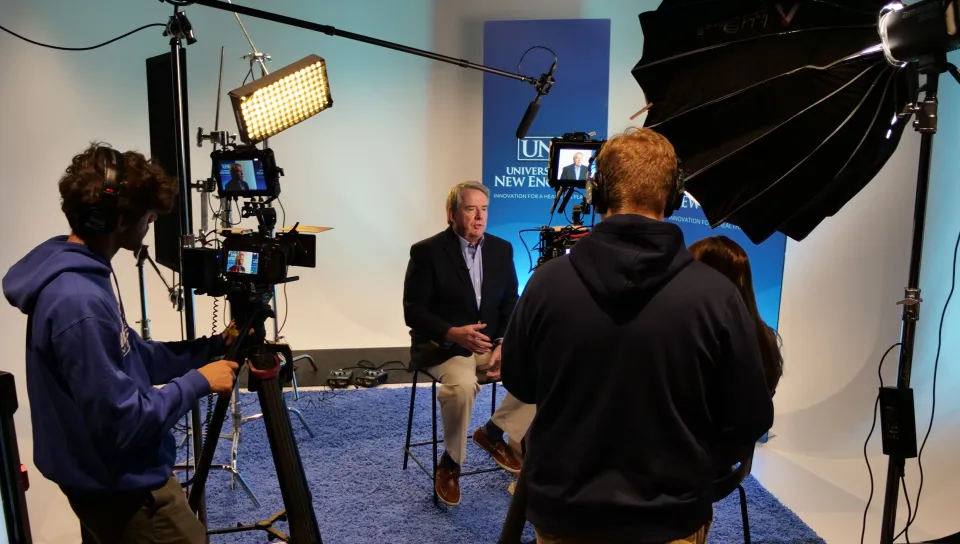
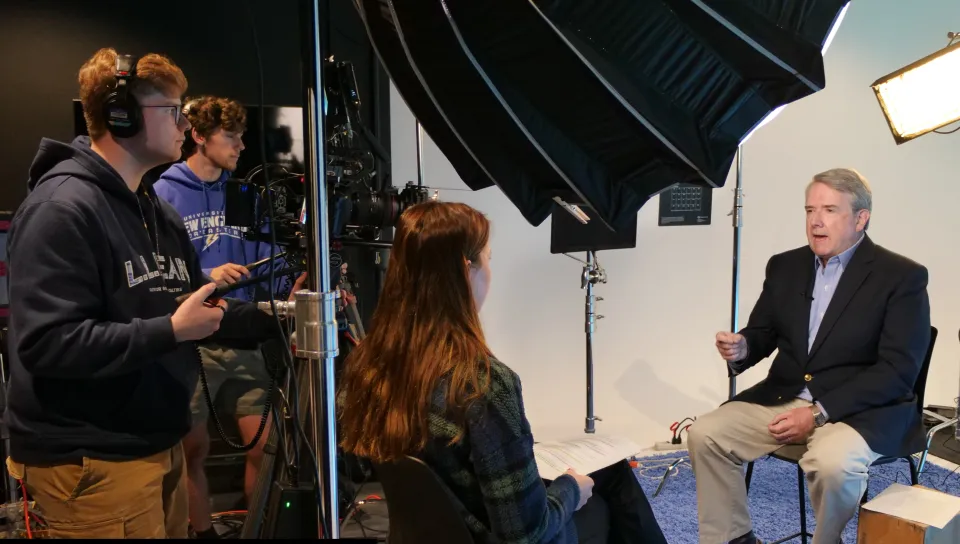
“There are sacrifices everybody must make for their jobs. And the sacrifices you’ll make as a journalist will be worth it if it’s important enough to you,” Callaghan encouraged.
He recommended that when starting out in their career, the students should be willing to jump on any story that needs to be reported — no matter how unglamorous. Two of the first news stories Callaghan reported were of an art museum exhibit and speedboat races.
“It’s not the most important thing you’ll do,” Callaghan said, “but it’s a way to show: ‘I know how to tell a good story.’”
He advised the media students to cultivate a diverse skillset so they could pivot from work as a reporter, producer, or videographer. Many on-air reporters began as producers and writers, Callaghan said, and working behind the scenes is a good way into a newsroom.
Today, young journalists struggle to grow in newsrooms staffed with few experienced editors, a result of industry cutbacks, Callaghan explained. He told the students to seek out mentors — and they’ll find them.
“It’s one of the ways you’ve got to evolve,” Callaghan said. “It’s change or die, sometimes.”
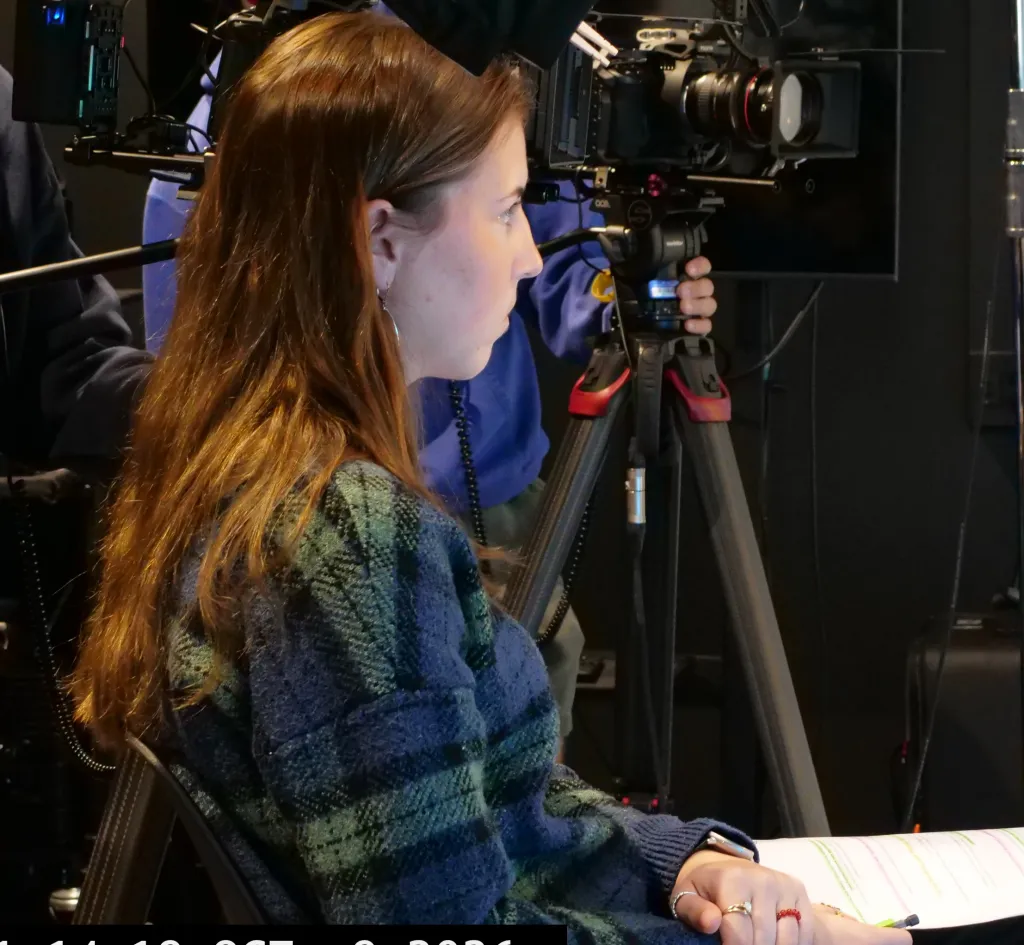
Cally Gudroe ‘28) interviews former Maine news anchor Pat Callaghan in the Nor’easter Production Studio
The UNE students in the communications class led by Matthew J. Siegel, M.F.A., assistant professor in UNE’s Communications and Media Arts program, found the former journalist's frank, gritty advice helpful — even inspiring and heartening.
“He showed it's important to be open to criticism from all sides and to make sure that, in your reporting, you are always accurate,” said Cally Gudroe (Communications and Media Arts and History, ‘28), who interviewed Callaghan in the taped production.
“I appreciated (that) he said he was open to other points of view, like when he ran into people in the grocery store who wanted to critique one of his news stories,” Gudroe added. “He welcomed that feedback.”
Gudroe, who grew up in Dexter, Maine, said that, especially in northern Maine, communities lack local news outlets. Without those, she said, the public can be largely uninformed about important decisions made by local municipal governments.
Gudroe hopes to help fill that gap.
UNE’s Community News Initiative is working on an answer, training young journalists through fellowships at local news outlets, which Gudroe has held.
“I think in the future, if I were to stay in Maine, I’d want to go back north and provide day-to-day journalism for the areas that do not receive it,” Gudroe said.
He showed it's important to be open to criticism from all sides and to make sure that, in your reporting, you are always accurate.” — Cally Gudroe (Communications and Media Arts and History, ‘28)
Callaghan’s advice also resonated with Angelina Keizer (English, ’28), another UNE Community News Initiative fellow who directed the taped interview with Callaghan with vocal input, editorial advice, and encouragement to her peers.
Keizer was considering a future in print journalism. But, listening to Callaghan talk about the adventures of broadcast news, Keizer said she was left reconsidering her future path.
“I might have to think about it more down the road now,” Keizer said, “because that was so much fun.”
For the students gathered in UNE’s Nor’easter Production Studio, Callaghan’s visit offered more than a lesson in journalism. Callaghan reminded them that the profession remains rooted in curiosity, public service, and a commitment to telling stories that matter.
As the media landscape continues to evolve, his message resonated clearly: Success in journalism and broadcast reporting comes not from chasing the biggest story, but from approaching every assignment with integrity, adaptability, and a willingness to keep learning. For UNE students preparing to enter the field, those lessons may prove just as enduring as Callaghan’s remarkable career.