

University of New England leaders traveled to Iceland recently to attend the Arctic Circle Assembly and to expand and deepen UNE’s growing relationships with academic partners. Specifically, they sought to identify opportunities for students and faculty for experiential learning and collaboration.
During the Assembly, there was a Maine Delegation Meeting event that brought together more than 45 policymakers, politicians, researchers, and entrepreneurs to discuss the role Maine plays in the Arctic around issues such as climate change, coastal resilience, planetary health, public health, and rural healthcare.
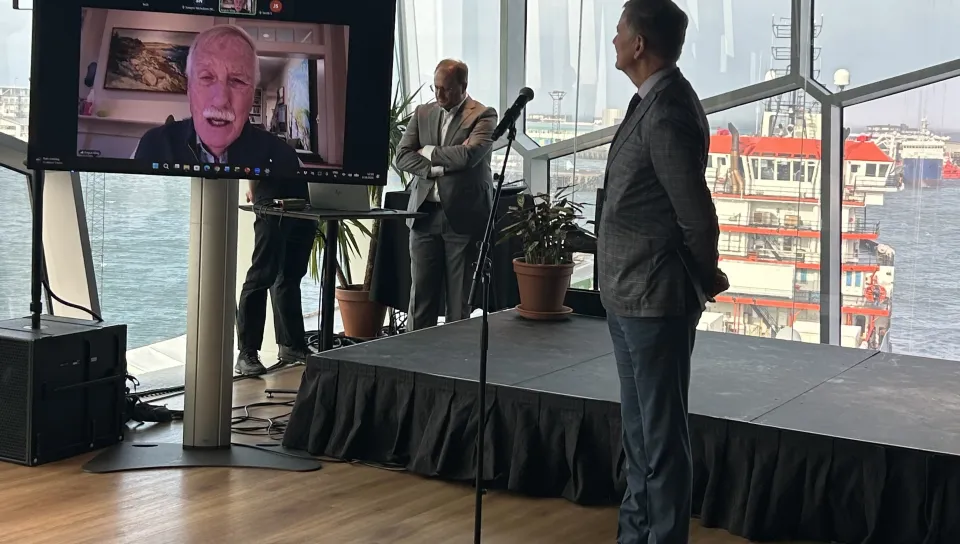
UNE President James Herbert provided welcome remarks at the gathering, which UNE co-hosted. Herbert also introduced Sen. Angus King, a longtime advocate for partnerships between U.S. and the High North.
In his opening remarks, Herbert highlighted how it has been more than 13 years since Eimskip moved their North American headquarters to Portland, Maine, and academic leaders, policymakers, and entrepreneurs began to collectively identify Maine as the United States’ gateway to the North Atlantic — a recognition that makes sense, Herbert noted.


“Maine shares common geography, values, and culture with other countries across the North Atlantic,” Herbert said. “It is primarily rural, with many small coastal and rural communities. Both share a strong connection to nature, the coastline, and the ocean. Both are home to resilient people and places and are family oriented; they support and believe in small enterprise; and they are places people want to visit ... (and both) share a commitment to climate solutions, sustainability, innovation, and renewable energy.”
Speaking on behalf of the Maine delegation, Herbert promised: “We are looking forward to a vibrant future, to more collaboration, more trade, more shared experience, and more connection.”
The assembly was a continuation of an ongoing dialogue between leaders from the Arctic, Maine, and beyond that explores issues around the blue economy, climate resilience, national security, geopolitics, and an increasing focus on AI.
Looking ahead to April 2027, UNE will sponsor the Leadership of the High North, Maine’s premier gathering with Arctic experts aimed at advancing the state’s role in the matters that impact Maine and other regions contending with similar engagement with public and planetary health.
Maine and the Arctic face interconnected challenges that call for shared knowledge and sustained collaboration.” — Debra Leahy, Ed.D., UNE interim provost, vice president of Global Affairs, and dean of the UNE Tangier Campus in Morocco
With UNE’s nationally recognized marine science programs, the recent launch of the David Evans Shaw Institute for Public and Planetary Health, and the University’s Master of Science in Climate Change Leadership program, UNE is poised to contribute more to the region, said Debra Leahy, Ed.D., UNE interim provost, vice president of Global Affairs, and dean of the UNE Tangier Campus in Morocco.
“Maine and the Arctic face interconnected challenges that call for shared knowledge and sustained collaboration,” Leahy said. “UNE can bring expertise in marine science, public and planetary health, and climate leadership to those partnerships while learning from the communities and institutions already doing this work. The goal is to turn that exchange into practical benefits across the regions and communities involved.
“Stronger partnerships across Maine and the Arctic can connect research with the experience of communities navigating a changing climate,” Leahy said. “UNE can contribute by bringing people and disciplines together, learning from local knowledge, and preparing students to turn that understanding into meaningful action.”

The UNE contingent spent much of their time in Iceland meeting with partners from Icelandic and Norwegian universities, including the Arctic University of Norway (UiT) in Tromsø, Norway, the world’s northernmost university. They renewed the University's student exchange agreement with the University of Iceland, and they also met with partners at the University of Akureyri and Reykjavík University to explore ways to deepen collaborations and draw upon the strengths of each university. UNE leaders also explored collaborative online international learning opportunities throughout the region.
“Our students seek international experiences that connect their academic interests with consequential challenges,” Leahy said. “Developing partnerships in the region allows us to create meaningful opportunities for students to learn alongside communities and researchers whose perspectives deepen their understanding of the issues they will help address.”
UNE has seen an increasing number of students studying in Iceland and in other parts of the High North. Since 2018, UNE has sent 25 students to study abroad for a semester at the University of Akureyri. Since 2023, UNE has sent 13 students to study at the University of Iceland. And, since 2022, the University has welcomed four students from both Icelandic institutions onto its Biddeford Campus.
“These meetings open the door for additional student exchange as well as faculty collaboration,” Leahy said. “We are excited to welcome more students from our partner universities to UNE, an opportunity that enriches our campus culture. And, the Arctic offers students a world that feels connected to Maine while opening their eyes to entirely new cultures and perspectives.”