
About the Fellowship
The Shaw Innovation Fellowship offers two programs to catalyze student innovation on campus by providing mentorship, curriculum, professional development opportunities, and stipend support. Shaw Fellows work with campus and community partners to develop and implement solutions to real-world challenges facing planetary and human health. These ideas and actions will promote equitable, thriving economies in Maine and across the globe. In the 2026–2027 academic year, the Senior Shaw Fellows from across UNE’s academic programs will each receive $6,000 to lead an innovative project in their area of interest. In addition, three Innovation Teams will collaborate on interdisciplinary projects, with each team member receiving $3,000. As part of the program, students also have the opportunity to meet other local and regional innovators and attend specially designed workshops and events.
Fellowship Details and Application Information
Program Goals
Educating and cultivating the next generation of innovative and entrepreneurial leaders
Fellows gain valuable experience and hone their skills as they work to apply their academic training to real-world challenges to the planetary, human, and economic health of our region. This theory-to-practice experience provides unique professional development for the fellows that will support the development of career-readiness skills and prepare them to be effective professionals and leaders.
Building a broad, interdisciplinary network that supports and connects students with campus and community mentors
The Shaw Innovation Fellowship program is designed on principles of collaboration and shared investment of time, mentoring, and resources. We expect relationships among participants, alumni, the UNE community, and host organizations will grow and evolve over time to establish a shared understanding of pressing planetary and human health challenges and how to address them at local to regional scales. Our vision is to grow into a broader network across the region that drives change, impacts practice, and inspires regional collaboration and innovative problem solving.
Application Process and Instructions
Applications are due no later than September 11, 2026.
Review program information
Review the program information, including program goals, compensation, expectations, and important dates.
Explore the Shaw Fellowship and Innovation Team Descriptions
Choose one or two fellowships that are of interest and that align with your skills and background.
Prepare all of your application materials
Before beginning the online application process, prepare your cover letter(s), resume, and faculty reference. If needed, applicants can work with their academic and career advisor in the Academic and Career Advising Center to develop their materials.
- Cover Letter: Write a cover letter for each fellowship you apply for. Your cover letter should indicate exactly which project/organization you are applying for and outline your background, project ideas, and how the fellowship aligns with your academic or career goals. Good cover letters express enthusiasm for the project and topic and make a clear connection between your skills and interests as well as the needs of that project.
- Resume: Prepare a resume that highlights your background, and make sure it is relevant to the fellowship(s) you are applying for.
- Reference: Please provide one faculty reference who knows you and is willing to discuss your specific skills, experiences, and ability to work independently, collaborate, and adapt to new situations. Please provide their title, department, and preferred contact method (phone and/or email). Letters of recommendation are not required.
Assemble your application package
Please name your files using this format: FirstName_LastName_SF_2026. You will be uploading these documents into the application form.
Complete the online application form and upload all required documents. Applications for the 2026–27 fellowships will close September 11, 2026.
Next Steps
The Center for Innovation and Entrepreneurship fellowship team will review your application shortly after September 11, 2026. Most applicants who are invited to interview for a fellowship(s) position will be contacted in mid-September. We plan to conduct interviews during the last two weeks of September, and most offers will be extended by the last week of September or early October.
Contact
For any questions about the process, contact Rachel Tiedemann at rtiedemann@une.edu.
Apply for the 2026–27 Innovation Team and Innovation Fellowships
Fellowship Timeline and Deadlines
| Date | Event |
|---|---|
| Sept. 11, 2026 | Deadline for student applications for 2026–27 fellowships |
| Mid September | Fellowships offered to students |
| September 24, 2026 | Kickoff retreat |
| Mid October | First monthly workshop |
| Late October | Group meetings and one-on-one check-ins with Program Manager |
| Early December | Mid-year reflection and team check-in |
Dates will be finalized based on the availability of fellows.
The spring semester schedule will have a similar cadence, dates TBD.
Human Health Fellows
CellField Technologies: Frontiers in Cell Biology and Biotech
Join CellField Technologies, a biotech company building more accurate preclinical testing models for joint diseases, and contribute to the development of their Microphysiological Articular Joint In a Chip (MAJIC) platform. As a research scientist fellow, you’ll run experiments, refine Standard Operating Procedures, analyze preclinical data supporting drug screening efforts, and help produce the scientific reports and presentations that communicate the team's findings. Beyond the bench, you’ll get direct exposure to the biotech startup ecosystem through networking events and University outreach. Hands-on experience with mammalian cell culture, microscopy, drug screening, or tissue engineering is preferred but not required; strong organizational skills, critical thinking, and attention to experimental detail matter most.
Hearts of Pine/Biddeford Schools: Building Resilience — Youth Mental Health Innovation in Biddeford
Help address Maine’s youth mental health crisis through an after-school program that pairs soccer with evidence-based social-emotional learning, leadership development, and mental health supports — starting in Biddeford. Working with UNE faculty, Hearts of Pine staff, and school partners, you’ll help adapt the curriculum, train mentors and coaches, possibly serve as an assistant coach in the pilot itself, and define and track the metrics that measure whether it's working. The fellowship runs across the academic year, with the potential to continue into summer work, and culminates in a presentation at the Spring Shaw Innovation Showcase. This fellowship is a strong fit for students in education, athletics, social work, psychology, or public health who are drawn to preventive, strengths-based approaches rather than crisis response.
Dirigo Sea Farm: Seaweed Solutions for a Plastic-Free Future
Join the R+D team at Dirigo Sea Farm, a Portland-based company developing plastic replacements made from seaweed, to explore seaweed-derived barrier coatings for packaging and beyond. The fellowship is structured in two phases: you’ll spend the first few months building foundational knowledge of coating chemistry and the competitive landscape, then move into hands-on formulation and bench-scale prototype testing under the supervision of Dirigo’s lead scientist. Your final deliverable is shaped around your own interests: a technical research report, a set of tested prototypes, a competitive landscape study, or a go-to-market road map. This fellowship is a strong fit for students drawn to materials science, chemistry, food science, marine biology, or sustainable packaging, or anyone curious about Maine’s growing blue innovation ecosystem.
Bigelow/MARIA Project: The Business of Bioprospecting — Algae’s Path to Market
Join the commercial development arm of the Maine Algal Research and Innovation Accelerator (MARIA) at Bigelow Laboratory for Ocean Sciences and tackle the question that follows scientific discovery: how do these compounds reach the market? While Bigelow’s scientists work to unlock the potential of the laboratory’s micro-algal collection, you'll investigate pathways to translate algae-derived compounds into viable products across cosmetics, nutraceuticals, pharmaceuticals, agriculture, and beyond through market research, competitive analysis, commercialization mapping, and go-to-market strategy. Your deliverable is defined with your supervisor and might take the form of a market analysis report, a commercialization road map, a business case or pitch deck, or branding and product concept development. Fellows who demonstrate strong commitment and aptitude during the academic year may be invited to continue into MARIA’s funded six-week summer program at Bigelow, which includes a stipend and on-site housing.
Doula x Design: Reimagining Birth Through Design
What happens when you apply a designer’s lens to something rarely treated as a design problem: childbirth? Work closely with Kim Holden, the architect and doula behind Portland-based Doula x Design, to document the history and current status of Maine’s birth centers and understand how physical environments shape birth experiences, outcomes, and disparities. Your workplan is co-created with Holden and could span archival research on birth center closures, oral histories with mothers and midwives, maternal health policy analysis, a human-centered design prototype reimagining a birth space, or a multimedia exhibit bringing these stories to a public audience. Storytelling — through narrative, media, and design — sits at the center of this fellowship, which welcomes students from any discipline, from nursing and public health to architecture, history, film, and creative writing.
UNE: Sipayik One Health Assessment — Community, Land, and Water
Partner with the Passamaquoddy Tribe at Pleasant Point (Sipayik) on a community-based environmental needs assessment that will directly shape Tribal environmental planning. Working alongside the Tribe’s Environmental Department and UNE faculty mentors, you’ll help design a culturally appropriate survey, lead its administration in the community, analyze the results, and present a final report of actionable findings. This fellowship builds real expertise in Indigenous community engagement and applied social science research while producing work a sovereign Tribal government will actually use. Students from all disciplines are encouraged to apply; what matters most is a respectful, dependable, community-centered approach.
UNE: SeaMade Bar Team — The Business of Sustainable Innovation
Planetary Health Fellows
UNE/Maine Office of Community Affairs: Eelgrass Farm Design — Restoring Maine's Coastline
Eelgrass is a foundational coastal habitat that supports biodiversity, improves water quality, stabilizes sediments, and stores carbon — but restoring it is labor intensive, site specific, and hard to scale. Working with UNE faculty member Zach Miller-Hope and partners from the Maine Coastal Program, you’ll design and prototype modular eelgrass nursery systems that can be adapted for different coastal conditions, restoration goals, and educational settings. The work moves from background research and stakeholder interviews into hands-on fabrication in the Makerspace, weighing tradeoffs in durability, cost, transportability, and scalability across successive rounds of design. Prior experience with prototyping or ecological restoration is helpful but not required, and your work will help establish eelgrass research at UNE.
Madeleine Point Oyster Farms: Powering Sustainable Aquaculture
Join Madeleine Point Oysters in Yarmouth to advance two connected goals: bringing solar power to a working oyster farm, and building the aquaculture education that's currently missing from local classrooms. You’ll help run a second trial of the farm’s upweller system — the first attempt has not yet incorporated solar — while working with the Yarmouth School District to develop and deliver aquaculture programming, including classroom presentations and hands-on visits to the farm itself. There’s potential to install an upweller system on the school campus as part of the effort. This fellowship suits students interested in renewable energy, aquaculture, marine science, or education, or anyone drawn to the practical work of decarbonizing Maine’s working waterfront.
Gulf of Maine Research Institute: 3D-Printing the Future of Aquaculture Education
Partner with the Gulf of Maine Research Institute (GMRI) to design tactile teaching tools that bring kelp farming into Maine’s K–12 classrooms. Marine concepts are hard for students to grasp because they happen beneath the surface. You’ll close that gap by interviewing science educators about their classroom needs, then designing and fabricating 3D-printed models of kelp farming systems — including kelp longlines — along with lesson materials and activities to accompany them. The work combines user-centered design, rapid prototyping in the Makerspace, and science communication, with educator feedback shaping the models through every iteration. Prior experience with 3D printing, curriculum development, or makerspaces is helpful but not required; curiosity, empathy, and strong communication skills matter more.
MycoBouys: From Mushroom to Marine Tech — Buoys and Bobbers
Help design, test, and evaluate MycoBuoys — marine buoys and fishing bobbers fabricated from hemp and mycelium — as a renewable alternative to petroleum-based marine materials. Working alongside UNE staff and a MycoBuoy founder, you’ll run experiments on durability and degradation under marine conditions, test protective surface coatings, assess buoyancy and the knotweed attachment design, and explore pathways to bring these products into local markets. The work moves fluidly between the lab and the market, pairing prototype fabrication and data analysis with market research, stakeholder interviews, and business model development. Students interested in environmental and marine science, sustainability, materials science, product design, business, or entrepreneurship will find a strong fit; prior lab experience is helpful but not required.
Bigelow/MARIA Project: Bioprospecting the Blue Economy — Algal Research and Innovation
Join the Maine Algal Research and Innovation Accelerator (MARIA) at Bigelow Laboratory for Ocean Sciences in East Boothbay, working alongside leading scientists on bioprospecting research that turns Bigelow’s largely understudied micro-algal collection into high-value products for aquaculture, pharmaceuticals, cosmetics, bioenergy, and more. You’ll begin in the fall as a Shaw Innovation Fellow, building laboratory skills and establishing your research direction in collaboration with Bigelow scientists; fellows who demonstrate strong commitment and aptitude may be invited to continue into MARIA’s funded six-week summer internship at Bigelow, which includes a stipend, on-site housing, and course credit. Depending on your project, you might work on culture maintenance, metabolic profiling, genetic or protein analysis, or biochemical annotation, producing a professional scientific deliverable defined with your research supervisor. This is a rare chance to build a sustained relationship with a leading ocean science institution and a competitive foothold in Maine’s blue economy.
UNE/Coastal Measures: From Sensors to AI — Monitoring Maine’s Coastline
UNE’s Center for Innovation and Entrepreneurship is placing two Shaw Innovation Fellows in a real-world coastal monitoring initiative connecting sensor technology, applied data science, and Maine’s blue economy. One fellow will work with Coastal Measures — a Portland startup whose tools are trusted by NOAA, NSF, and the U.S. Army Corps of Engineers — deploying a multi-sensor array to measure how the new Camp Ellis spur jetty is reshaping wave energy and sediment dynamics in Saco Bay. The second fellow will partner with UNE marine scientists and the Maine Aquaculture Innovation Center to map where Maine’s nearshore monitoring gaps fall, building the geospatial and stakeholder foundation for a future large-scale monitoring network serving aquaculture farmers. The two roles are distinct but interlocking, with both offering the rare experience of contributing original work at the formative stage of a research initiative.
Maine DEP: Renewing the Watershed — Assessing Water Protection in Maine
Over the past several decades, the Maine Department of Environmental Protection (DEP) has supported a substantial portfolio of projects designed to protect water quality across the state’s lakes, streams, and watersheds. Partnering with the DEP Water Bureau, you’ll help assess the current condition and performance of installations now 20+ years old, evaluating them against contemporary best practices in water protection. Your analysis will contribute to the bureau’s understanding of where renewal, repair, or redesign would deliver the greatest benefit. This fellowship offers students interested in environmental science, sustainability, or environmental policy direct experience with applied assessment work that supports state-level environmental decision-making.
Shell+Claw Green Crab Project: Turning Invasion into Industry
European green crabs are among Maine’s most destructive marine invasives, preying on soft-shell clams and oysters, competing with lobster, and tearing up eelgrass beds — but they’re also a potential high-value seafood product, and building a market for them creates an economic reason to pull them out of the water. Working with UNE faculty and Mike Masi of shell+claw, you’ll redesign the “crab condo,” the compartmentalized system that houses individual crabs through the one-to-three-day window before they molt. You’ll spend time on the working waterfront understanding the current setup’s limitations, then move into the makerspace to prototype and test alternatives with live crabs, weighing tradeoffs in water flow, durability, stocking density, cleaning, and worker ergonomics. Prior experience with fabrication or aquaculture is helpful but not required; this project rewards students willing to test an idea, watch it fail, and build the next version.
Impact Storytelling Fellows
UNE: Impact History Lab — Maine’s Storytelling Hub
Join a cross-disciplinary Innovation Team learning the methods of public history and documentary storytelling, then putting them to work with exhibits, short films, workshops, and publications that drive awareness in Maine communities. Your team will choose which Maine-centered project to pursue — the Biddeford Mills, contested Civil War monuments, or the building of Acadia National Park — and shape its direction from there, working alongside faculty and staff in history, business, media arts, archaeology, and library science. UNE is the only institution in Maine that offers an undergraduate minor in Public History, and the lab is building toward becoming the state’s central hub for this work. Teams need a broad skillset — research, writing, filmmaking, podcasting, GIS mapping, data visualization, marketing, web design — but enthusiasm for learning counts as much as existing experience.
UNE: Impact Journalism Lab — Maine’s Student News Hub
Local news is collapsing across the country, and Maine is building a response: a statewide student newswire, launching in January 2027, that puts college reporters to work covering their own communities. As one of two Shaw Fellows co-leading UNE’s Impact Journalism Lab, you’ll help drive that effort — surfacing story leads, coordinating a team of student reporters covering communities within 40 miles of the Biddeford Campus, and working with local editors and the newswire to get those stories published. You’ll also help organize the Maine Student Reporters and Local News Conference, hosted at UNE in spring 2027 in partnership with Press Forward Maine, and gain professional development experience with working journalists along the way. Coursework in journalism and strong writing skills are expected; prior reporting for a local outlet is a strong plus.
NOAA Voices: Voices of a Changing Coast — Oral Histories of Climate Change
Partner with NOAA’s Voices Oral History Archives to document and share oral histories that capture the human experience of climate change. You’ll conduct interviews and build practical storytelling and audio production skills while preserving voices that illuminate the cultural and environmental shifts reshaping coastal communities — accounts that might otherwise go unrecorded. This fellowship suits students drawn to journalism, environmental studies, anthropology, history, or audio production and work that makes large-scale change legible at a human scale.
UNE/MaineHealth: Voices of Medicine — Healthcare Storytelling and Story Slam
Living in a body means having stories. Since 2021, the UNE Healthcare Story Slam has brought the healthcare community together for an evening of live storytelling that humanizes the experience of illness and caregiving — and as the fellow leading it, you’ll choose the 2026 theme and produce the entire event. Working with improv artist Tara McDonough, you’ll recruit storytellers from across UNE, Maine Medical, and local community partners; run the workshops that prepare them to take the stage; and capture the event to extend its reach beyond the room. Past fellows have also organized smaller storytelling workshops leading up to the main event. This fellowship suits students with organizational strengths and a passion for theater, communications, healthcare, or storytelling; event management experience is welcomed but not required.
Shaw Fellows Program: Innovation Teams
SeaMade Bar Innovation Team
The SeaMade Bar Innovation Team brings together students from diverse disciplines to develop a nutritious, sustainable snack bar featuring ingredients sourced from UNE’s own sea farms. This team combines entrepreneurship, marine science, and product design to create a market-ready product that reflects Maine’s commitment to innovation and sustainability. Fellows gain experience in branding, sourcing, and scaling production while collaborating with faculty and industry partners to bring an idea from concept to campus and beyond.
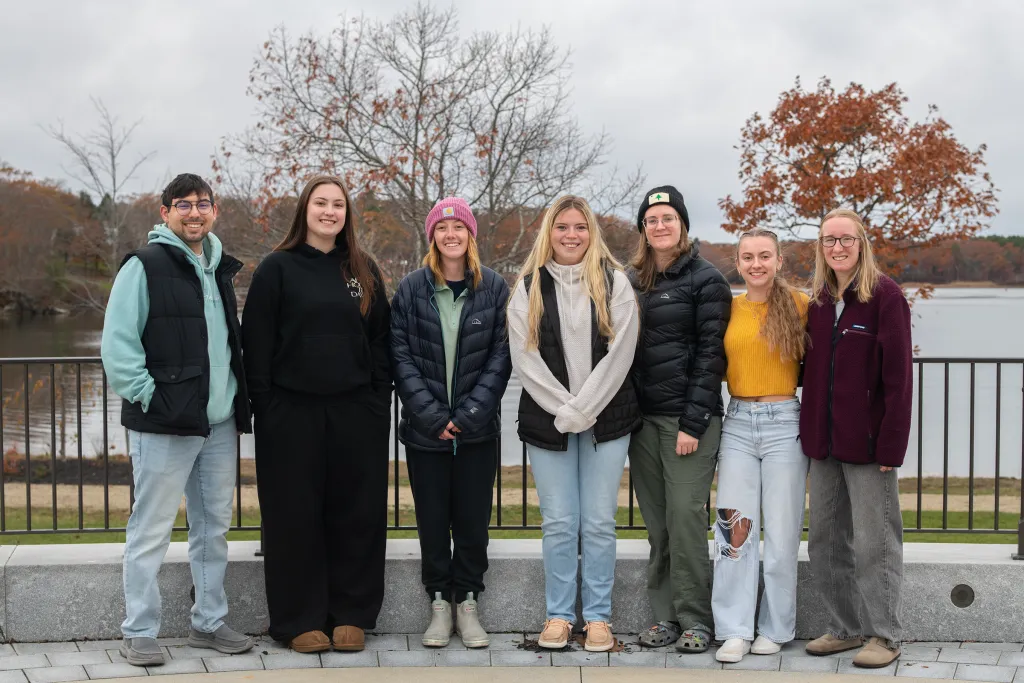
Meet the SeaMade Bar Innovation Team
Hailing from Bow, New Hampshire, Maya Brochu is majoring in Nutrition and minoring in Mental Health Rehabilitation. A self-proclaimed “book nerd,” Maya is also a self-published author. She is excited to promote wellness and nutrition in the community while advocating for sustainable solutions in the food system.
From Poland, Maine, Eliza Neill is majoring in Nutrition with a minor in Public Health. She has hands-on experience making soft goat cheese on a local farm and is passionate about exploring healthy, sustainable alternatives through a nutrition-focused lens.
Originally from Middle Grove, New York, Kylie Reisinger is a Marketing major with double minors in Nutrition and Art. She stays active in campus life through involvement in six clubs as well as intramural sports. Kylie is enthusiastic to network with innovative leaders and participate in the advancement of her Shaw Innovation project.
From Bangor, Maine, Jayden Schoppee is a double major in Athletic Training and Nutrition with minors in Public Health and Health, Medicine, and Society. She is also a forklift driver and the Beverage Assistant at the Maine Savings Amphitheater in Bangor.
Coming from Charlotte, Vermont, Jasmin Townsend-Ng is majoring in Marine Sciences with a minor in Animal Behavior. She is currently working as a Coastal Observation Fellow and on the SeaMade Bar Innovation Team. In her free time, Jasmin likes to make art, be outdoors, and spend time with friends. She is excited to make a meaningful contribution to her community, engage in scientific research and applications, and build important career skills along the way.
From Smithfield, Rhode Island, Olivia Vendittelli is a 2025 UNE graduate with a B.S. in Business Administration and a concentration in Marketing. She is excited to bring her strengths in digital marketing and creative strategy while building meaningful relationships.
Impact History Lab Innovation Team
The Impact History Lab Innovation Team transforms historical inquiry into a platform for innovation and community engagement. Inspired by National Geographic’s Impact Story Lab, this team uses storytelling, technology, and public history to uncover and share Maine’s rich heritage through exhibits, films, and digital media. Students collaborate across disciplines to create projects that preserve local history while fostering dialogue and positive change, positioning UNE as a leader in public history and cultural innovation.
For the 2025–26 academic year, the Impact History team will lead two major projects. “Behind Closed Doors at the Biddeford Mills Museum” explores the legacy of Pepperell Mills — one of the nation’s earliest textile mills — through worker stories, environmental impacts, and exhibit design to expand the museum’s storytelling. “Whose Stories, Whose Public Spaces?: Access, Equity, and the Building of Acadia National Park” examines how New Deal programs shaped Acadia’s infrastructure, investigates the lives of workers, and uses archives and digital tools to create public-facing projects that connect past and present.
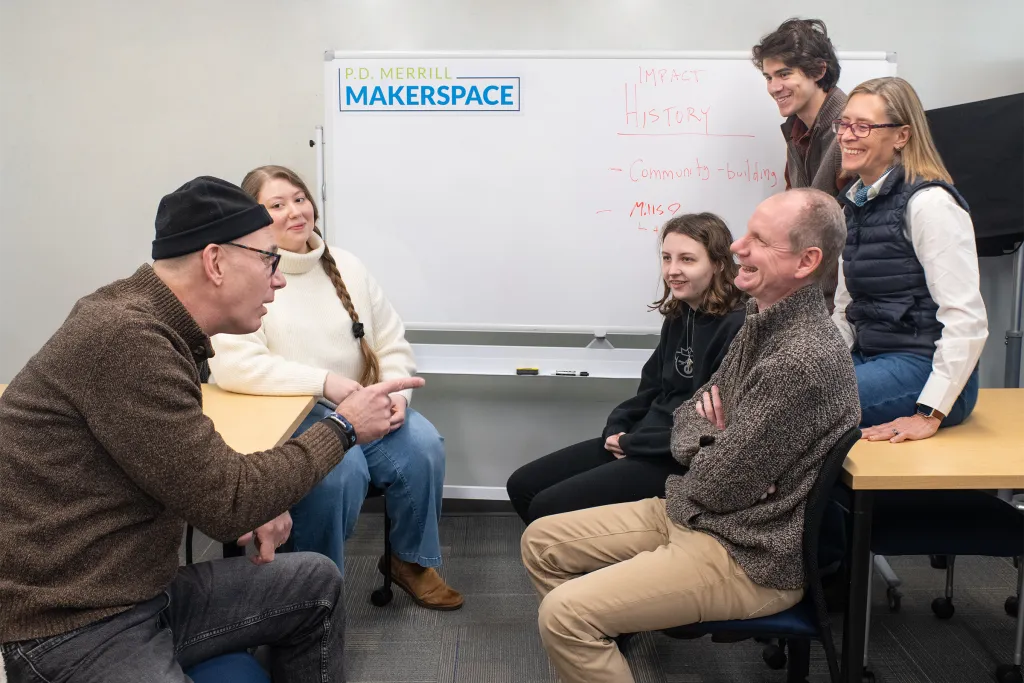
Meet the Impact History Lab Innovation Team
From Atlanta, Georgia, Chloe Boulle is a double major in Art and Design Media and History, with a double minor in Communications and Creative Writing. She currently runs a podcast on campus and enjoys film and podcast production as well as painting and drawing.
From Pasadena, California, Evelyn Cole is majoring in History. They have a fascination with historical medicine and plan to be an archivist or a forensic anthropologist. Evelyn hopes to gain experience for future employment through the Impact History Lab.
Originally from Louisville, Kentucky, Miles Gabriele-Burke is a History major with a minor in Anthropology. Miles is a dual citizen of Italy and is excited to work with the local Biddeford community to preserve their public history.
From Cape Elizabeth, Maine, Jack McKibben is a History major with a minor in Medical Biology. Jack is excited to work on the Impact History Lab Innovation Team.
Past Shaw Innovation Fellows and Teams
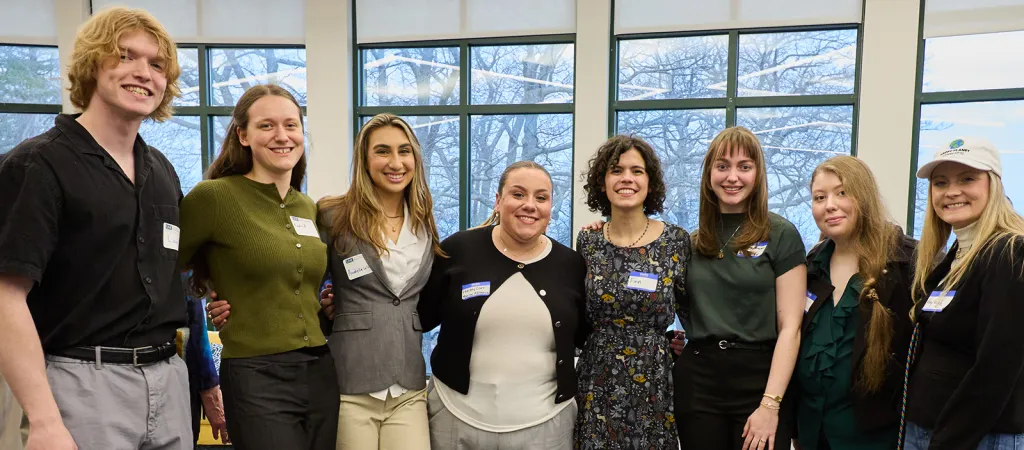
2025–2026 Shaw Senior Fellows
- Caitlyne Bobsein, Medical Biology/Health, Medicine, and Society ’28
- Hailey Carr, Marine Affairs/Global Studies/Political Science ’26
- Jayden Schoppe, Athletic Training/Nutrition/Public Health/Health, Medicine, and Society ’27
- Payton Fleury, Medical Biology ’26
- Finn Sclafani, Biological Sciences/Applied Mathematics ’27
- Emily Battye, Nursing ’25
- Tyler Janik, Aquaculture, Aquarium Science, and Aquaponics/GIS ’27
- Kalei Peck, Marine Entrepreneurship and Marine Biology ’28
- Luke Jenkins, Biological Sciences/Environmental Studies ’26
- Annabella Lafond, Oceanography/Environmental Science ’25
- Olivia Leighton, Marine Sciences/Data Science/Chemistry ’27
- Richie McGovern, Marine Sciences/Applied Mathematics ’26
- Jasmin Townsend-Ng, Marine Sciences/Animal Behavior ’26
- Liam Harris, Marine Science/Environmental Science ’28
- Elizabeth Huggins, Art and Design Media/English ’26
- Kaci Bieu, Marine Affairs/Climate Change Studies/Environmental Studies ’26
- Rosalie Bridge, Environmental Science ’28
- Miranda Carrabba, Marine Affairs/Political Science December ’25
- Kayleigh Duncan, Communications ’26
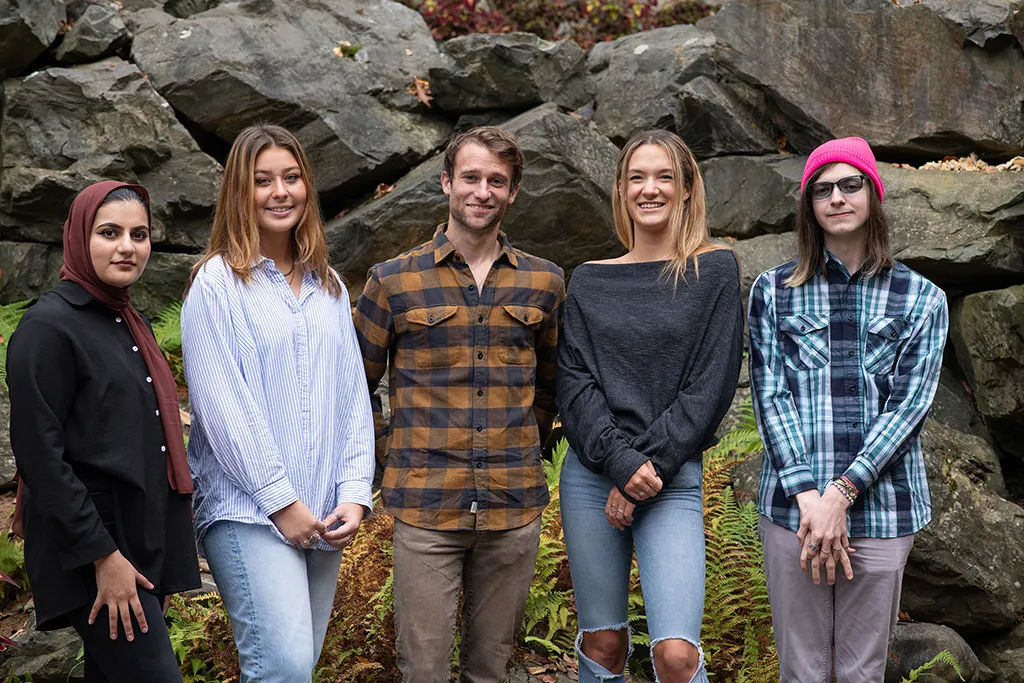
2024–2025 Shaw Senior Fellows
- Ruth Ellis, Environmental Science, Geographic Information Systems, ’26
- Hailey Haynes-Davis, Marine Biology, ’27
- Tyler Janik, Aquaculture and Aquarium Science, Geographic Information Systems, ’27
- Cloey Parlapiano, Environmental Science, Aquaculture and Aquarium Science, ’25
- Isabel Ryan, Environmental Science, ’27
- Grace Sprague, Communications and Media Arts, Psychology, ’25
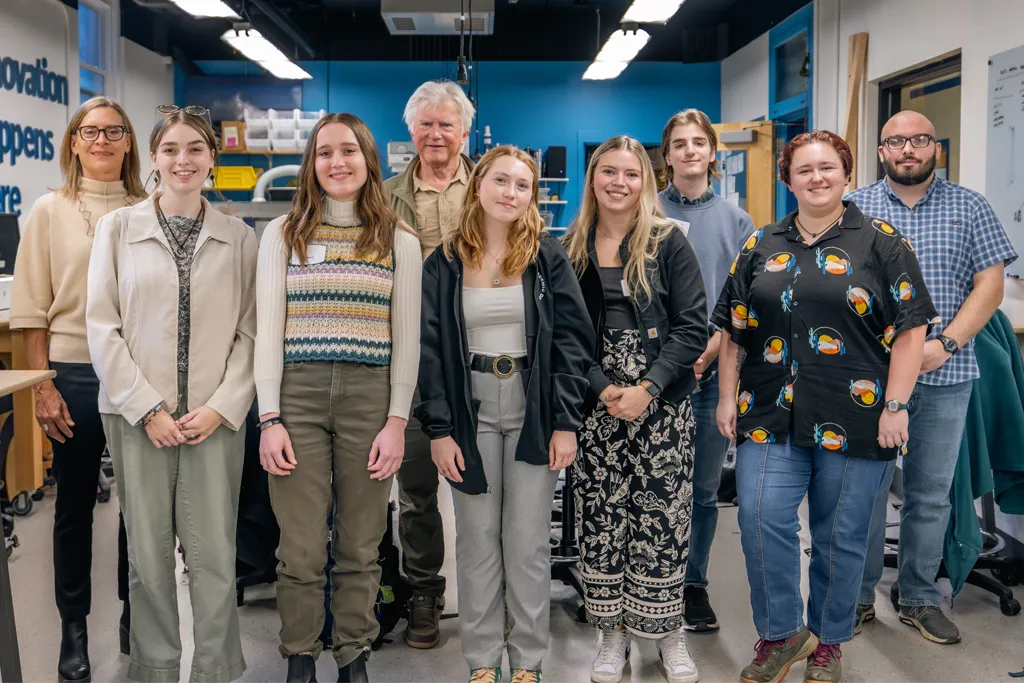
2024–2025 Shaw Innovation Team
The 2024–2025 innovation team worked to bring a nutrition bar to market that uses ingredients such as seaweed and honey sourced from UNE’s campus.
- Ryan Garrant, Aquaculture and Aquarium Science, ’25
- Vaughn Jennings, Marine Entrepreneurship, ’28
- Cloey Parlapiano, Environmental Science, Aquaculture and Aquarium Science, ’25
- Sarah Rossignol, Nutrition, Public Health, ’27
- Jayden Schoppee, Nutrition, Athletic Training, ’28
- Jasmin Townsend-Ng, Marine Biology, ’26
About David Evans Shaw
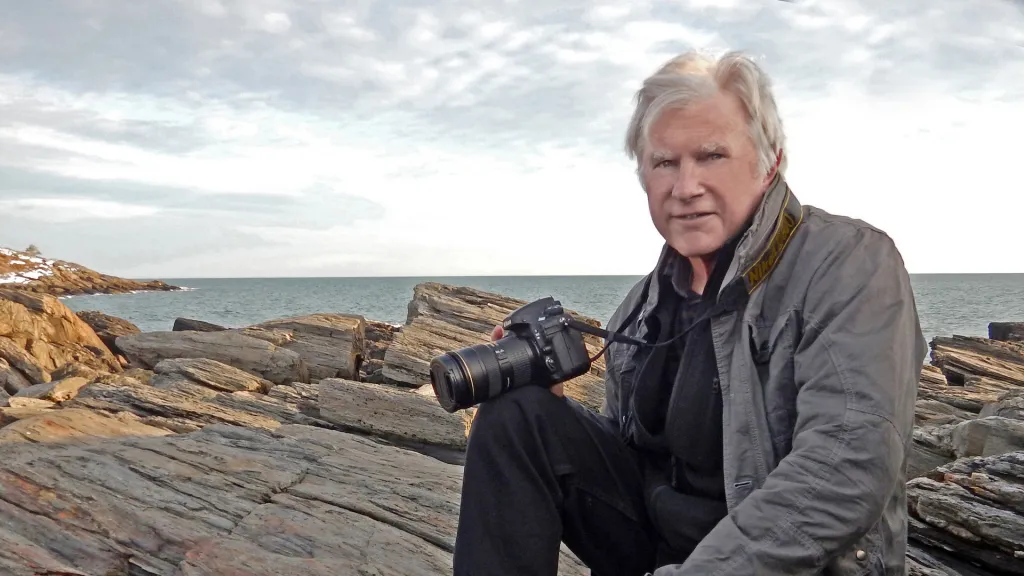
The Shaw Innovation Program, launched in 2021, is made possible through the generosity of David Evans Shaw. Through the program, Shaw, a prominent business and social entrepreneur and resident of Maine, seeks to supplement demand for education and research in the fields of entrepreneurship, science, technology, business, and leadership in order to help build a network of student innovators across several New England universities.
With extensive global leadership experience in science-based companies, investment management, and social impact NGOs, David Evans Shaw has helped build more than a dozen successful technology companies as a CEO or board member. These companies, employing more than 15,000 people worldwide, harness modern science to address important needs in health care and other markets. Early in his career, Shaw helped build a leading consulting firm in food and agriculture.
Shaw’s career has included extensive public service in science, arts, conservation and public policy. He has served on the faculty of Harvard’s John F. Kennedy School of Government and the advisory board of the Center for Public Leadership. He is a founding director of the U.S. Olympic and Paralympic Museum, chair-emeritus of The Jackson Laboratory, and treasurer emeritus of the American Association for the Advancement of Science. He has also been a global leader in science-based conservation of nature as a trustee of the National Park Foundation, founding chair of the Sargasso Sea Alliance and Aspen High Seas Initiative, patron of nature to the International Union for the Conservation of Nature, member of Ocean Elders, and as founder of Second Century Stewardship for America’s national parks.
Shaw supports his many interests with the production of short films.