Resilience and key fellowship help UNE graduate find footing in Maine’s climate economy
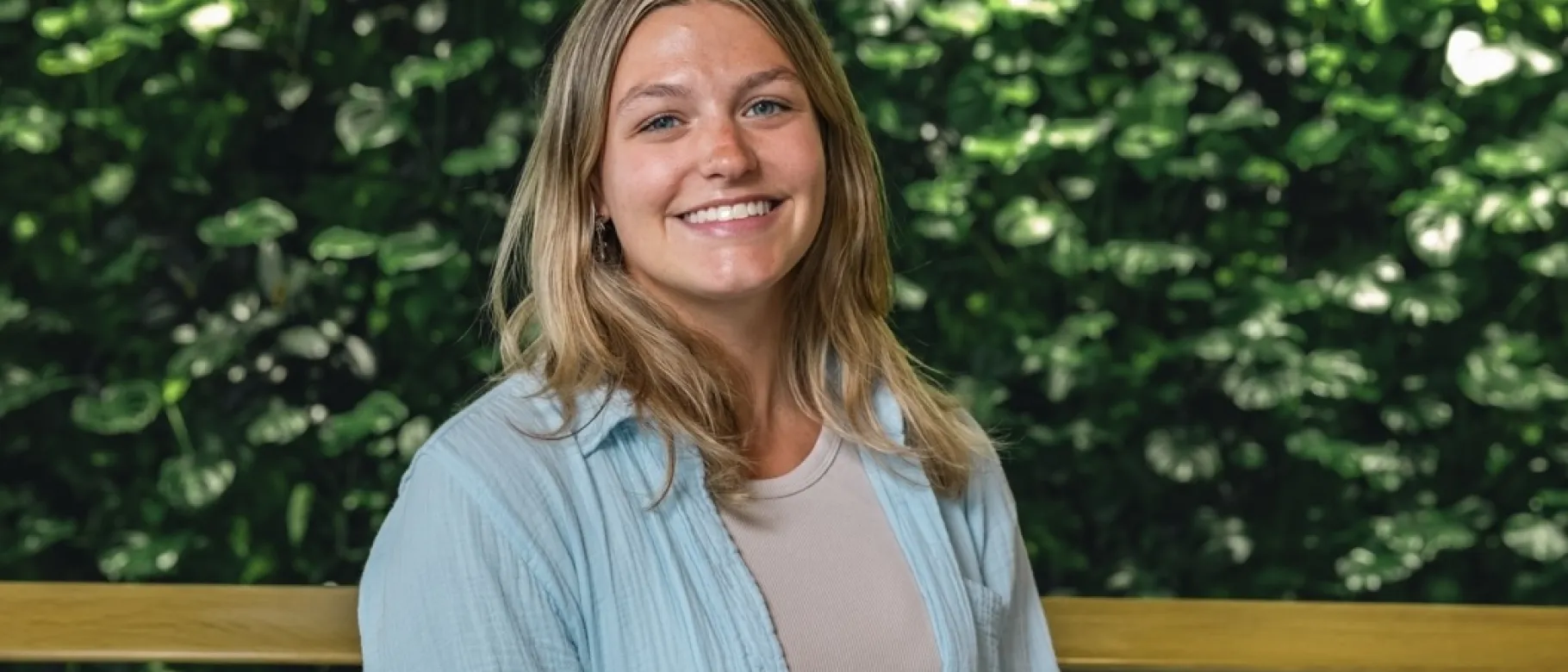
Sophie Piette came to the University of New England thinking businesses were the cause of the climate crisis. Now, after graduating in 2024 with a degree in marine affairs, she is being paid to help them be part of the solution — and it took an unexpected layoff that tested her resolve and a lot of “showing up” to get there.
Today, Piette largely credits UNE’s Sustainability Fellowship with helping her navigate her upward professional trajectory and landing a job in business sustainability this June, when she was hired as an associate program manager at Efficiency Maine, an agency that implements programs that promote energy efficiency in the state.
Piette’s path to climate work wasn’t a straight line. But two years after graduating from UNE, she’s proud of how she navigated the zigzag of her early career and is grateful for the UNE mentors who guided her along the way. Key among them were the mentors she found through her Sustainability Fellowship in 2024, such as Cameron Wake, Ph.D., director of UNE North, the University’s Center for North Atlantic Studies, who founded the Sustainability Fellowship Program.
Piette sought the fellowship a year after graduation, after working in jobs that were not part of her future goals.
“(My UNE professors) reminded me of what I’ve done to deserve these roles, and they reminded me what I need to do to get where I want to go,” Piette said. “Cameron Wake had an expression he said all the time during the Sustainability Fellowship Program. And I see now he was right: Sustainability has three R’s, and they’re relationships, relationships, relationships.”
Through the Summer Sustainability Fellowship program, UNE students and recent graduates chosen as fellows work on sustainability solutions to make businesses, nonprofits, towns, and communities more climate resilient.
Since it was launched in 2024, the program has grown from six fellows in 2024 to 23 in 2026. The number of UNE advisors assisting in the summer program — faculty and professional staff with expertise in business and climate research — also grew from two to eight.
I really used to think that, unless I was directly working in the ocean as a biologist or went to law school and directly worked in law and policy, that I wasn’t going to do important climate work. The Sustainability Fellowship and talking with my fellow fellows, as we called ourselves, showed me there is a space for every kind of skill in the sustainability movement." — Sophie Piette ’24
UNE Assistant Teaching Professor Jeremy Pare, LPD, M.S., director of the Sustainability in Business Program in the College of Business and a mentor in the fellowship program, said his professional relationship with his students doesn’t stop when the fellowship ends.
“I’m lucky because I direct small programs in the College of Business, so it makes it a lot easier to be able to stay in touch with graduates, because I have them in my classes. But if it weren’t for my helping to mentor Sophie through her Sustainability Fellowship, I would not have the keen insight into her amazing trajectory in Maine’s climate sector,” Pare said. “She is one that easily could have left the state, and now she is staying here as a result of this work that she’s so invested in.”
Piette arrived at UNE in 2020 planning to become a marine biologist but quickly shifted her focus toward communicating science rather than conducting it. She began taking classes in sustainable business, which altered her view of the business sector and its role in making communities more climate resilient.
“I really used to think that, unless I was directly working in the ocean as a biologist or went to law school and directly worked in law and policy, that I wasn’t going to do important climate work,” Piette said. “The Sustainability Fellowship and talking with my fellow fellows, as we called ourselves, showed me there is a space for every kind of skill in the sustainability movement. Sustainability could use every single person in our society.”
Piette mostly worked jobs just to pay her bills until she heard from Pare, her former professor, who encouraged her to apply for the inaugural fellowship cohort in 2024. Piette interviewed with several businesses and nonprofits and landed a summer position with ClimateWork Maine, where she then built the organization’s sustainability council “from the ground up.”
After the fellowship ended, Piette continued to volunteer with the nonprofit, following Pare’s advice to “keep showing up.” That effort led to a part-time job with ClimateWork Maine that quickly became a full-time job as a program manager in January 2025, a post she held for a year and a half.
But when the funding for that newly created position dried up and Piette was laid off, she was back on the job search. She headed out West to camp, hike, and paddle — and regained a determined outlook. All the while, Piette continued to check in with the UNE professors who helped coach, advise, and support her on her career journey.
Just two months later, she landed a full-time post as the associate program manager for Efficiency Maine’s home energy savings programs.
Looking back, Piette said that two-month stretch of unemployment was disappointing and unnerving, but she feels fortunate she had UNE mentors to support her long after she graduated.
“We’re in a time where it’s really easy to feel pessimistic about our changing climate or about landing a role. But, I look back now and I’m like, ‘Man, that was no time at all for me to be unemployed.’ Staying optimistic is a choice, right?” Piette said. “When you are graduating college or concluding your fellowship, the whole world is ahead of you. And that’s exciting, but also really scary because you think that the entire weight of the world is based on this one next decision.
“But, you have time,” she said. “You have so much time. I still have time.”