
UNE education student earns prestigious literary honor
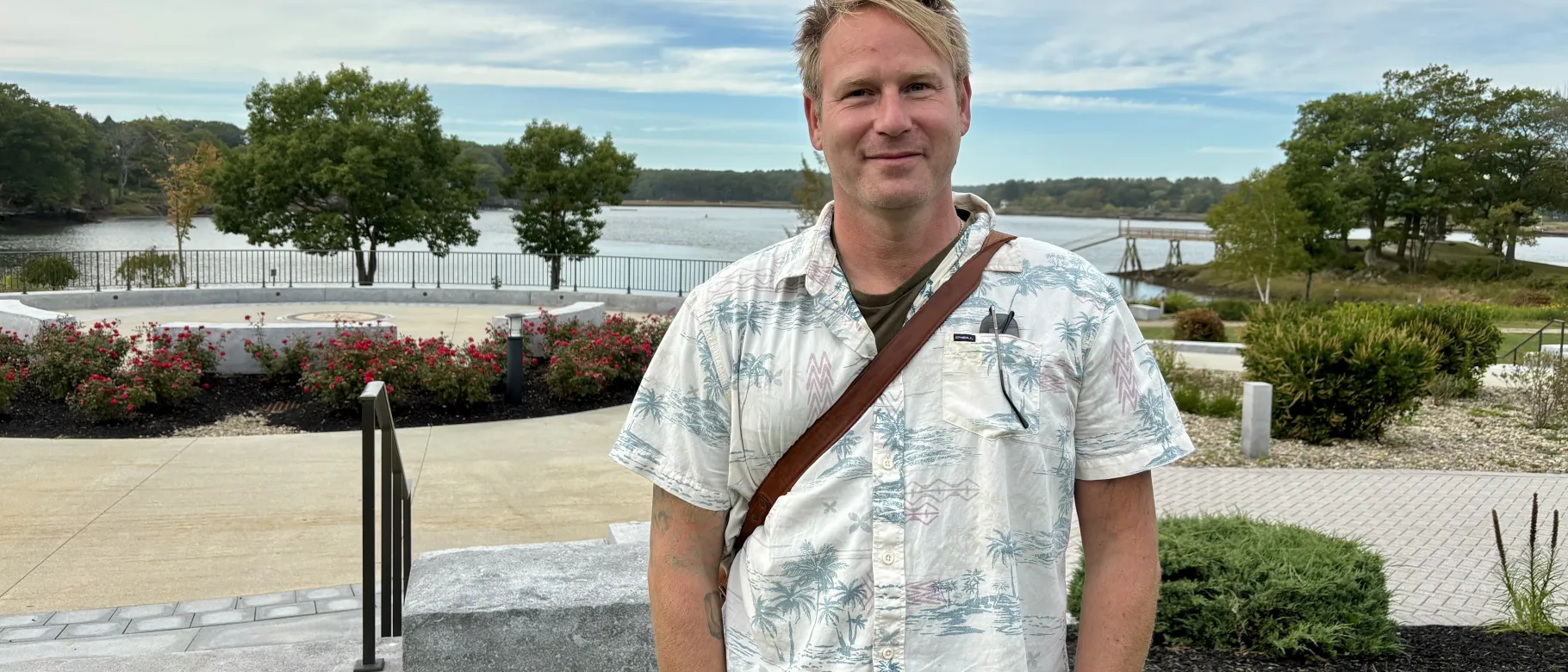
University of New England junior Dane Frost (Secondary Education, ’28) never planned to be a poet. But the first three poems Frost ever submitted in a national writing contest made him a finalist in The Iowa Review's 2026 Veterans’ Contest, a high honor from a prestigious literary journal that proved to Frost his decision to switch majors halfway through his college journey was a wise move.
A year ago, Frost was in his third year of medical biology studies, with plans to go to medical school, when he decided to switch majors to secondary education with a focus on English and a minor in writing.
Frost credits his immediate success in the national writing contest to Matthew Anderson, Ph.D., a professor in the UNE School of Arts and Humanities, whose poetry course “Lyrics” introduced Frost to the two poems that inspired him to write his contest entry.
Frost’s main poem, “A Howl for George W. Bush,” is a 78-stanza poem of nearly 3,000 words modeled after Allen Ginsberg's legendary "Howl for Carl Solomon and “Howl for Toni Keller” written by Amy Newman. Frost’s “Howl” made him one of 10 finalists in a writing contest that can draw hundreds, or even thousands of entries.
Those 10 finalists will be judged by Khadijah Queen, a poet and Navy veteran, and the winners will be published in The Iowa Review in 2027.
“UNE and the faculty played an instrumental role in creating that poem,” Frost said. “If Dr. Anderson had not chosen Ginsberg and Newman’s poems for course reading, the poem I wrote would not exist.”
Frost’s literary voice offers a bold statement about the military and his experience in the Army, both of which he hopes are messages that resonate today.
A U.S. Army veteran who served two tours in Afghanistan and one in Iraq over an 11-year career, his poems speak about veteran suicide and the experience of young men, like himself, who enlisted in the Army after 9/11.
After entering the miliary at age 18, a spinal injury Frost suffered in Afghanistan ended his military career in 2016 and led him to years of physical and mental rehabilitation.
“I'd been in the Army for so long that I was psyched at finally having a chance to do something that was enriching to me because the Army wasn't always enriching to me,” Frost said of his new course of study, which affords him the chance to finally write more. “I think you get enriched when you do things that you're in alignment with. There was a time I was in alignment with the Army and then that kind of went away.”
When Frost was still majoring in medical biology last fall, his wife gifted him a trip to a writing workshop in Ireland, a trip that made him reconsider his career path.
UNE and the faculty played an instrumental role in creating that poem. If Dr. Anderson had not chosen Ginsberg and Newman’s poems for course reading, the poem I wrote would not exist.” — Dane Frost (Secondary Education, ’28)
Frost recalls an epiphany he had when he went to the grave sight of Irish poet John O’Donohue (who also switched careers from the priesthood to writing) and he read the words on O’Donohue’s tombstone: “May I have the courage today to live the life that I would love, to postpone my dreams no longer but do at last what I came here for and waste my heart on fear no more.”
“At that grave site, I kind of was standing at a precipice in my mind,” Frost recalled. “And seeing that quote on his grave, it was a quote from him, and it essentially just said: ‘Stop being a coward and just pursue art.’
"I was just constantly writing research papers and studying the body,” Frost continued. “But for my whole life, there's been a voice in my head telling me I should just write, and I ignored it. I just ignored it.”
When Anderson put Ginsberg’s “Howl” in front of him last spring, Frost said “something clicked.” The next day, he sat by the fireplace in the Ripich Commons dining hall writing for two hours without pause and produced his own “Howl.”
Frost then researched writing contests on his own, found The Iowa Review’s contest for veteran writers, and submitted his entry last May.
“The Iowa Review is one of the premier journals. The U of Iowa (Master of Fine Arts) in creative writing has long been one of the leading — if not the leading MFA program in the country,” said Anderson, who didn’t assign the poems Frost wrote but knew from their conversations that Frost was inspired by the class readings.
The truth? Frost doesn’t want to be a poet.
But in another UNE writing class Frost took last spring with English Professor Jesse Miller, M.F.A., he submitted a short story that Miller challenged him to turn into a novel. Now Frost is looking for an agent to help him sell that 75,000-word manuscript. And he already plans to pursue an M.F.A.
But, more importantly, Frost said, his decision to switch majors and the subsequent writing he’s done for Anderson and Miller has helped “to heal” his mental wounds of war.
"After I finished this poem, the next day when I woke up, so much of my post-traumatic stress disorder and anxiety and fear and rage was gone," Frost said. "It was poetry that fixed it.
"Going to school here, it's like a balm. This place heals me. I'm not treated badly because I'm a veteran.”