
Volunteers brave raw, wet day to assist in UNE’s second BioBlitz of 2026
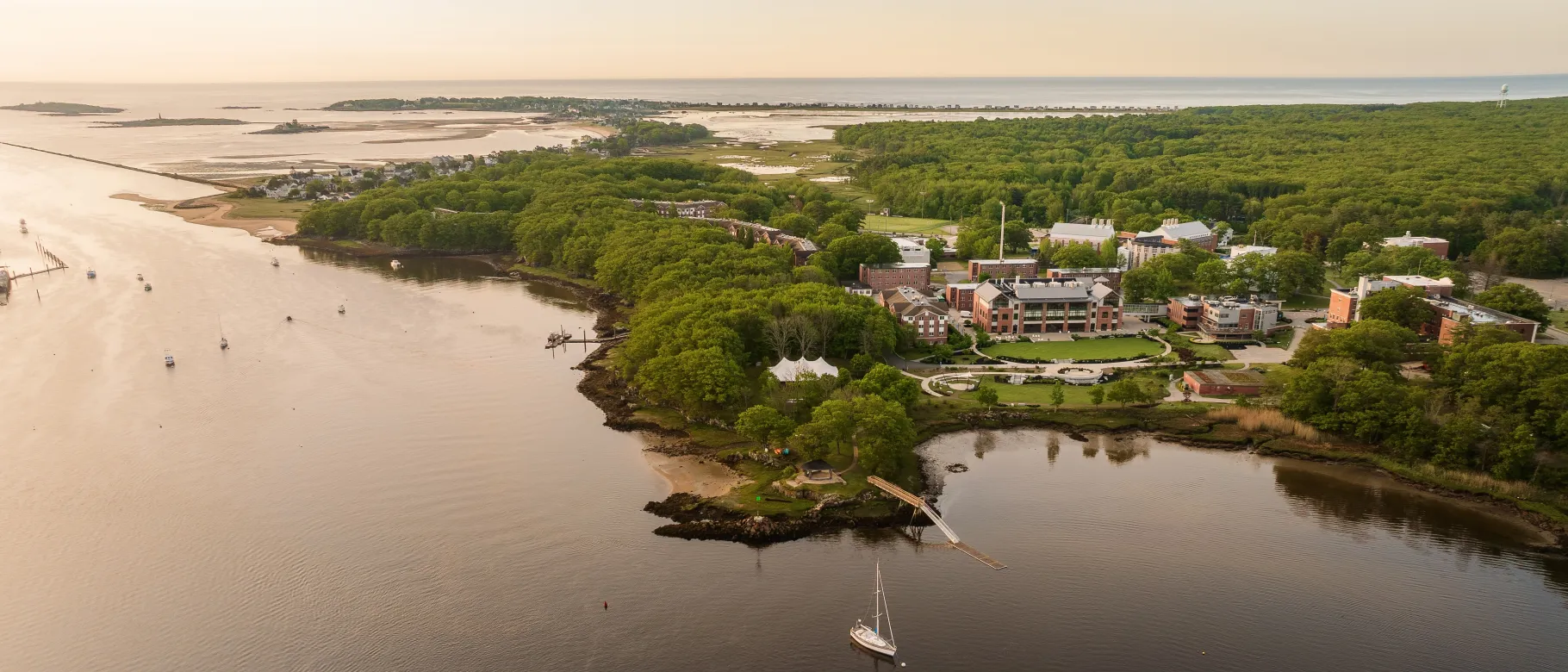
The volunteers who showed up for the second “BioBlitz” of 2026 on the University of New England's Biddeford Campus on Sunday, Sept. 27, showed their school spirit like never before: They conducted the methodical survey of living species known as a BioBlitz during a Nor’easter.
Sunday’s pounding rain didn’t stop seven students from making their way across UNE’s coastal campus around the Danielle N. Ripich Commons, the Barbara J. Hazard Fields, the Harold Alfond Forum, and Freddy Beach to find, photograph, and document as many species of lichen, insects, plants, birds, amphibians, animals, and trees as they could within a two-hour window of time.
The result: 61 species were identified and recorded using community science tools including iNaturalist, a smartphone app that allows users to photograph and identify species, and Merlin, an app that helps identify birds.
It was half as many species recorded as last April when a four-hour bioblitz conducted by 10 volunteers resulted in 121 species recorded on the citizen science apps. But the seven volunteers out Sunday only surveyed for half as long as they braved the cold rain and wind.
“Honestly, I’m happy we still had a good group considering the weather was crazy,” said event organizer Rachel Mendez (Animal Behavior, ’27), who is minoring in environmental studies at UNE. “Sixty-plus species is a pretty good amount. We didn’t see many birds or insects because of the rain. But we had over 100 observations, which is pretty good for a few hours.”
This event was organized by Mendez with support from several UNE clubs — the Photography Club, Earth's ECO, and the Funguys — and Assistant Professor Jennifer Brousseau, Ph.D., who organized April’s BioBlitz with assistance from UNE faculty and professional staff.
Mendez and Brousseau together produced a second BioBlitz to engage students in hands-on environmental research while contributing real-world data to ongoing biodiversity monitoring efforts.
“I was ecstatic when Rachel approached me about organizing a BioBlitz and taking the lead. I would like to host these annually in the fall and-or spring, but I am more than happy to be a behind-the-scenes supporter if a student wants to take the lead,” said Brousseau, who teaches in the School of Marine and Environmental Programs. “I can only hope to build support and enthusiasm among other UNE students to carry this forward into the future, so that these events contribute to annual biodiversity monitoring at UNE.”
For Mendez, the event added to a growing list of important fieldwork experiences that will help her plot a course to a career in conservation.
An internship last summer with the Kennebunkport Conservation Trust — which Mendez pursued through contacts she met at UNE’s first Career Connections Mixer last winter — taught her much about identifying plants, invasive plant species removal, and what the day-to-day work at a land trust looks like.
Following that opportunity, Mendez was accepted into the iNaturalist Ambassador Program this fall, a position that requires she run events like UNE’s BioBlitz. Mendez then reached out to Brousseau and asked if she could help organize the field survey and Brousseau gladly turned the reigns over to Mendez.
Now, Mendez is already looking forward to the next UNE BioBlitz, either later this fall or next spring — hopefully under sunnier skies.
"Doing biodiversity surveys like this gives us an idea of what species are present on and absent from our campus,” Mendez said. "On Sunday, I kept an eye out for invasive plant species because it's interesting to see how they are interacting with our environment. When you keep a record, you can see if invasive species are spreading and the effectiveness of management efforts.”