Image

This website uses cookies to understand how you use the website and to improve your experience. By continuing to use the website, you accept the University of New England’s use of cookies and similar technologies. To learn more about our use of cookies and how to manage your browser cookie settings, please review our Privacy Notice.
As a haze of Canadian wildfire smoke begins to clear and the sky meets the mirrorlike waters of the York River, a wire mesh trap dripping with eelgrass, mud, and dozens of scrambling critters breaks the surface.
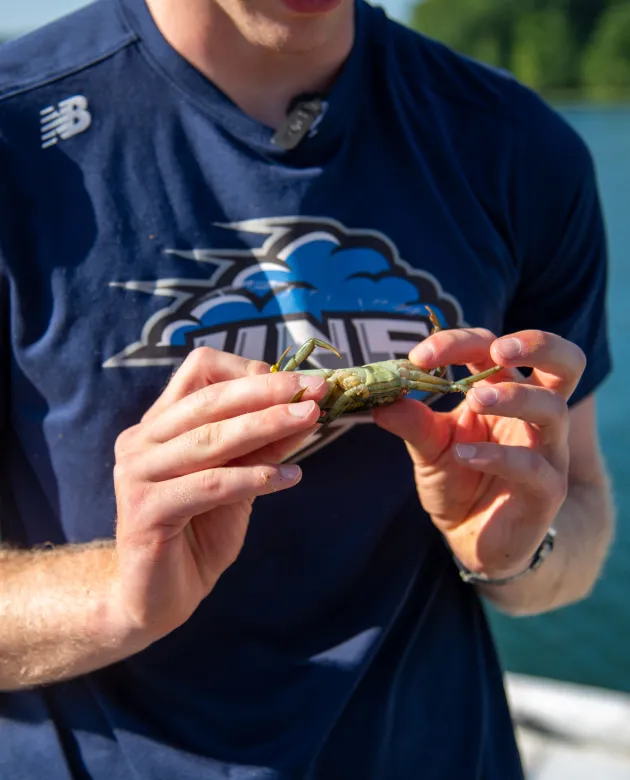
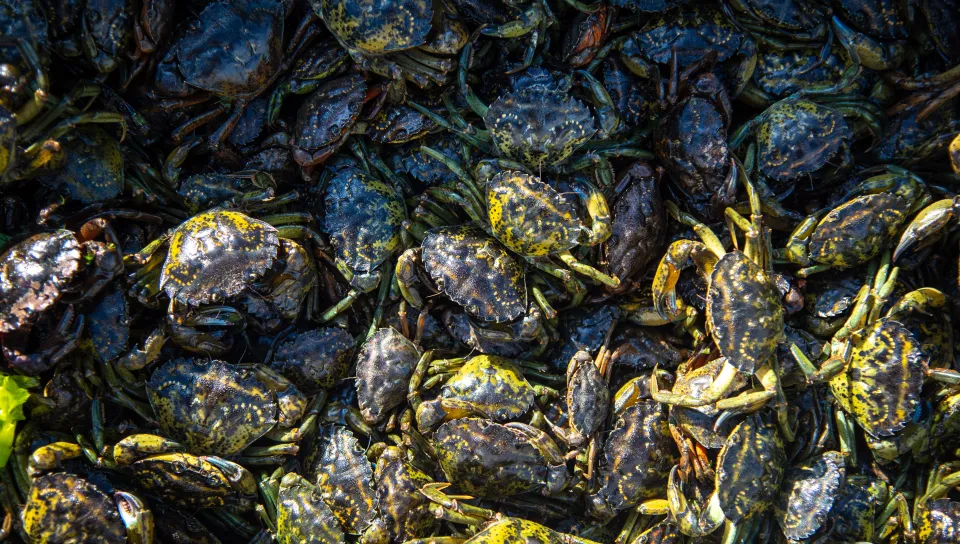
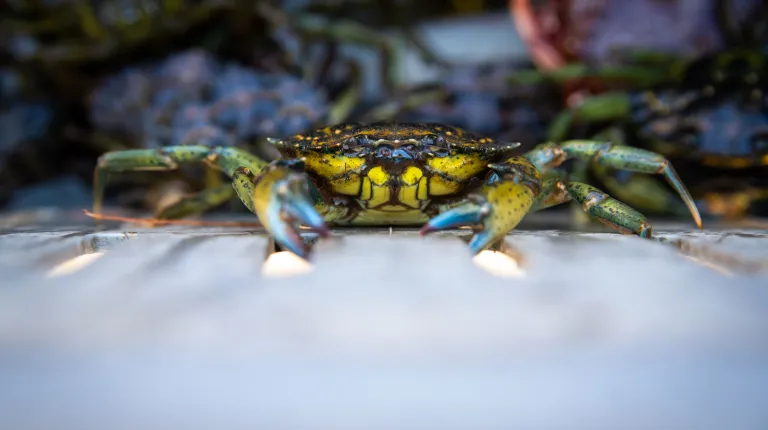
Standing at the bow of a small skiff, University of New England marine sciences student Jackson Martine (’27) braces the trap against the gunwale before carefully sorting through its catch. Native rock crabs and the occasional lobster go back overboard. But a tangle of invasive European green crabs capable of devouring shellfish beds, accelerating salt marsh erosion, and disrupting coastal ecosystems across Maine — and the target of the day’s haul — stay behind.
By the end of the morning, Martine will have repeated the process again and again, part of a summer spent helping transform one of Maine’s most destructive marine invaders into the foundation of an emerging fishery.
“I’ve probably sorted somewhere around 100,000 crabs this summer,” Martine said with a laugh. “It’s been a lot.”
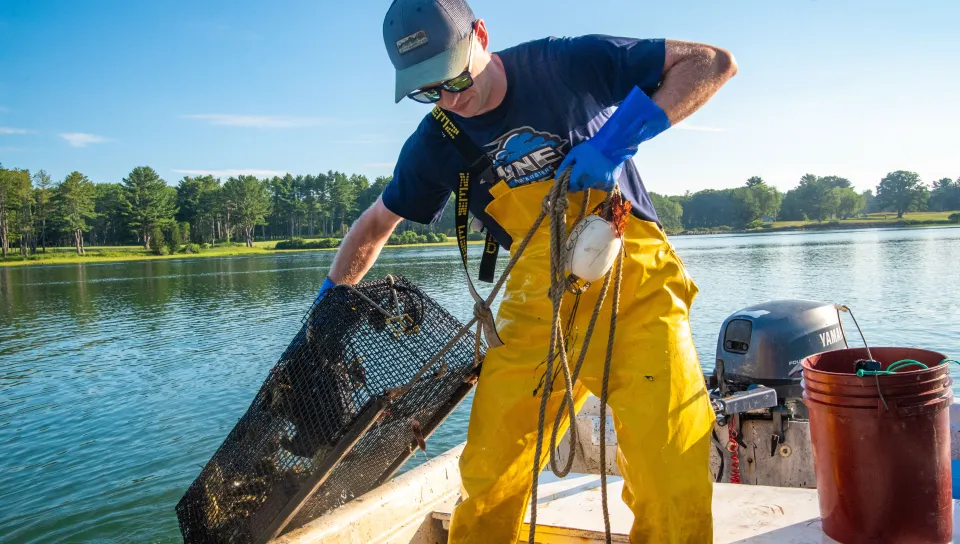
Martine’s day collecting green crabs on the York River begins at high tide, often at dawn or earlier.
The rising senior is spending his summer with the York, Maine-based startup Shell + Claw through UNE’s Summer Sustainability Fellowship, a 10-week paid program that places students alongside municipalities, nonprofits, businesses, and community organizations tackling some of Maine’s most pressing sustainability challenges. Rather than observing from the sidelines, fellows take ownership of projects designed to produce tangible outcomes for their host organizations while gaining professional experiences related to their academic pursuits.
For Martine, the opportunity arrived through what he described as a series of happy accidents.
After talking with one of his professors about conducting summer research, he learned the faculty member would be unavailable but suggested applying for the Sustainability Fellowship instead. The project immediately caught his attention.
“I applied immediately because I love dealing with crabs; they’re one of my favorite organisms,” Martine said. “I like the idea that this was going through the Sustainability Fellowship. I think it’s super important that we find more ways to be sustainable, especially on the coast because it’s such a fragile ecosystem.”
His host organization, Shell + Claw, is working to answer a deceptively difficult question: Can invasive green crabs become an economically viable seafood product while helping reduce pressure on Maine’s coastal ecosystems?
The species has spread aggressively throughout the Gulf of Maine, consuming young shellfish, competing with native species, and burrowing into marsh banks, where their activity contributes to erosion.
“If you have any issues, whether it’s inflation or problems with your riverbank, and if it has to do with the water, you can likely just blame the green crabs,” Martine said while holding one of the small crustaceans. “They cause a ton of issues.”
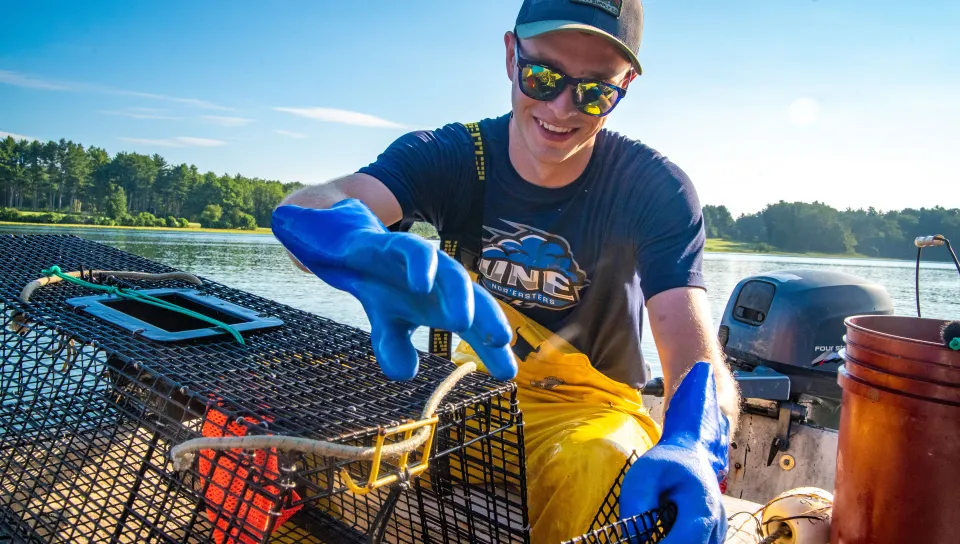
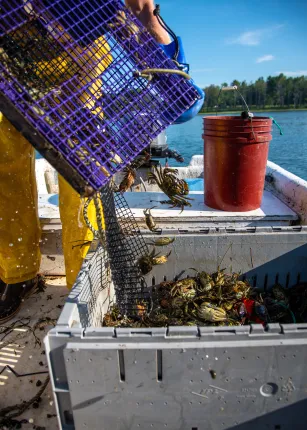
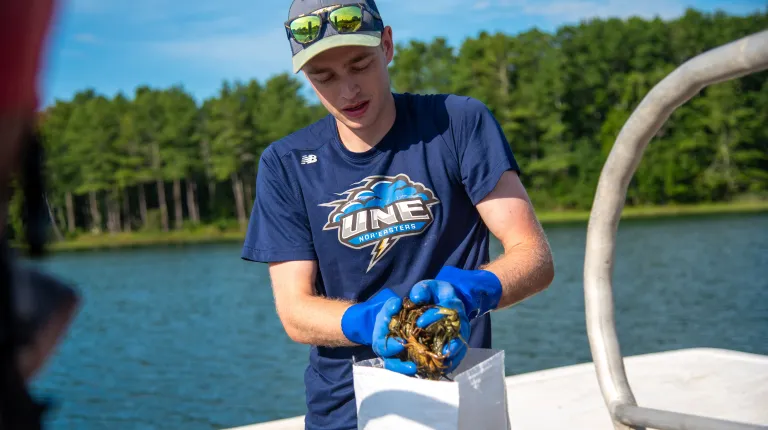
Martine often spends harvest days on his own, hauling traps out of the water, tossing back bycatch, and sorting crabs according to molting cycle — all by hand.
Much of his work begins long before sunrise or shifts with the tides. Martine and his supervisor, Shell + Claw co-founder Michael Masi, haul traps from the York River, sort hundreds to thousands of crabs according to where they are in their molting cycle, monitor them daily, and identify those about to shed their hard shells.
Those newly molted “soft-shell” crabs, the Northeastern equivalent of a famous Mid-Atlantic delicacy, are carefully refrigerated before being delivered to local seafood distributors and restaurants. Others are processed for bait or pet food, ensuring as much of the catch as possible finds a productive use.
But the fellowship has become about more than catching crabs.
Because commercial soft-shell green crab fisheries remain uncommon in the United States, Martine is helping evaluate techniques that could make the practice more practical and profitable for Maine harvesters. Throughout the summer, he’s collected data on different storage methods, tracked molting success, and helped identify ways to reduce labor and improve efficiency — insights that could make the difference between an interesting idea and a sustainable business model.
The experience has also given him his first look at aquaculture beyond the classroom.
“This is my first experience in aquaculture,” he said. “I’ve learned about these crabs before, but now I’m seeing how much work actually goes into maintaining a fishery.”
Just as importantly, Martine said, the fellowship has strengthened skills that extend well beyond marine science.
“I think some part of what this fellowship has prepared me for more is talking to people about it,” he said. “We’ve had photographers and reporters come down, and I’ve learned how to explain the project and be more professional.”
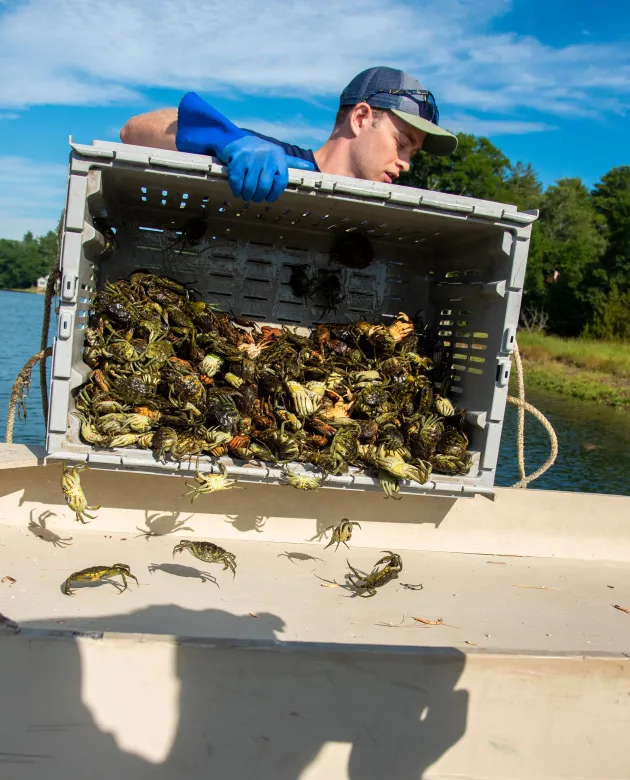
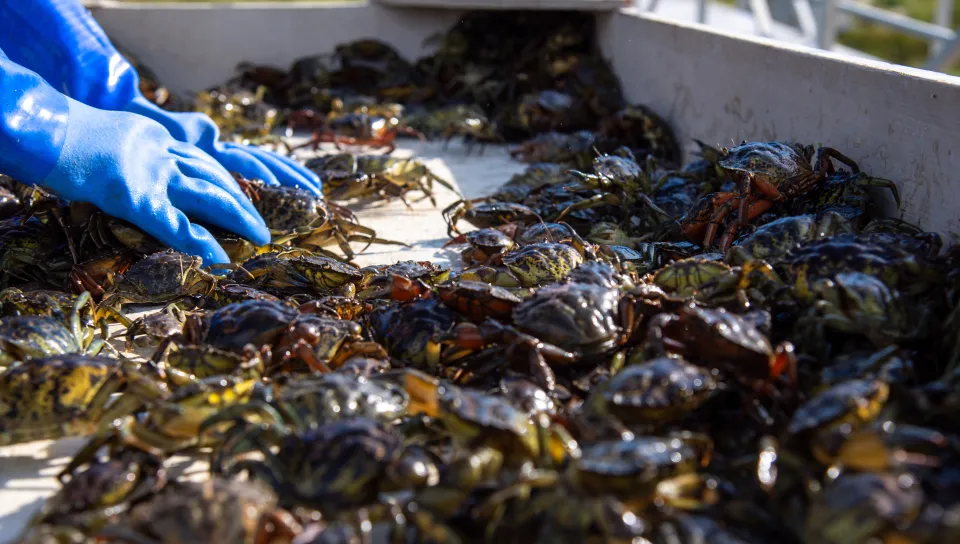
Martine estimates he’s sorted about 100,000 green crabs since he began his UNE Sustainability Fellowship in June.
Masi, a former high school marine science teacher, said Martine’s help through UNE’s Sustainability Fellowship has been crucial in allowing his business to pilot new strategies for sustainable aquaculture.
“Producing soft-shell green crabs is challenging on its own, but conducting research alongside commercial production would simply be economically impossible without the support of the University of New England Sustainability Fellowship,” he said.
And he said Shell + Claw “really hit the jackpot with Jackson,” whom Masi praised for his attention to detail and ability to adapt in the face of labor-intensive work.
“Anyone who has spent hours sorting green crabs knows that having the right person beside you makes all the difference, and Jackson has been a fantastic teammate,” Masi said. “Jackson’s dedication, positive attitude, and work ethic have made him an invaluable part of our team this season. He’s an absolute workhorse who never shies away from the demands of this work.”
Whether he ultimately pursues aquaculture, education, or another path within marine science, Martine said he's keeping the broader purpose of his work in mind. Each trap hauled from the York River, he said, brings the project one step closer to understanding whether an ecological challenge can also become an economic opportunity.
“This experience has shown me how much work goes into building something from the ground up,” he said. “We're not just catching green crabs. We're figuring out how a fishery like this can actually work, and it's rewarding to know that our efforts could benefit both Maine’s coastal ecosystems and the people who depend on them.”