

The University of New England partnered with the Southern Maine Planning and Development Commission (SMPDC) on Wednesday, Nov. 18, in hosting the annual Southern Maine Climate Action Workshop, a growing day-long event where municipalities, nonprofits, and organizations across the region share methods and successes in building climate resilience in local communities.
The collaborative event, organized with help from UNE faculty, professional staff, students, and the University’s Center for North Atlantic Studies, was aimed at addressing the public health challenges caused by sea-level rise, worsening storm patterns, and rapid ecological change by sharing the proven climate action strategies that have been used, and have worked, across Maine.
Now in its third year, the event drew 140 — and a waiting list of interested participants for the first time, many of them UNE students, said Karina Graeter, the SMPDC sustainability division director and one of the event’s organizers. Talks around how to expand next year’s workshop are already underway, Graeter added.
The workshop offered a panel discussion with local leaders and breakout sessions that covered topics such as how to lower transportation emissions, nature-based strategies for coastal resilience, effective strategies in waste diversion used by Maine municipalities, and the benefits in local climate policy in a time of ecological change and rising health challenges.
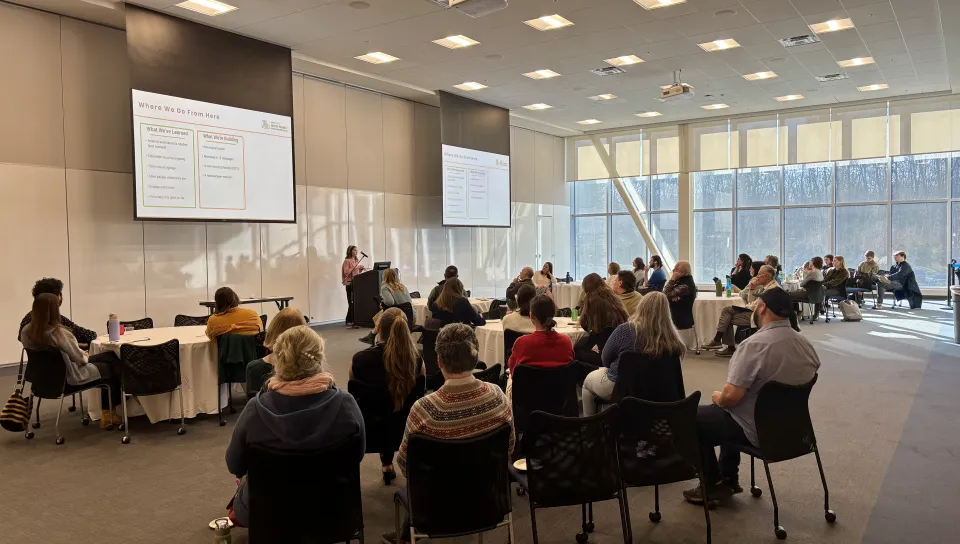
President James Herbert welcomed those gathered in the Harold Alfond Forum by emphasizing the need for sharing strategies and innovative methods to help build climate resilience in Maine communities.
“Sustainability is baked into UNE's DNA,” Herbert said. “If you look at our tagline on our brochures, it says: ‘Innovation for a Healthier Planet,’ and we conceptualize health on three different levels of analysis, if you will: the health of individuals, the health of communities, and the health of the planet.
“Our thesis is that those three things are inextricably linked, that you can't have healthy people without healthy communities and a healthy planet and vice versa,” he said. “It's something that we take seriously and try to enact in everything that we do. Today's work, the work you all are doing, supports health on all three of those levels.”
My primary message is: Please partner with us, reach out to our faculty, find ways that we can help. We want to be good partners, and so continue to partner with us.” — President James Herbert
Herbert said something else that the UNE community takes seriously is the very partnerships that have played out in the third iteration of the regional climate workshop, which are essential for solving the complex problems around sea level rise and the rise in damaging storms associated with dramatic ecological change.
“That is something else that we take seriously: building those relationships and strengths, because we can do so much more working together than working in our own silos,” Herbert said. “My primary message is: Please partner with us, reach out to our faculty, find ways that we can help. We want to be good partners, and so continue to partner with us.”
SMPDC, which supports 39 cities and towns across York and Oxford counties in Maine, has put an emphasis on sustainability in the past several years. And working collaboratively between UNE, municipalities, and local organizations is the winning approach to tackling the challenges related to a warming climate, said Stephanie Carver, the SMPDC’s executive director.
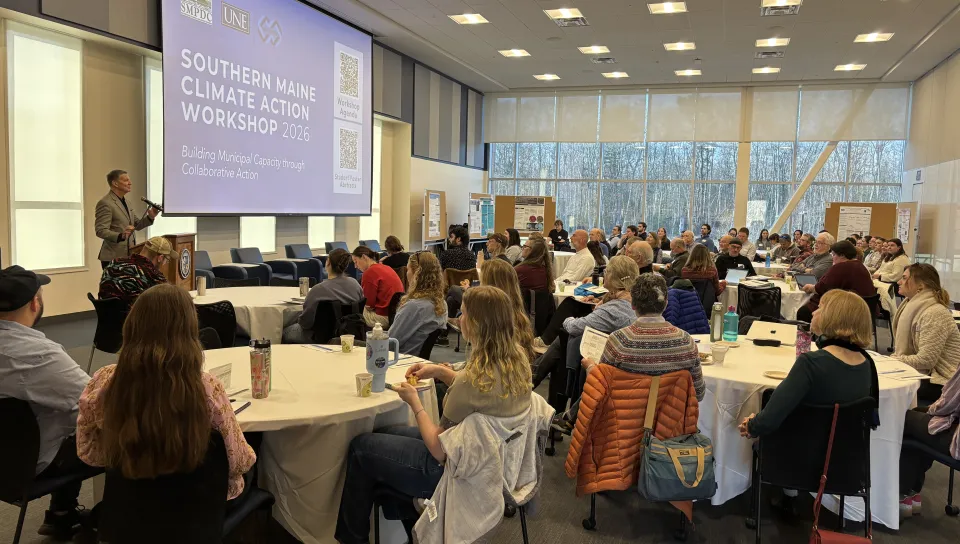
“From more frequent and intense storms and flooding to coastal erosion, changing precipitation patterns, extreme temperatures and pressures on our natural resources, it's pretty much everywhere and in every conversation we're having at the municipal level,” Carver said in her welcome remarks. “For many communities, the challenge is not just recognizing that climate change is happening; it's figuring out what to do about it.”
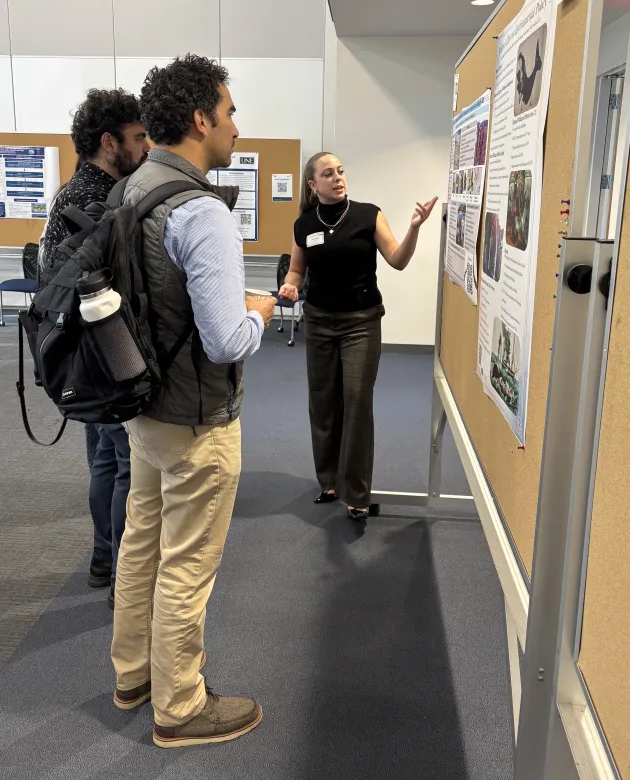
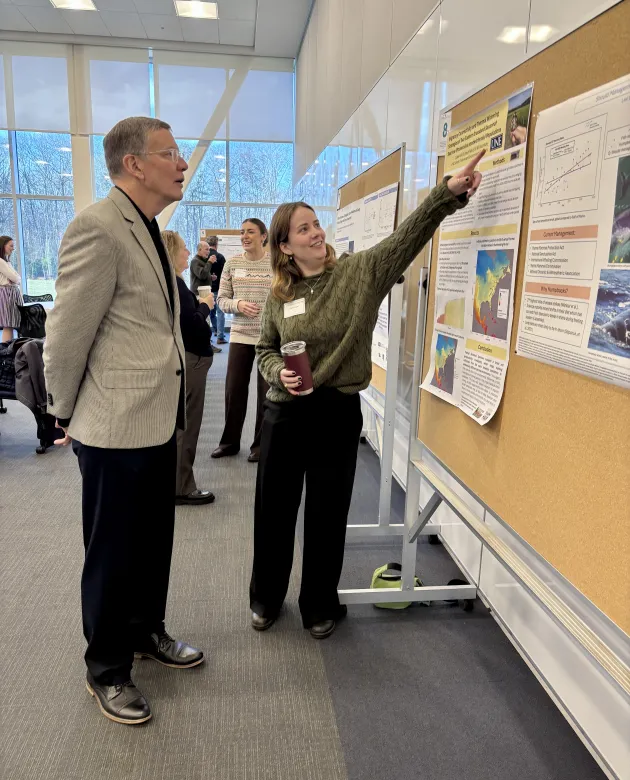
UNE students were involved in the workshop throughout, sharing their research aimed at improving community and planetary health. Several discussed the new weather detection systems deployed by UNE Assistant Professor Will Kochtitzky, Ph.D., in Saco Bay and Biddeford and, in some cases, in partnership with local communities in order to help scientists better understand extreme weather events along the Maine coast.
Senior Ethan Bombard (Marine Science, ’27) came to present research he’s participated in with Kochtitzky on the changing beaches and sand dunes in Maine — and was unexpectedly surprised to be approached and questioned at his poster presentation by two city planners.
Bombard expected people with coastal homes to ask about the dune research he’s helped to conduct at UNE. But to share that research with two engineers in an informed conversation about coastal resilience was an unexpected high point.
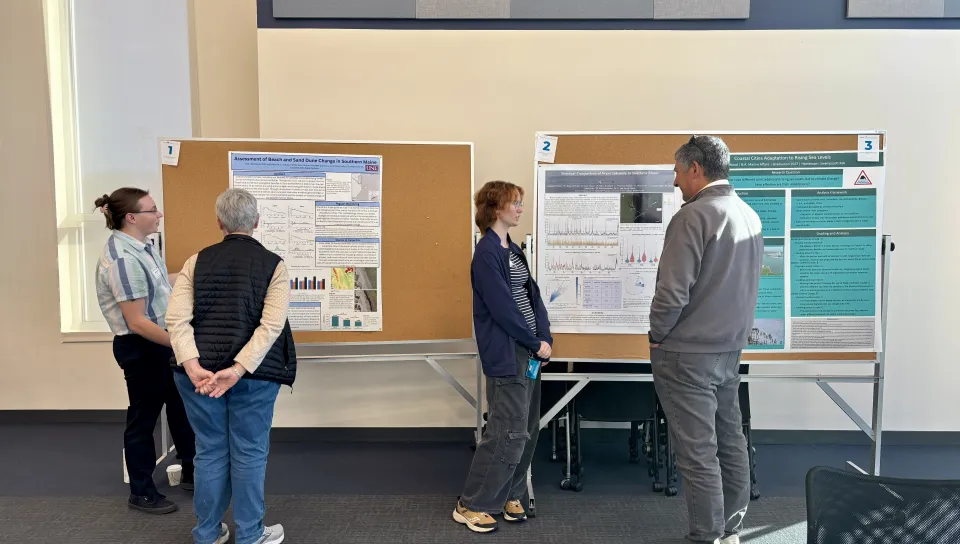
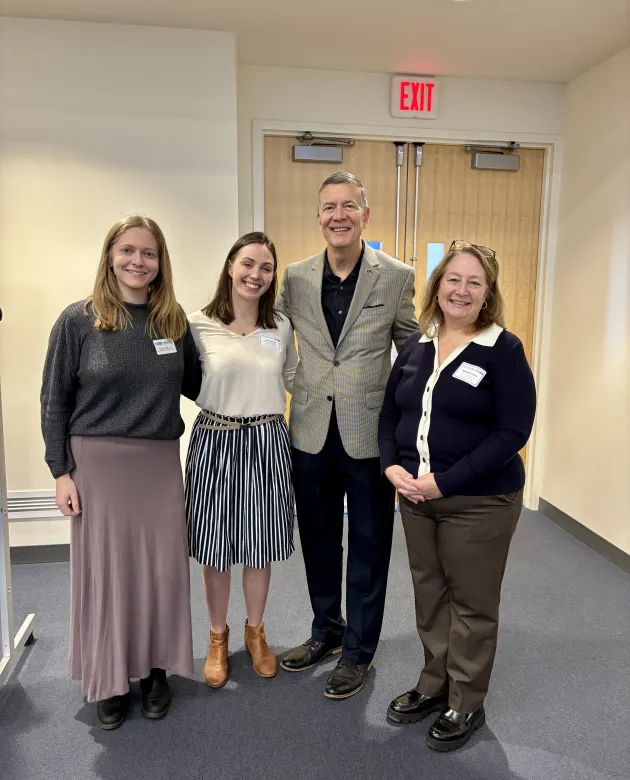
“It was interesting to come here and talk to people who live in these towns. But it also was interesting to talk to the two city planners who work at the towns where we monitor the beaches, to talk with them about the approach the towns are taking and how they view things, and what we’re seeing in the data,” Bombard said.
Kochtitzky, one of the event’s lead organizers who teaches in the UNE School of Marine and Environmental Programs, led a morning tour at nearby Biddeford Pool Beach in Biddeford to showcase that dune research, as well as the kind of community collaboration Herbert touched on in his welcome remarks.
Starting in 2025 and again in 2026, Kochtitzky explored with the Biddeford Pool Conservation Trust on the land trust’s coastal property different methods of dune planting to find more effective methods of building coastal resilience along the Maine coast.
“It is inspiring to see communities from across Southern Maine come together to tackle these challenges,” Kochtitzky said. “It is only through these partnerships that we will be able to thrive in a rapidly changing world.”