
Image

This website uses cookies to understand how you use the website and to improve your experience. By continuing to use the website, you accept the University of New England’s use of cookies and similar technologies. To learn more about our use of cookies and how to manage your browser cookie settings, please review our Privacy Notice.
The 12th edition of the University of New England’s President's Forum on Oct. 14 examined whether the current generation coming of age at this time in American history faces unique barriers compared with previous generations as they enter the workforce, seek to build wealth, purchase homes, and start families. Or, if it’s possible that they, too, can achieve the “American Dream.”
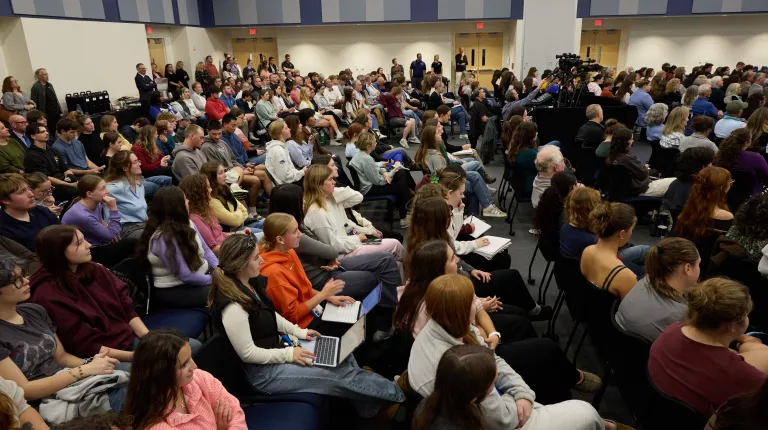
It proved a compelling subject that drew a crowd that swelled to more than 500 and spilled over into another conference room in UNE’s Harold Alfond Forum.
The President's Forum, created in 2018, aims to provide a venue for diverse perspectives on today’s most pressing issues. And while the previous 11 events in the President’s Forum series examined controversial topics chosen for their relevance to the University's student body, Wednesday’s panel discussion raised questions that are especially pertinent to the lives of UNE students today, said President James Herbert, who founded the forum.
Herbert noted in his welcome remarks that Gen Z, or those between the ages of 14 and 29 — which includes many UNE students today — has already been a generation defined by an onslaught of unprecedented challenges, such as a once-in-a-century pandemic, the rise of new technologies including Artificial Intelligence (AI), the extreme political polarization in the nation today, and the rapidly warming climate that’s resulted in extreme weather events, among other disruptions to American life.
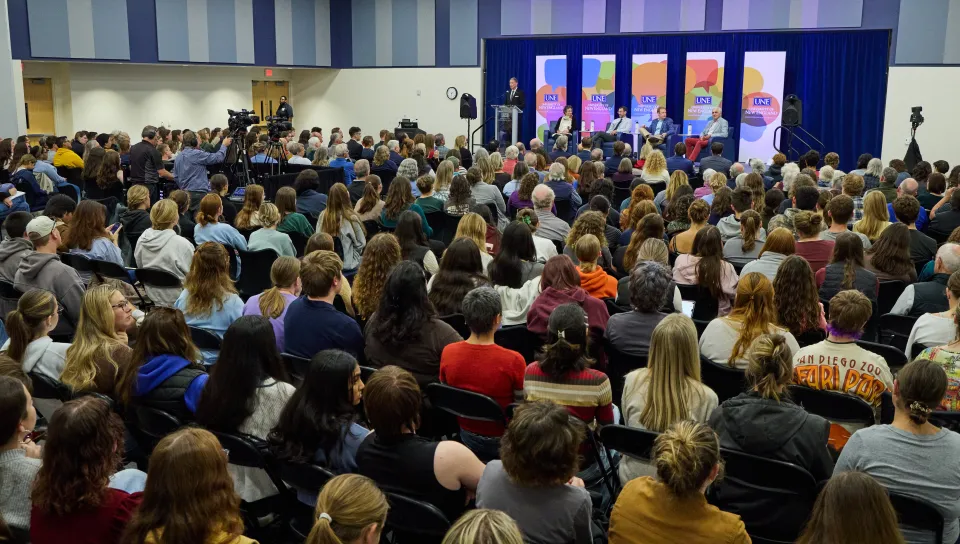

“We'll consider whether the power dynamics between today's older and younger Americans could use adjusting,” Herbert promised, “whether Zoomers are being impatient and expecting life's luxuries too soon, whether the media and social media, in particular, are creating unrealistic expectations for today's young people — whether this group even aspires to the same goals as their parents and grandparents, and, ultimately, what it will take for members of Gen Z to flourish.”
The three notable thought leaders who came to UNE to discuss the question “Can Gen Z Achieve the American Dream?” were up to the challenge as they vigorously debated the question for an hour and then continued through a lively half-hour question-and-answer segment.
The panel of distinguished scholars, moderated by Jeanne A.K. Hey, Ph.D., UNE dean emerita and CEO of Hey University, included Jeffrey Jensen Arnett, Ph.D., senior research scholar at Clark University; Jeremiah Johnson, M.S., co-founder of the Center for New Liberalism; and Samuel Moyn, Ph.D., Kent Professor of Law and History at Yale University.
Arnett, who has conducted research on those ages 18 to 29 for the past 30 years, argued that Gen Z are less concerned with material wealth than past generations and more interested in rewarding work, a career that helps the world in some way, and living somewhere interesting.
I'm not sure that most emerging adults today would say that the traditional ‘American Dream’ is their dream for their lives.” — Jeffrey Jensen Arnett, senior research scholar at Clark University
"I'm not sure that most emerging adults today would say that the traditional ‘American Dream’ is their dream for their lives,” Arnett said. “I think today's emerging adults are more idealistic than previous generations.”
Moyne stated openly that he came to the panel discussion to give Gen Z “some love” because, he said, younger people are facing fewer opportunities than they should because the wealth and political power in America is being “hoarded” by older generations.
“There are very few politicians at the federal level under 40, and that's by design, and it's because of the way we've structured our politics in an aging society that is just demographically older than any in American history,” Moyne said.
Moyne adding that Gen Z is also at an unfair disadvantage financially, noting that a recent study by The Federal Reserve found Americans over age 75 — in the four years between 2022 and now — saw their wealth increase almost 40%, whereas those under 35 saw it decrease almost 25%.
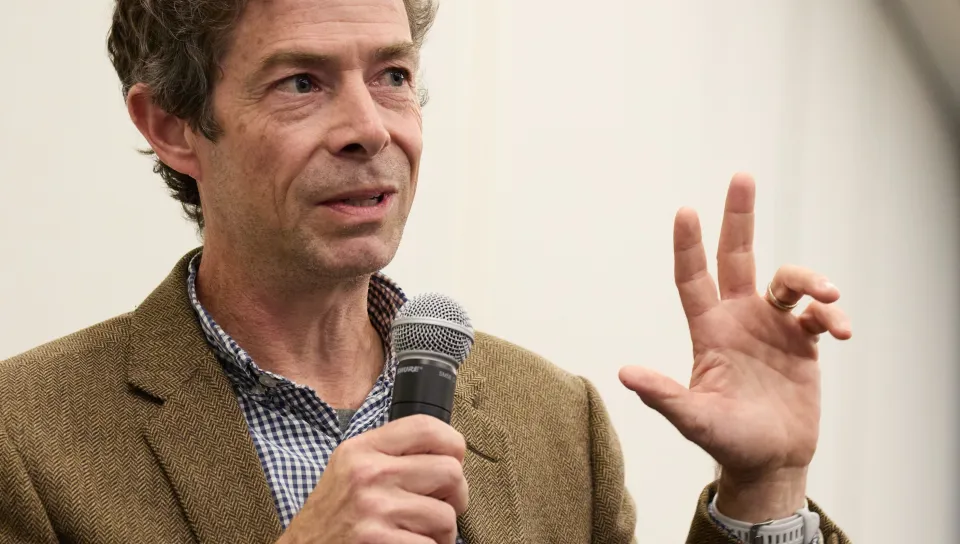

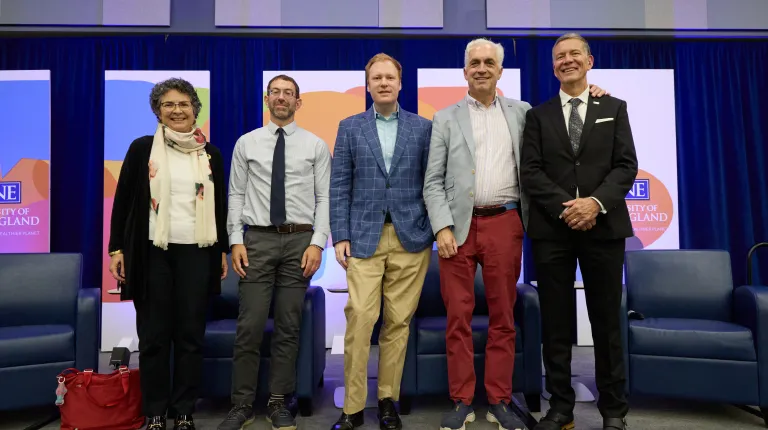
And Johnson — who gamely cast himself as the panel’s “villain” for the sake of inspiring a spirited debate — argued that members of Gen Z may, in fact, enjoy a higher quality of life and greater opportunities today than past generations. He explained that Gen Z is coming of age at a privileged time that is free of the gripping challenges of the past, such as the Great Recession or the Cold War-era threat of nuclear holocaust.
Johnson argued that every generation faces uncertainty and unique hardships, but the fact there are challenges doesn't negate the fact that success is possible.
To make his point, Johnson asked for the men in the audience between the ages of 19 to 26 to stand — and then for those whose first name began with the letters A through I to remain standing while the rest sat. To those left standing Johnson said: “Congratulations, you're all going to Vietnam now. You've just been drafted.
“This is something that previous generations had to deal with that Gen Z obviously does not,” Johnson explained. “I, as a millennial, did not. We've never faced a draft. But it's easy to forget that when you don't go through something that other generations did … And it's good to remember that kind of thing.”
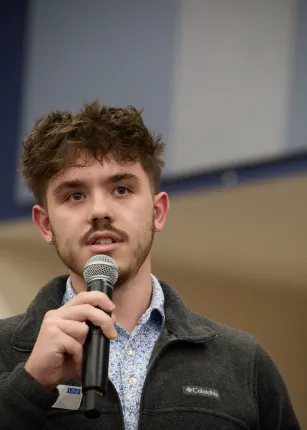
The respectful debate drew several questions from the audience, not only about the arguments the panelists made, but also about realities in American life today that they did not mention.
“As we think about living the American Dream in the next 30 years, it seems like you need to figure out how to do that and pay these huge unfunded liabilities that are all going to come due,” posed John Waterman, Ph.D., an associate professor of philosophy at UNE — and a past forum panelist.
“And it worries me that we're not going to be able to do it and that is going to become an obstacle to what (Gen Z) want to achieve. And we haven't really talked too much about that,” Waterman added.
Moyn, who recently published a book on the topic — “Gerontocracy in America: How the Old Hoard Power and Wealth — and What to Do About It” — agreed with Waterman whole heartedly, saying that today’s aging populations in America have left the biggest problems for the younger generations to fix.
“We're going to have big debates about this, like around Social Security, very quickly. And I firmly believe we should fund it better and fund all of our elder entitlements better, not to mention greater welfare for people of every age, especially children whom we neglect most in American society,” Moyn said. “I totally agree that someone's going to have to pay for it.”