
Image

This website uses cookies to understand how you use the website and to improve your experience. By continuing to use the website, you accept the University of New England’s use of cookies and similar technologies. To learn more about our use of cookies and how to manage your browser cookie settings, please review our Privacy Notice.
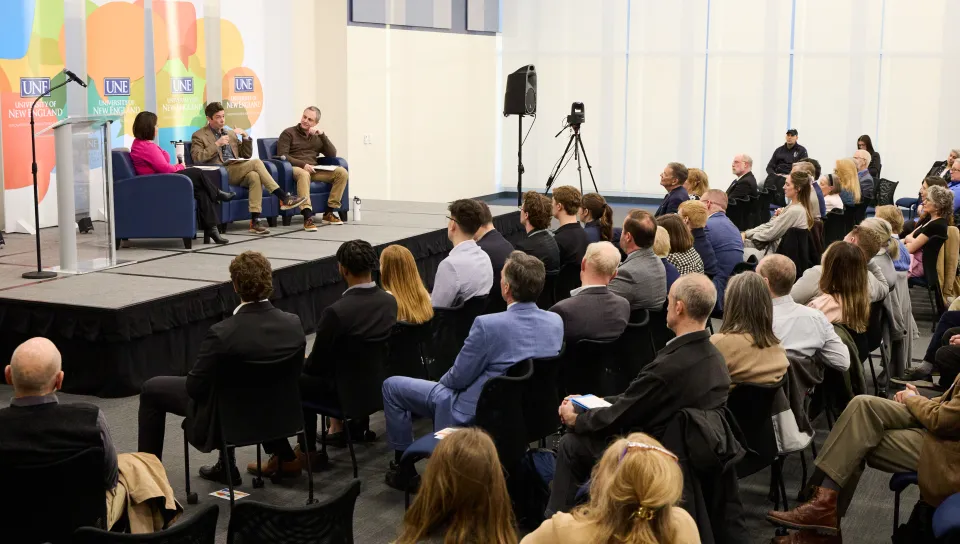
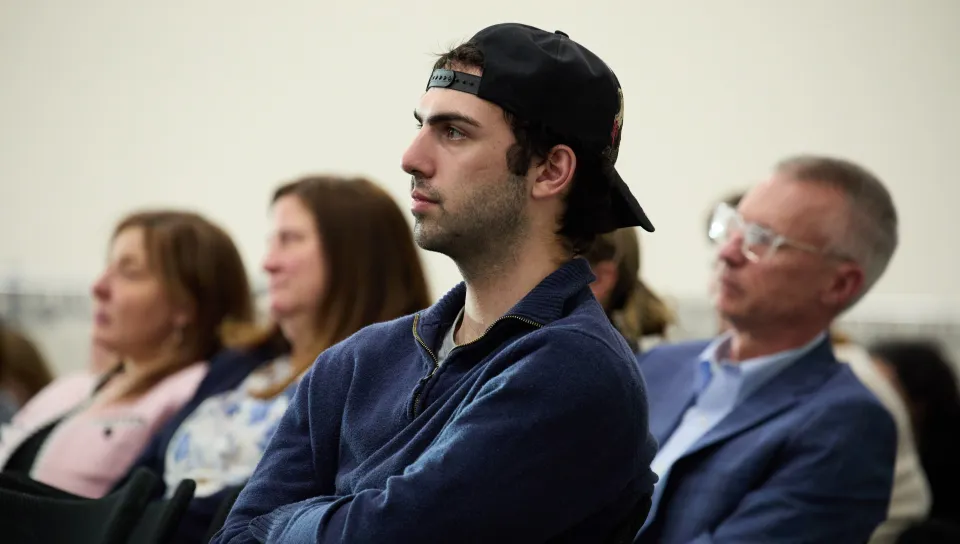
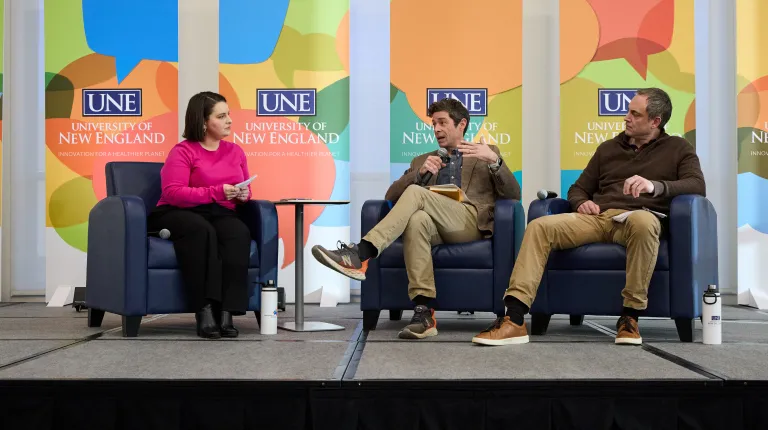
The University of New England hosted its bi-annual President's Forum Monday, April 6, at the Harold Alfond Forum in Biddeford bringing together faculty, staff, students, and members of the larger Biddeford community to examine how American higher education became a flashpoint in the nation's culture wars — and what it might take to reclaim its footing.
The discussion took place at a charged moment. Recent headlines have included a University of Oklahoma instructor losing her job following what many viewed as a premeditated grading dispute, a Texas A&M University professor being ordered to remove portions of a Plato text from his syllabus under a policy regarding race and gender instruction, and a string of prestigious institutions bowing to the Trump Administration’s demand over alleged infractions ranging from allowing antisemitism on campus to promoting programming around diversity, equity, and inclusion.
Against that backdrop, UNE looked to three of its own to explore how higher education became so deeply politicized and whether the current conservative pushback represents a necessary correction or an overcorrection.
Led by moderator Sarah Delage, UNE associate vice president of communications, Andrew Rotondo, Ph.D., and John Waterman, Ph.D., both associate teaching professors of philosophy in the School of Arts and Humanities, explored what universities must do to rise above the partisan fray and reclaim their standing as engines of opportunity and scientific advancement for the sake of the civic good.
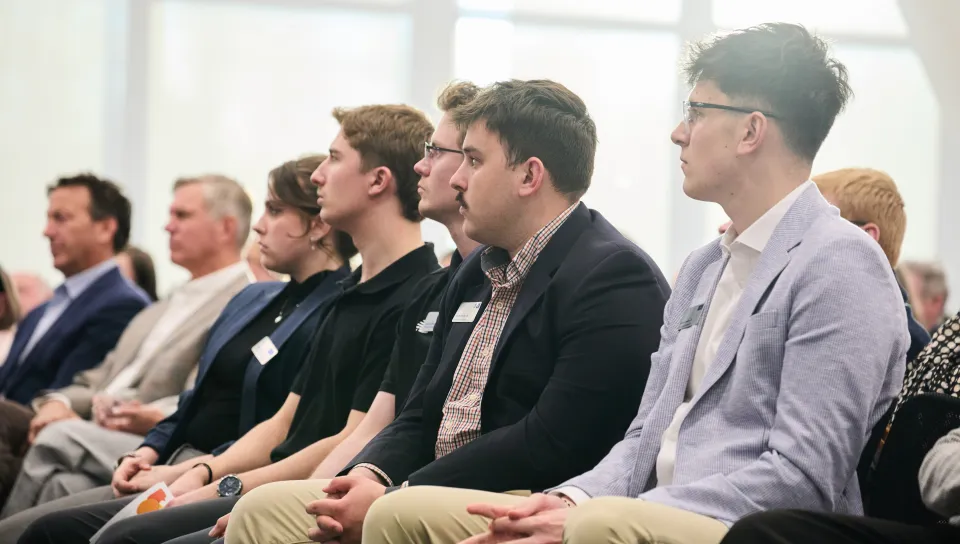
In his welcome remarks, UNE President James Herbert noted how lively, yet respectful discourse on polarizing topics occurs regularly at UNE through initiatives like the President's Forum, the University's signature community event that started eight years ago to help foster the marketplace-of-ideas environment UNE strives to embody.
"Like all of the topics we discuss in this series, this is one that elicits strong reactions on both sides. It's the kind of topic that some of us might be tempted to avoid for fear of saying the wrong thing,” Herbert said. “But here at UNE, we believe we can have these conversations, and, more than that, we believe we must have them to understand one another better and ultimately to work together to find solutions to the problems that currently divide us.”
With that, Rotondo and Waterman traded perspectives, frequently agreeing, and disagreeing, with mutual respect and even, at times, humor.
Waterman quipped that he was going to assign homework to the roughly 200 gathered and referred to George Orwell’s "Politics and the English Language” because, he said, it instructs us to “attend to language.” Right now, he said, citizens need to dissect the language coming from the current U.S. Administration.
If we really are seeking the truth, what we need to do is listen to them, try to understand them charitably, and collect those insights, collect those grains, collate them, and then form a more complete picture of reality.” — Andrew Rotondo, UNE associate teaching professor of philosophy
The administration’s "language of reform,” Waterman said, can be clearly seen in the April 2025 letter that was sent to Harvard University, which outlined the Trump Administration’s critique of the Academy.
“What you see in that letter are demands and coercion,” Waterman remarked. “It's not about the pursuit of truth anymore. It is about the most powerful institution in our lives trying to exert its influence over an institution that seeks the truth.”
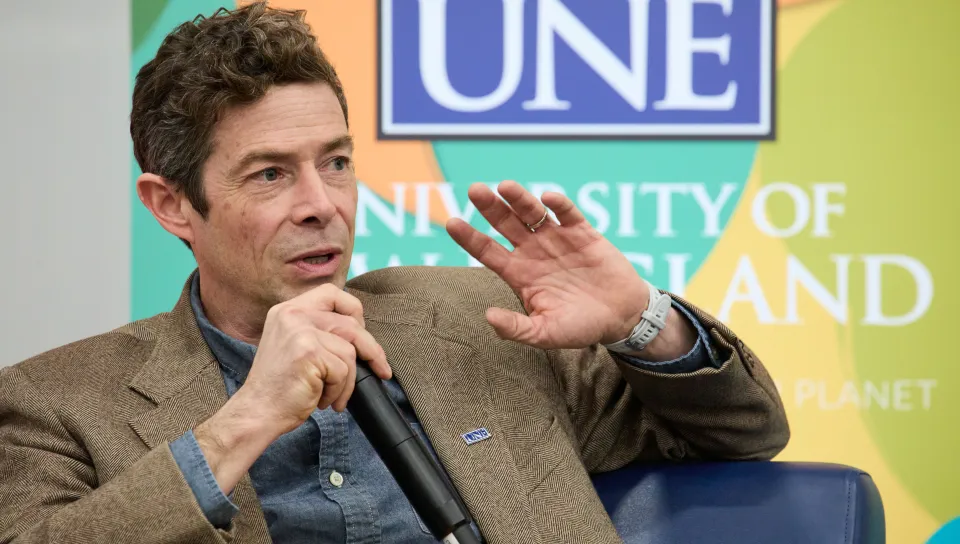
Rotondo agreed with much of what Waterman said, describing the Trump Administration's approach to fixing higher education heavy handed. But Rotondo also said “there is more to the story” and the Academy does need to foster genuine open inquiry and, perhaps, the government stepping in may ultimately lead to the reform needed to make the Academy a place with a more balanced mix of conservative, as well as progressive, viewpoints.
He pointed to philosopher John Stewart Mill, who famously wrote 150 years ago in “On Liberty” that we need to hear everything that can be said about an issue from all sides before we can truly get at the truth.
“One of the most compelling arguments Mill gives, I think, is when we're talking about complex social moral issues,” Rotondo said. “It's rare that one side has the complete truth. He says usually all sides have a partial truth, an insight, a grain of truth. And if we really are seeking the truth, what we need to do is listen to them, try to understand them charitably, and collect those insights, collect those grains, collate them, and then form a more complete picture of reality.”
Rotondo called this approach to seeking the truth a “noble mission.”
“And I think we need a little outside help to get that going right now,” he said.