Fall CGH Season Explores the Intersection of the Humanities and Sciences
The fall series marks the 18th year of the UNE Center for Global Humanities bringing thought-provoking lectures and films to the UNE community and the University’s neighbors across southern Maine
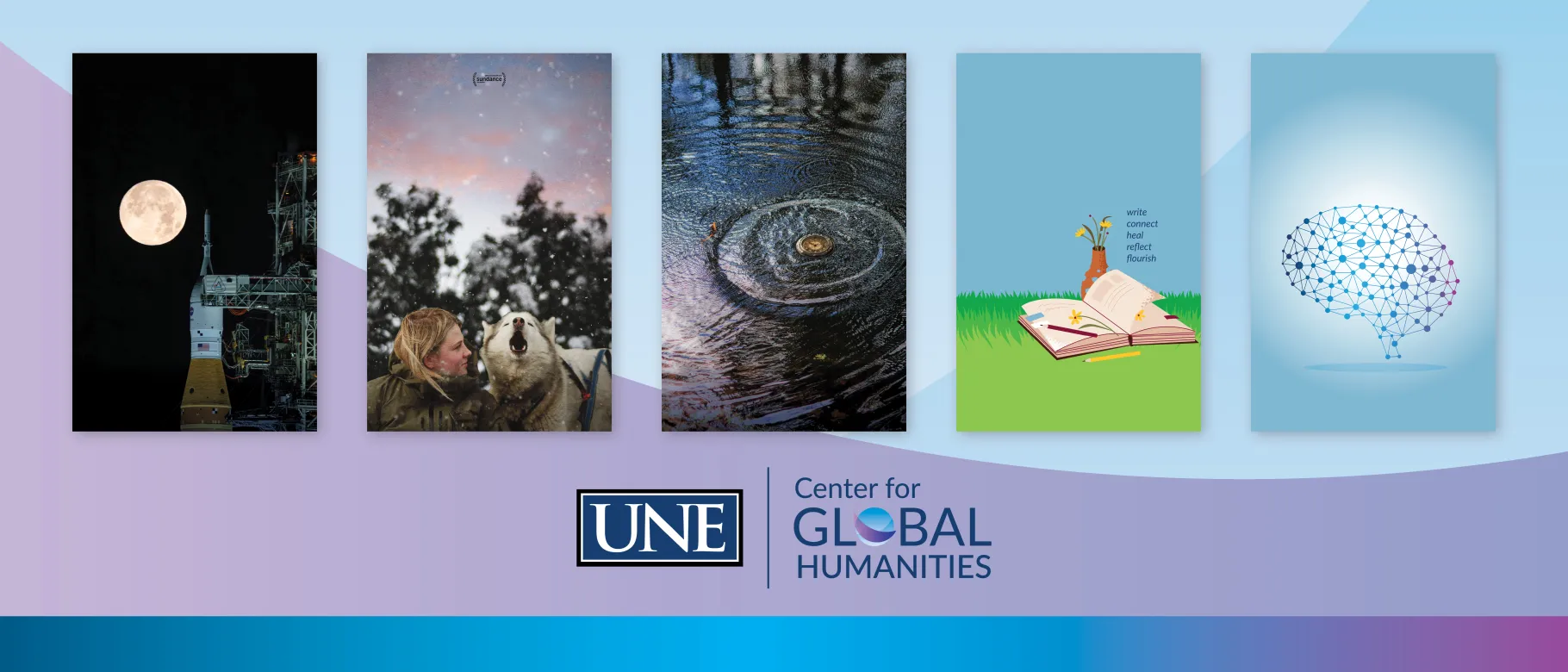
The Center for Global Humanities (CGH) at the University of New England will host five public events this fall that challenge attendees to consider such topics as the possibilities created by the recent Artemis moon mission; what Henry David Thoreau’s experiences at Walden Pond can teach us about how we perceive time; the inner workings of the human brain where memories form, change, and sometime disappear; and more.
The fall series marks the 18th year of the Center bringing thought-provoking lectures and films to members of the UNE community and the University’s neighbors across southern Maine. The new series includes three lectures and a film on the Portland Campus for the Health Sciences and a special daytime lecture on the Biddeford Campus.
“The fall season primarily explores the intersection of the sciences and humanities,” explained CGH Director Josh Pahigian, M.F.A. “We have so many students flourishing in our health professions and science programs, as well as in our humanities programs, and the series is designed to appeal to students across UNE’s colleges and programs.”
The season kicks off with a visit from Georgetown University environmental historian Dagomar Degroot, Ph.D., who will present The History and Future of the Moon on Sept. 28. As Degroot will detail, the moon has always piqued human imagination and pioneering spirit, and now new advances in technology promise to herald what some are calling a Lunar Anthropocene. With the Artemis mission earlier this year reminding us of what we’re capable of as a species, Degroot’s talk will illuminate the rich history of human fascination with and exploration of the moon, while also painting a picture of what the future may hold.
Next, the Center’s fall screening of the documentary Folktales on Oct. 19 will explore the story of a group of teenagers exhausted by loneliness and social anxiety who leave the comfort of their homes to enroll in a traditional “folk high school” in the wilds of northernmost Norway. Relying only on themselves and a pack of sled dogs, the students step from childhood to adulthood and emerge stronger from the experience.
The fall’s Biddeford Campus matinee will bring to campus scholar Kristen Case, Ph.D., fresh off her starring role in the recent Ken Burns documentary Henry David Thoreau that aired nationwide on PBS this spring. Case, who directs the Monson Seminar, a three-week artist-in-residency program for college students pursuing creative and research-based projects, will present Thoreau’s Sense of Time at 1 p.m. on Oct. 28 on the Biddeford Campus, a talk that explores Thoreau’s engagement with time as an environmental, personal, and political dimension of experience.
While Thoreau is often celebrated for his environmental imagination, Case’s talk focuses on his temporal imagination — his effort to resist the thin, linear time of industrial capitalism and reclaim a richer, cyclical sense of time rooted in the natural world.
The Nov. 16 CGH event will bring Carolyn Roy-Bornstein, M.D., to the Portland Campus for the Health Sciences to present The Power of Narrative in an Uncertain World. The session will follow an interactive narrative-medicine style format with Roy-Bornstein speaking for about 30 minutes and then leading attendees through a series of exercises designed to exemplify how reflective writing can help us find clarity and self-understanding amidst the daily challenges of today. The first 75 attendees will receive a complimentary copy of the speaker’s award-winning 2026 book “A Prescription for Burnout,” as well as other free gifts, thanks to a partnership between CGH, Roy-Bornstein, and the Johns Hopkins University Press.
The final event of the fall will bring Boston University neuroscientist Steve Ramirez to the Portland Campus on Dec. 7 to present How to Change a Memory, a talk that focuses on Ramirez’s groundbreaking research on how to strengthen, weaken, erase, and, in some cases, even create memories that never actually happened. Along the way, Ramirez will ask some of the deeper questions this science forces us to confront, such as: If we could erase a traumatic memory, would we want to? Would doing so change who we are, or free us to become who we want to be? And, if we gain the power to control memory, how should we use it responsibly?
As always, CGH events are free and open to the public. For full details on times, locations, and speakers, visit the Center for Global Humanities website.