
Karen Houseknecht outlines UNE’s impact on Maine’s innovation landscape to statewide industry audience
As BioME Conference celebrates industry successes in Maine, keynote panelist Karen Houseknecht, Ph.D., vice president of Research and Innovation at UNE, highlights notable advances at the University
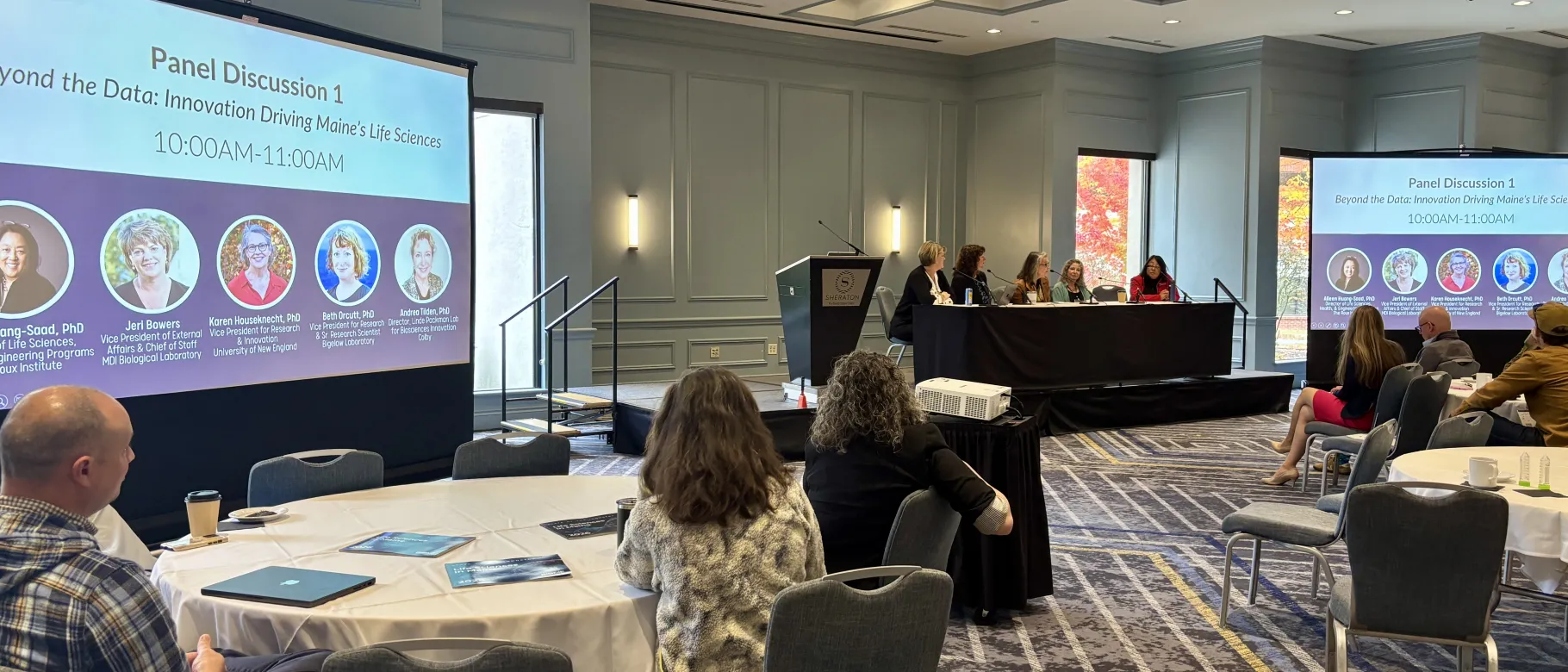
The Bioscience Association of Maine (BioME) 2026 Conference in South Portland on Wednesday, Oct. 14, opened with a new report on the impact of the life science sector in Maine: A reported 8,345 jobs across 651 businesses now contribute upward of $2.3 billion to the state’s economy.
And the University of New England is situated squarely at the heart of this emerging economic engine in the easternmost state in the nation, as indicated by UNE’s numerous contributions detailed by Karen Houseknecht, Ph.D., vice president for Research and Innovation at UNE, who sat on the BioME Conference keynote panel.
The annual gathering filled a conference room at the Sheraton Sable Oaks in South Portland, with nearly 300 industry leaders from the corporate and private industry sectors in attendance, but all sectors were represented at the conference that focused on business development and industry partners.
According to BioME’s most recent data, 16 Maine colleges and universities in 2024 awarded 999 life science degrees — the most in the past decade and a 44% increase from 10 years earlier.
But, in his welcome remarks Jim Damicis, senior vice president of the Camoin Associates, a consulting firm that helps organizations and sectors achieve sustainable growth, said while these numbers are promising: “We need to keep filling the pipeline."
In the panel discussion titled “Beyond the Data: Innovation Driving Maine’s Life Sciences,” Houseknecht joined prominent thought leaders Aileen Huang-Saad, Ph.D., director of life sciences, health, and engineering Programs at Northeastern University’s Roux Institute; Beth Orcutt, Ph.D., vice president for research and senior research scientist at the Bigelow Laboratory for Ocean Sciences; and Andrea Tilden, Ph.D., director of the Linde Packman Lab for Biosciences Innovation at Colby College.
Together they discussed how their respective institutions have found ways to collaborate, innovate, and include students in meaningful research.
When moderator Jerilyn Bowers, the vice president of external affairs and the chief of staff for the MDI Biological Laboratory, asked the panelists "What does innovation look like at your institutions right now?" Houseknecht highlighted three areas of strategic investments that UNE has made to build UNE's innovation ecosystem.
At UNE, innovation is connecting excellent science with excellent education and real-world impact while engaging students, especially undergraduate students, every step of the way." — Karen Houseknecht, Ph.D., vice president for Research and Innovation
Houseknecht pointed out that, "at UNE, innovation is connecting excellent science with excellent education and real-world impact while engaging students — especially undergraduate students — every step of the way."
Specifically, she said, UNE has built a “discovery engine” through the University’s two National Institute of Health (NIH)-funded Centers of Biomedical Research Excellence (COBREs), which allow UNE to build research infrastructure and, with that, provide greater research capacity.
“These are large research infrastructure building grants from the federal government that, along with institutional match from UNE, represent a long-term investment in research and discovery,” Houseknecht said. “These intentional investments allow us to build core facilities, recruit faculty and professional staff through targeted recruiting, and … create real, meaningful research opportunities for students — all the way from high school students to graduate students.”
She noted that a perfect example of this discovery approach was detailed in a feature story in the BioME report about Eva Balog, Ph.D., a UNE professor of chemistry and member of the UNE’s Center for Cell Signaling Research, the second COBRE awarded to UNE, who has partnered with Maine-based Marin Skincare on a research project to advance Marin's R&D portfolio using marine glycoprotein derived from lobsters.
“And Dr. Balog has undergraduate and graduate students involved in all aspects of her research program,” Houseknecht said.
The second area of investment has been in the UNE Center for Innovation and Entrepreneurship, which focuses on providing students meaningful opportunities to learn how to address problems facing our communities. Houseknecht pointed to the center’s formation of student partnerships with founders, businesses, and nonprofits to solve problems through its Shaw Innovation Fellows program, which provides paid opportunities for students to immerse themselves in using entrepreneurial strategies to address persistent planetary health challenges.
Finally, she highlighted UNE’s newly launched Center for Emerging Technologies, which is focused on providing all UNE students, regardless of major, experience working with emerging technologies, such as AI, the ability to critically assess the risks and benefits of emerging technologies, and the skills to apply technology in their work.
The panel’s moderator, Jerilyn Bowers, vice president of external affairs and the chief of staff for the MDI Biological Laboratory, noted how, in a small state like Maine — with just 1.3 million people — collaboration between institutions and organizations is vital for a sector to grow. Given that, she asked the panelists what they’ve done to help facilitate meaningful interactions between partners.
Houseknecht shared that collaboration is critical to addressing sustainability of the important research and innovation infrastructure at institutions throughout Maine and shared a recent example of how she collaborated with the MaineHealth Institute for Research to co-host a research core sustainability retreat, where researchers from the two institutions considered how, together, their research cores could become more sustainable by sharing best business practices including diversifying and increasing their revenue streams, particularly at a time when federal funding hangs in the balance.
Houseknecht said that retreat prompted discussions on ways to facilitate more collaboration and idea sharing. She also invited the audience to visit a conference display about UNE’s core facilities to learn more about how the University’s facilities can enable the research and innovation activities of businesses and organizations attending the conference.
“At UNE we're very much focused on bringing in external clients like all of you to our core facilities,” she said. “And working together to explore how we can sustain the important R&D infrastructure in Maine has never been more important. We'd like to extend that conversation more broadly.”

Karen Houseknecht, Ph.D., vice president for Research and Innovation at UNE, sat on the BioME keynote panel.