
UNE’s Eva Rose Balog receives nearly $2 million NIH award to advance protein research
The five-year grant supports research into cell signaling, wound healing, and pain while marking a milestone for UNE’s Center for Cell Signaling Research
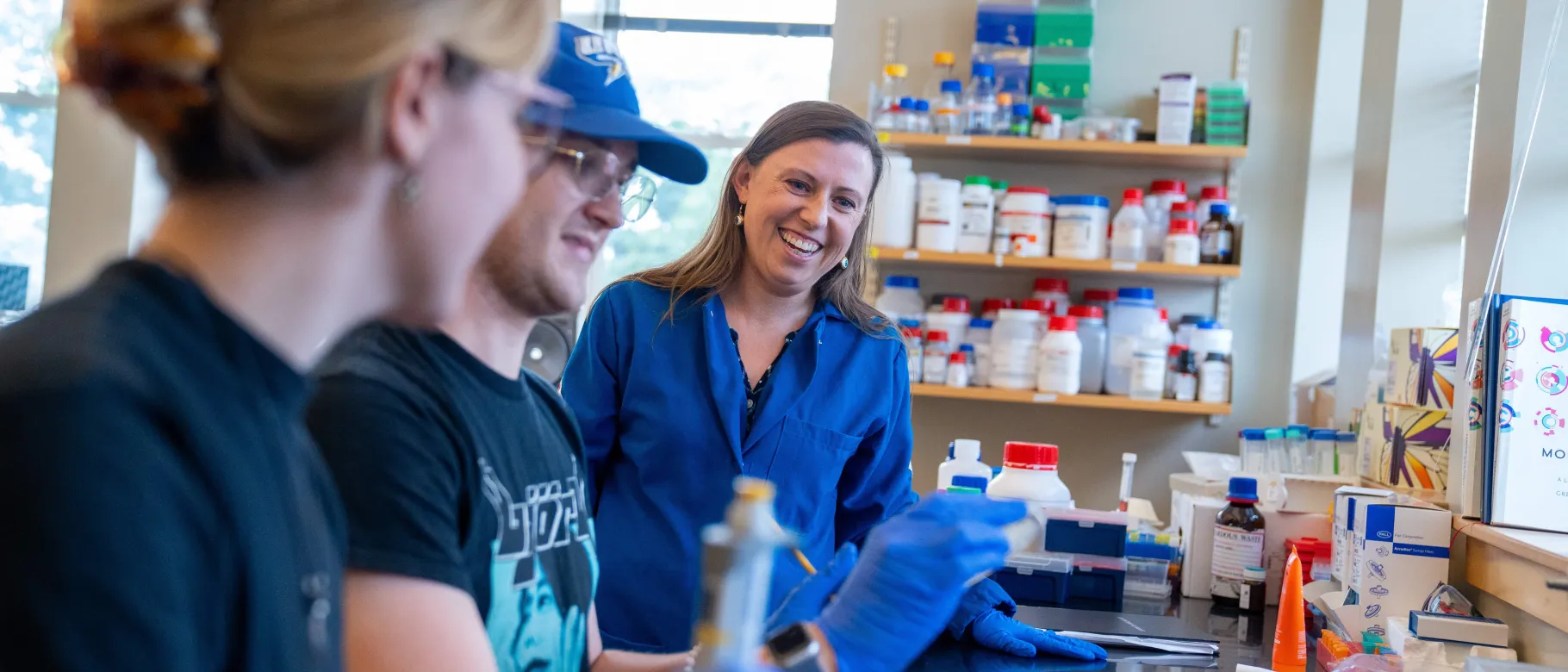
The University of New England’s Eva Rose Balog, Ph.D., has received a five-year, nearly $2 million award from the National Institutes of Health to advance research into how engineered proteins influence cellular communication, work that could help inform new approaches to wound healing, pain relief, and protection against kidney injury.
Balog, a professor of chemistry in UNE’s College of Arts and Sciences, received the Maximizing Investigators’ Research Award, or MIRA, from the National Institute of General Medical Sciences, a division of the NIH, for her project “Probing Cell Signaling Complexity in Wound Healing with Engineered Protein Materials.” The MIRA award provides sustained, flexible support to pursue promising discoveries as her research develops.
The award also marks a milestone for UNE’s Center for Cell Signaling Research, an NIH-funded Center of Biomedical Research Excellence (COBRE), with Balog as the center’s first project leader to secure independent NIH research funding of this magnitude.
“This award reflects confidence in our ideas and in UNE’s ability to bring them to life,” said Balog, a noted biochemist who maintains an experimental biochemistry lab on UNE’s Portland Campus for the Health Sciences. “The mentorship, collaboration, and research support I have received here have made it possible to ask more ambitious questions. Now we have the stability and flexibility to follow those questions toward discoveries that could make a meaningful difference in human health.”
Balog’s laboratory employs biophysical techniques to design proteins and study how cells communicate with their surroundings and one another. By systematically changing the proteins’ properties, her team aims to better understand the signaling processes that govern healing, pain, and tissue damage.
Promising preliminary results from animal models of post-surgical pain show that an engineered protein developed by Balog’s laboratory reduced pain and accelerated healing; in another model, the same protein protected small kidney blood vessels from injury.
Those findings will guide further study of how the protein interacts with receptors, which receive signals and trigger cellular responses. Although the work remains at the laboratory stage, understanding those interactions could help researchers develop materials with therapeutic applications, Balog said.
A patent application for the protein polymer is pending.
RELATED: Small Steps, Big Impact
Learn more about UNE’s advancements in biotechnology and commercialization in the UNE Magazine, featuring Balog’s research on protein manufacturing and other novel research. Read more
Balog is the first UNE faculty member to receive an R35 award from the NIH. Unlike grants tied to a narrowly defined project, these grants (such as MIRA) support an investigator’s broader research program, allowing scientists to follow emerging questions and adapt their approaches as new evidence becomes available.
“The virtue of this kind of grant is that it allows you to follow where the science takes you,” Balog said.
UNE established the Center for Cell Signaling Research in 2024 with a five-year, $10.8 million NIH award to study cellular communication in aging and disease. Its funding, mentorship, and shared scientific resources help investigators build research programs and secure independent support.
Through the COBRE program, Balog gained access to specialized research facilities and support for a postdoctoral researcher who expanded her laboratory’s capabilities. Those resources helped her team generate the preliminary findings underlying the MIRA award.
Derek Molliver, Ph.D., who leads the center and serves as Balog’s mentor through the program, said her achievement demonstrates the value of UNE’s collaborative research community.
“We all review and discuss each other’s grants and manuscripts for publication. We support each other,” Molliver said. “It’s great to see Eva’s success as our first project leader in the CCSR to get independent NIH funding.”
RELATED: The Faces behind UNE’s Center for Cell Signaling Research
Meet the faculty exploring how cellular communication influences disease and how their work is paving the way for new treatments to some of the most pervasive health issues of our time. Read more
Shared research infrastructure, including the Portland Laboratory for Biotechnology and Health Sciences, supports that work while expanding opportunities for collaboration and hands-on training in Maine’s life sciences sector.
As Maine’s top educator of health care professionals, UNE connects its research enterprise with a broad commitment to improving health and preparing the workforce needed to serve the state. Its growing focus on biotechnology extends that mission by connecting fundamental discoveries with the development of tools and materials that could improve patient care.
UNE is the only college or university in Maine with two NIH-funded COBRE centers, including the Center for Cell Signaling Research; the Center for Pain Research, established in 2012, is dedicated to increasing the scientific understanding and treatment of chronic pain.
The University has also for years been the largest academic recipient of NIH funding in Maine. UNE maintained that status through fiscal year 2025, with the NIH awarding the University over $8.8 million in research funds that year.
Undergraduates have long contributed to Balog’s laboratory, including as lead authors of published research. Their involvement, Balog said, reflects UNE’s commitment to preparing students with the technical skills, curiosity, and experience needed for research and biotechnology careers.
“At UNE, students can see that meaningful scientific discovery is something they can contribute to themselves,” Balog said. “We are building a community where mentorship and collaboration give people the confidence and skills to pursue their ideas. That is how we prepare the next generation of scientists and innovators while advancing research that can improve lives.”