
Image

This website uses cookies to understand how you use the website and to improve your experience. By continuing to use the website, you accept the University of New England’s use of cookies and similar technologies. To learn more about our use of cookies and how to manage your browser cookie settings, please review our Privacy Notice.
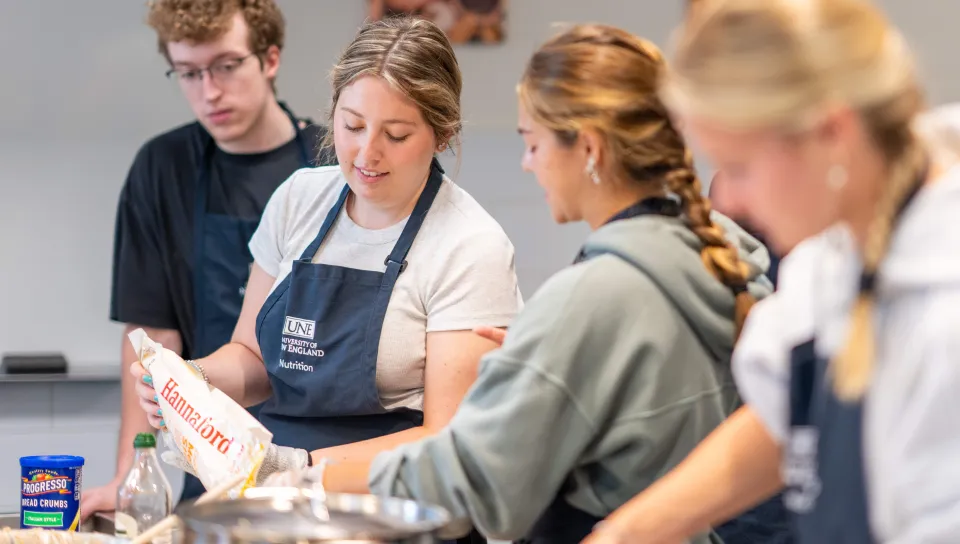
University of New England students transformed simple meal kits into nutritious, appealing recipes on Tuesday, using UNE’s Biddeford Campus Teaching Kitchen to explore how creativity, nutrition, and service can help Maine families experiencing food insecurity.
UNE hosted Don Morrison, operations manager for Wayside Food Programs, for the Sept. 8 culinary demonstration in its Biddeford Campus Teaching Kitchen, giving students a practical way to examine how food distributed through pantries can be extended, adapted, and transformed into balanced meals.
The event served as a hands-on introduction to Meals for Maine, UNE’s annual service initiative that will bring together more than 500 volunteers across the University’s Biddeford and Portland campuses on Wednesday, Sept. 16, to assemble 200,000 meals for distribution across all 16 Maine counties.


At left: Don Morrison, operations manager for Wayside Food Programs
During the demonstration, Morrison prepared two recipes using the same red beans and rice kits that will be assembled through Meals for Maine, combining them with ingredients commonly available through food pantries. Students then broke into teams to apply what they learned by creating their own dishes from the meal kit and a selection of pantry staples.
Recipes developed through the exercise will be shared with food pantries and included with Meals for Maine distributions, extending the classroom activity into a useful resource for recipients.
The session gave students a practical look at food insecurity in Maine and the considerations that shape how hunger-relief organizations select, distribute, and help recipients use available ingredients. Ashley Clark (’27), a medical biology major on the pre-physician assistant track, said the exercise showed how UNE students can connect health-focused learning with practical approaches to nutrition and food access.
“I think it definitely opened my eyes to how you can be creative in the kitchen setting, especially when you’re given very limited options,” Clark said. “If you have one, two, or three healthy ingredients, it’s really easy to throw them together in any capacity and still maintain a balanced diet and have good food to eat."


Bottom row, right: Trisha Mason, M.A., director of Service Learning at UNE
Through the activity, students also gained a closer look at the systems connecting donated and distributed food with the people who rely on it, including the role organizations such as Wayside Food Programs play in reducing waste, fighting hunger, and strengthening community through food recovery and distribution.
Clark said learning from Morrison made the exercise more engaging because he could explain how hunger-relief programs operate beyond campus and how ingredients move through the distribution process.
“I learned a lot more about the process and this program, which I didn’t even know existed,” she said. “It was really valuable to hear about how they operate and how food actually gets from Point A into people’s pantries.”
At Wayside Food Programs, Morrison’s work spans recipe development, food procurement, distribution, and daily operations, giving students a direct view of how hunger-relief organizations recover, prepare, and distribute food that might otherwise be discarded.
By bringing that experience into UNE’s Teaching Kitchen, the demonstration connected classroom learning with the practical realities facing food pantries and the people they serve.
Trisha Mason, M.A., director of Service Learning at UNE, who spearheaded the event, said the event reflects the purpose of service-learning by pairing academic knowledge with the expertise of community organizations addressing complex needs firsthand.
“This is exactly the kind of experience service learning is meant to create,” Mason said. “Students are not only contributing to a statewide meal-packing effort; they are learning from community partners, thinking critically about the needs behind that work, and creating resources that can make the meals more useful for the people who receive them.”

At right: Morrison and Ashley Clark (’27) with Meals for Maine food security kits
The exercise extended Meals for Maine beyond meal assembly by helping students consider how nutrition, access, and individual circumstances affect whether recipients can make full use of the food they receive.
"Watching students take basic food pantry staples and transform them into nutritious meals with minimal guidance by me was incredible. Without any professional or formal cooking background, the students relied entirely on their own creativity and resourcefulness-creating meals that were not only nutritious, but delicious,” Morrison reflected. “I was amazed and impressed by their level of creativity. I hope the students had as much fun as I did.”
Launched in 2023, Meals for Maine has grown from an inaugural UNE effort that assembled 50,000 meals into a statewide service initiative. This year’s 200,000 meals will be distributed to communities in every Maine county with support from the Maine Masonic Charitable Foundation, bringing the initiative’s cumulative impact to more than 550,000 meals since 2023.
UNE’s Sept. 16 Meals for Maine event will take place from 11 a.m. to 1 p.m. in the Campus Center Gymnasium on the Biddeford Campus and from 5 to 8 p.m. in Arthur P. Girard Innovation Hall on UNE’s Portland Campus for the Health Sciences.
View coverage of the culinary demonstration and learn more about UNE’s 2026 Meals for Maine programming at NEWS CENTER Maine