
Image

This website uses cookies to understand how you use the website and to improve your experience. By continuing to use the website, you accept the University of New England’s use of cookies and similar technologies. To learn more about our use of cookies and how to manage your browser cookie settings, please review our Privacy Notice.
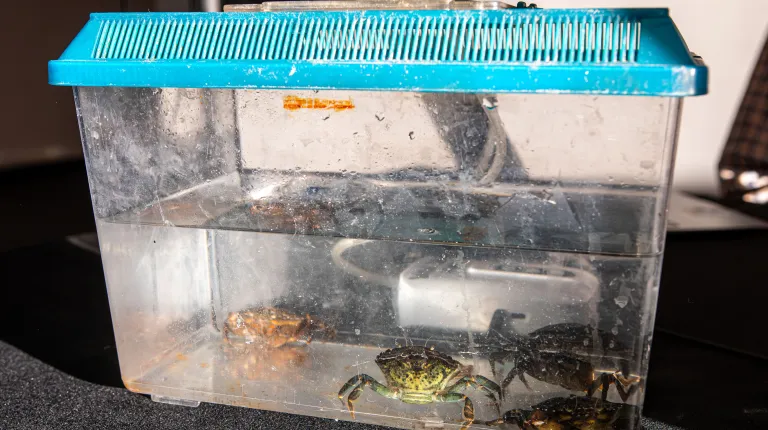
From transforming invasive green crabs into a marketable seafood product to developing alternatives to petroleum-based plastics, Maine entrepreneurs are finding new ways to turn challenges facing the state’s marine industries into business opportunities.
Those innovations, and the entrepreneurial thinking required to bring them to market, were the focus of the University of New England College of Business’ latest SPARK Series event, “The Business of the Blue Economy,” held Oct. 7 on UNE’s Biddeford Campus.
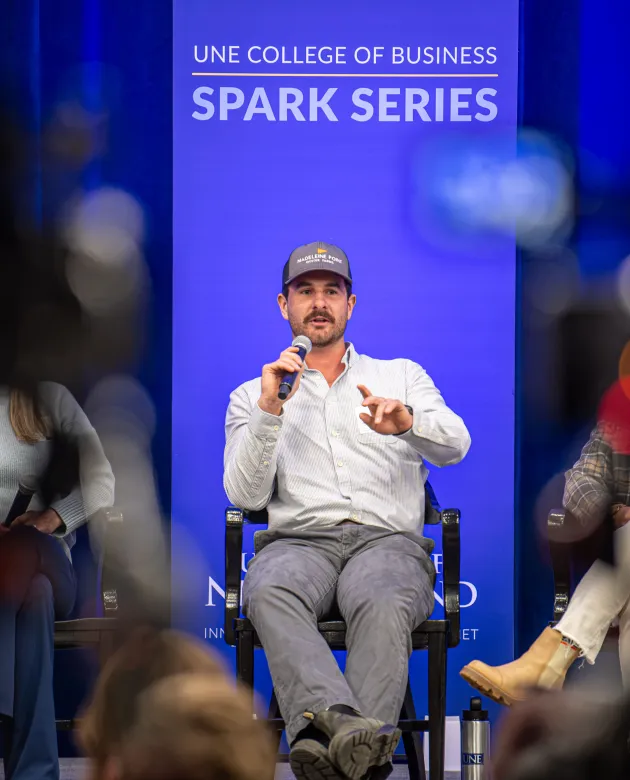
The discussion brought together four entrepreneurs working at the intersection of marine science, sustainability, and business to share their experiences building companies, navigating uncertainty, and identifying opportunities within Maine’s growing ocean economy. The event also highlighted how UNE is preparing students to contribute to that economy through interdisciplinary education, industry partnerships, and hands-on professional experiences.
“At the College of Business, we are investing directly in preparing students to participate and lead the future of Maine’s blue economy,” said Amir Mousavian, Ph.D., acting dean of the College of Business, in opening remarks.
“That connection between the classroom and the real world is central to who we are as a College of Business,” Mousavian continued. “We want our students to learn from entrepreneurs, work with industry partners, ask difficult questions, develop ideas, and ultimately have the confidence and the skills to turn those ideas into action.”
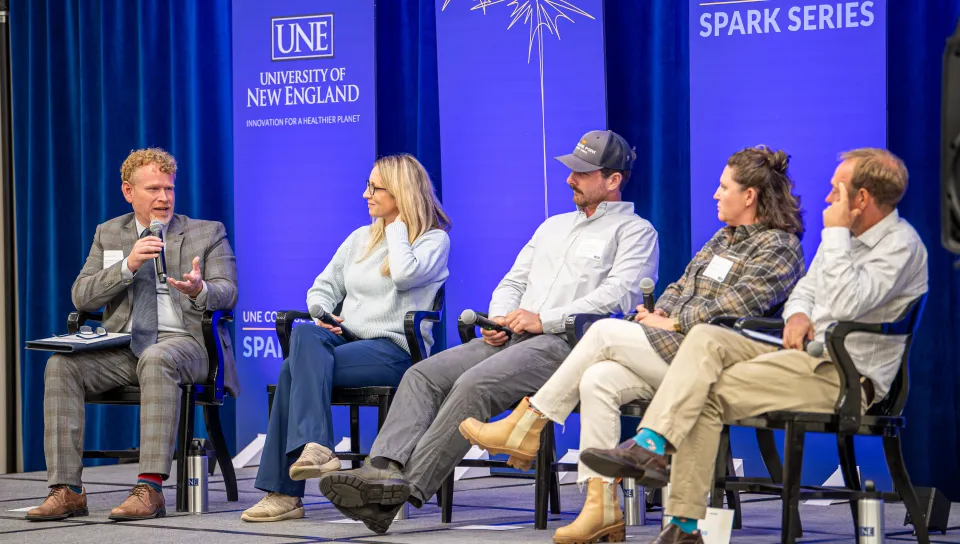
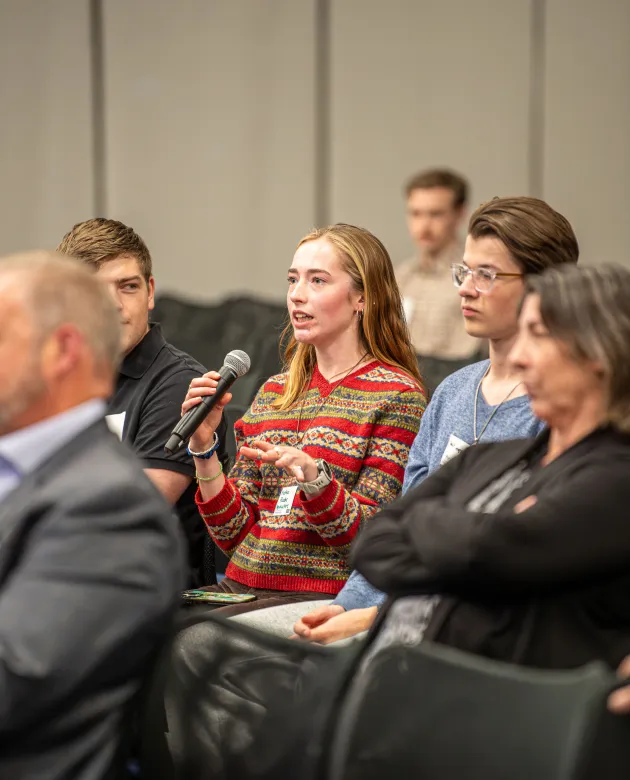
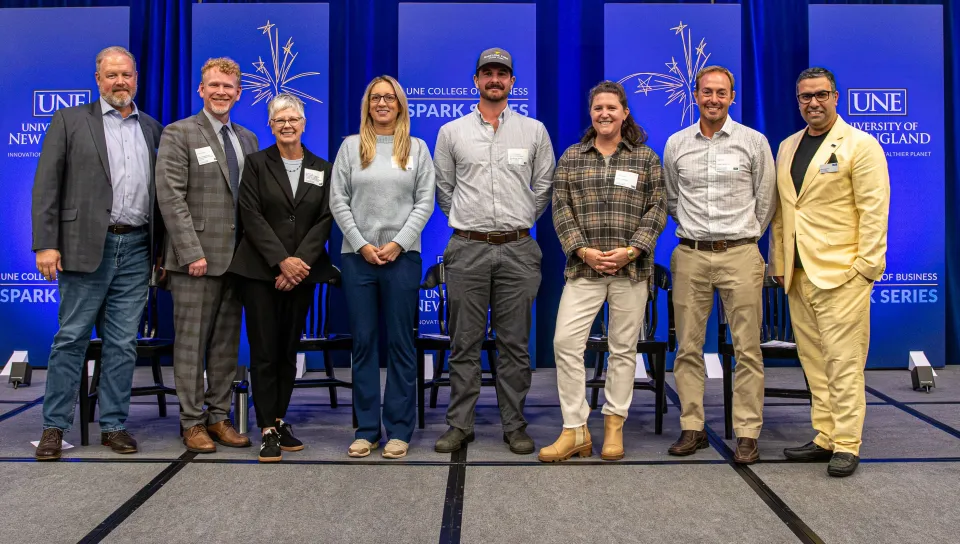
The event featured Nate Henninger, founder of Sea Farm Solutions LLC and farm manager at Madeleine Point Oyster Farms; Krista Rosen, CEO and co-founder of Atlantic Blue Biotech; Katie Weiler, founder and CEO of Viable Gear; and Mike Masi, founder of Shell+Claw. Jeremy Pare, L.P.D., M.S., director of UNE’s Marine Entrepreneurship and Sustainability in Business programs, moderated the conversation.
Together, the panelists offered perspectives on an economic sector that generates an estimated $6.8 billion in economic activity and supports more than 90,000 jobs in Maine.
Despite their different industries, the entrepreneurs shared several common lessons: Successful businesses require adaptability, persistence, collaboration, and a willingness to experiment even when outcomes are uncertain.
Panelists spoke candidly about the challenges of growing their businesses, from production setbacks and unsuccessful experiments to difficulties securing capital and building markets for unfamiliar products. Rather than viewing these experiences simply as failures, they emphasized the importance of learning from setbacks, refining strategies, and applying those lessons to future decisions.
Their experiences also demonstrated how entrepreneurship can benefit from partnerships between businesses and universities, particularly when companies need research support, new ideas, and access to specialized resources.
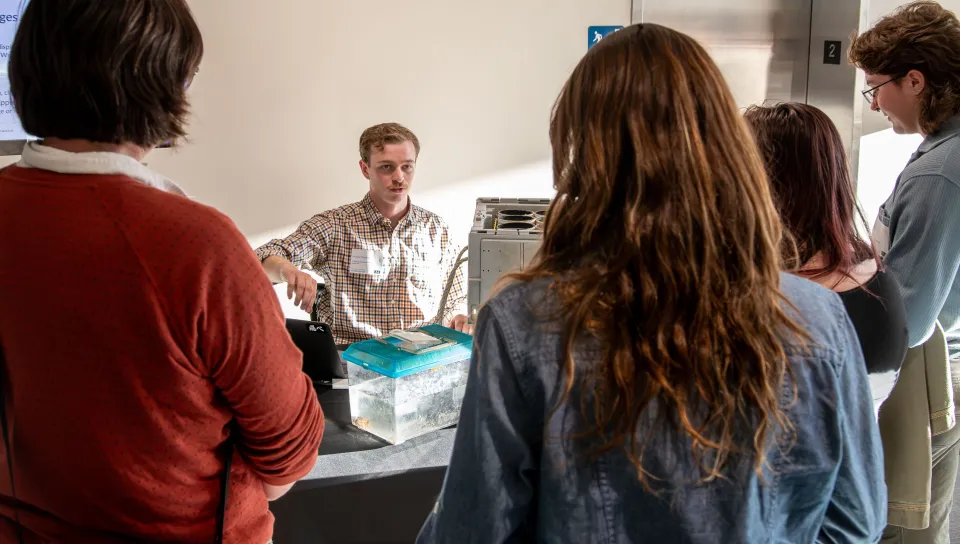
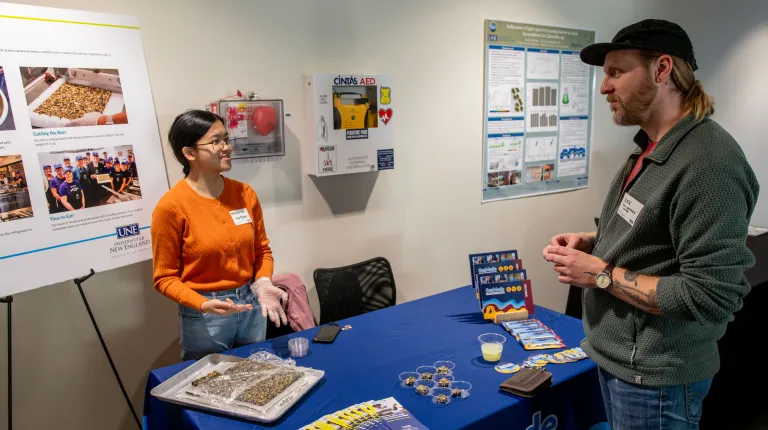
For UNE students, those partnerships are already creating opportunities to contribute to emerging industries.
Masi highlighted his collaboration with UNE marine sciences student Jackson Martine (’27), who spent the summer working with Shell+Claw through the University’s Summer Sustainability Fellowship.
Martine helped conduct experiments evaluating green crab storage methods and molting success to determine how the labor-intensive operation might become more efficient and commercially sustainable. Now a Shaw Innovation Fellow through UNE’s Center for Innovation and Entrepreneurship, Martine is continuing that work by helping redesign specialized equipment used to hold crabs as they prepare to molt.
Related: UNE student claws toward a sustainable solution to the green crab crisis
Henninger also described working with UNE students to develop a solar-powered system for growing juvenile oysters, while Rosen discussed how UNE students contributed ideas to her company’s social media marketing efforts.
The collaborations exemplify UNE’s approach to integrating business and marine science education while connecting students with companies addressing challenges facing Maine’s working waterfronts.
Entrepreneurship as a mindset
The evening also featured remarks from Heidi Neck, Ph.D., the Jeffry Timmons Professor of Entrepreneurial Studies at Babson College, academic director of the Babson Academy, and faculty director of the Babson Collaborative for Entrepreneurship Education.
Neck challenged students to think about entrepreneurship as more than launching a company, emphasizing its value as a mindset applicable across industries and professional disciplines.
“Opportunities are everywhere. Ideas are everywhere. But without that courage, that belief in yourself to actually take action, there’s no impact, there’s no value,” Neck said.
She encouraged students to begin with the resources and relationships already available to them rather than waiting for ideal circumstances, to pursue opportunities that distinguish them from others, and to recognize that meaningful innovation requires action.
Neck’s appearance reflected UNE’s expanding collaboration with Babson College, internationally recognized for entrepreneurship education.
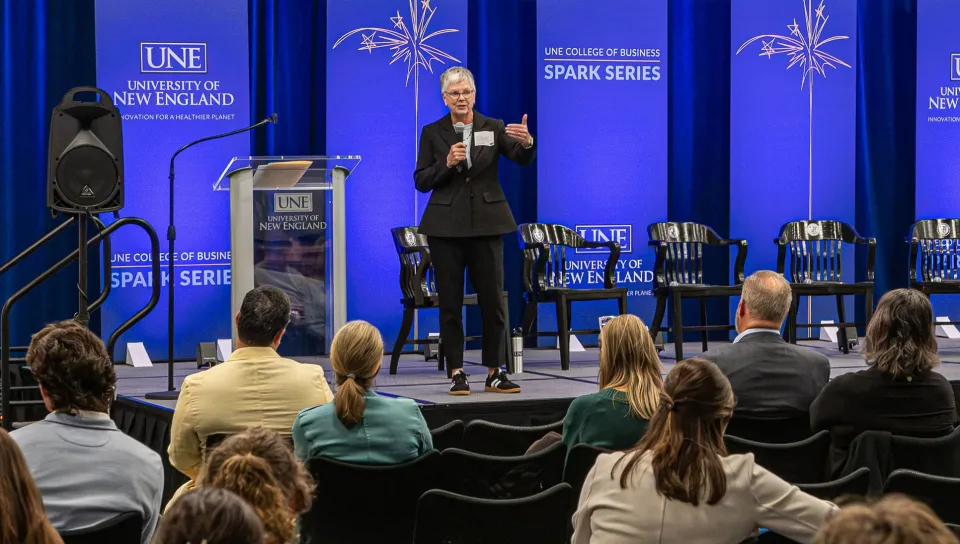
In 2025, UNE joined the Babson Collaborative for Entrepreneurship Education, a global network of universities that share research, teaching resources, and programming designed to strengthen entrepreneurial education across disciplines. The institutions further expanded their relationship in 2026 through an agreement establishing graduate business education pathways for eligible UNE students, alumni, and employees.
Together, the collaborations broaden opportunities for UNE students to develop entrepreneurial skills and pursue advanced business education, building on the University’s commitment to experiential learning and career preparation.
For Neck, those opportunities underscore the role universities can play in helping students develop the confidence to apply their knowledge and create something meaningful.
“Do not come to UNE to find yourself; come to UNE to create yourself,” she told students, encouraging them to embrace opportunities across the University’s academic programs.
Launched in 2025, UNE’s SPARK Series brings executives, entrepreneurs, and industry leaders to campus to discuss emerging business trends and real-world challenges. Previous discussions have explored professional sports, cybersecurity, and building values-driven Maine brands.
Presented by the College of Business and Center for Innovation and Entrepreneurship, the series is part of UNE’s broader efforts to connect classroom learning with industry experience, expand professional networks, and prepare students to help shape Maine’s evolving workforce.