
Image

This website uses cookies to understand how you use the website and to improve your experience. By continuing to use the website, you accept the University of New England’s use of cookies and similar technologies. To learn more about our use of cookies and how to manage your browser cookie settings, please review our Privacy Notice.
The University of New England College of Business welcomed Mary Allen Lindemann, co-founder of Portland-based Coffee By Design, to the University’s Biddeford Campus, on Tuesday, April 8, for the latest installment of its Spark Conversations series.
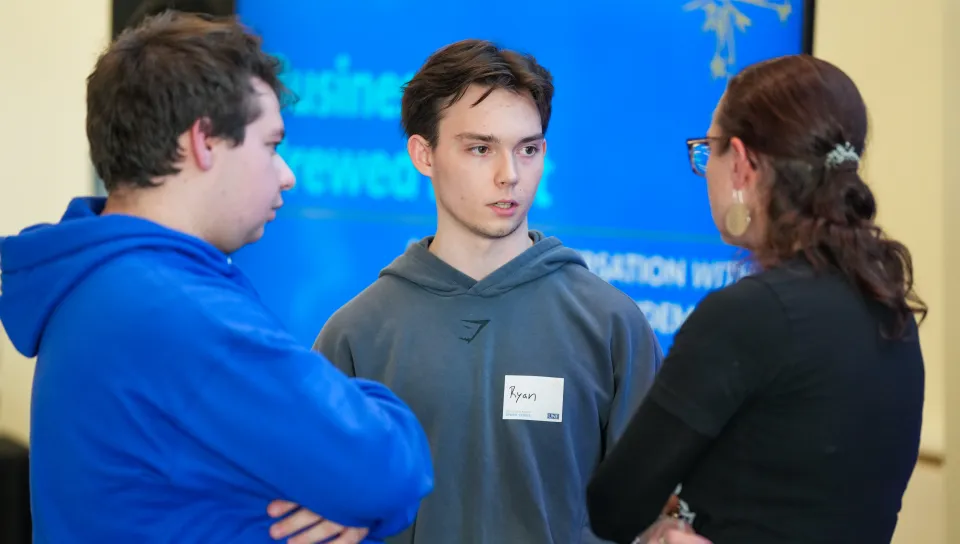
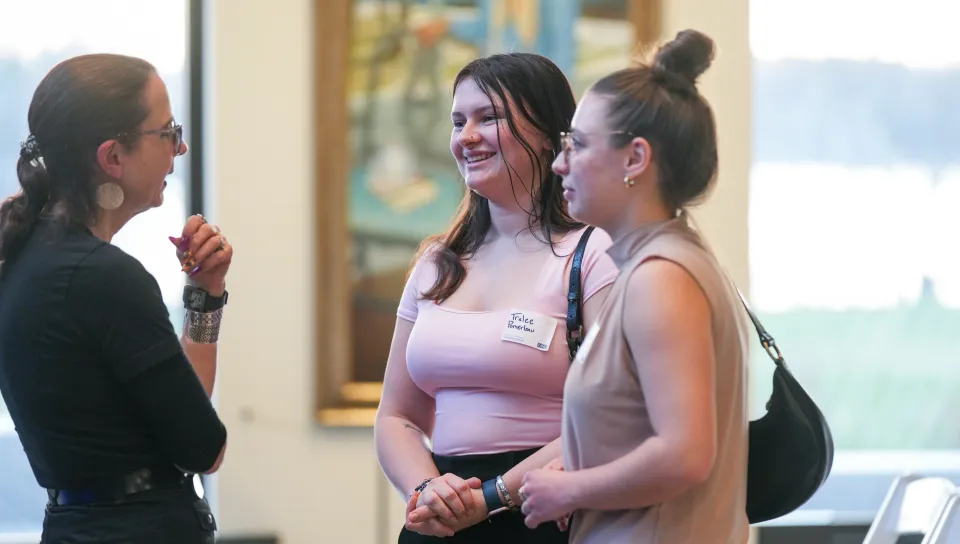
The event, titled “Business Brewed Right,” opened with a complimentary coffee tasting in the Danielle N. Ripich Commons, co-hosted by Lindemann, her daughter and head roaster Alina Lindemann, and UNE’s Women in Business Club, before giving way to a wide-ranging conversation moderated by Penny Guyton, MBA, assistant teaching professor and program director of Business Administration in the College of Business.
Lindemann, who co-founded Coffee By Design in 1994 after spending several years in Seattle during the late-1980s recession, gave students an unfiltered look at the company’s founding story, the global economics of specialty coffee, and what it takes to build a brand where values aren’t negotiable.
Opening a specialty coffee company in a downtown Portland that was roughly 40% vacant wasn’t just a business venture, Lindemann said: It was a statement about what community-rooted business could look like.
“We talked about the three-legged stool: people, planet, profit,” Lindemann said, noting that, from the beginning, profitability and social responsibility were inseparable goals. “We had to really prove to people you could still be profitable and actually care about people and the planet.”
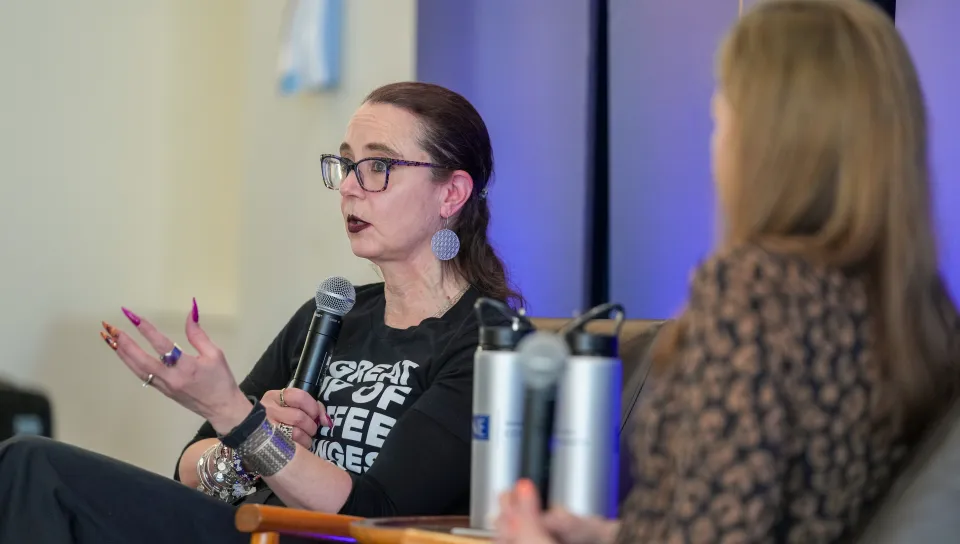
That philosophy, which Lindemann described as social responsibility long before the term sustainability became commonplace, has shaped three decades of decisions, from early commitments to welcoming refugee customers in Coffee By Design’s first years, to a sustained practice of direct trade relationships with farming cooperatives in Rwanda, Uganda, and Burundi.
Lindemann described a model in Rwanda in which the company pays farmers a third of their crop cost upfront, an intervention that matters deeply in regions where short-term borrowing rates can reach 18 to 20%. The extra capital, she said, has gone toward health care, livestock, and education for farming communities.
Guyton, an accomplished business leader and educator with nearly three decades of experience driving innovation, growth, and organizational transformation, added that it represented something far beyond a typical buyer-supplier relationship.
“You’ve really invested in them fully as partners,” Guyton said. “What some companies would think of as just a supplier, you’ve taken a completely different approach.”
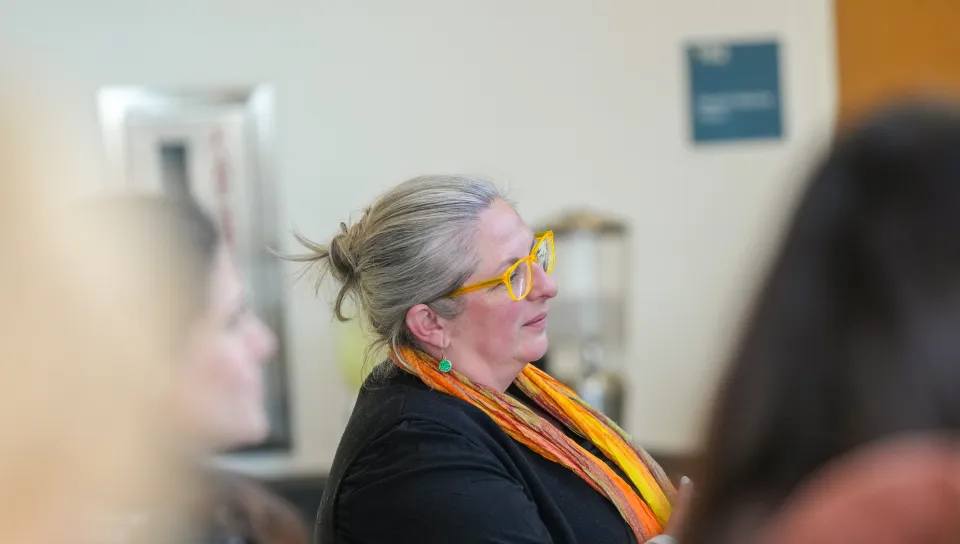
Lindemann also spoke candidly about the harder trade-offs that come with running a values-driven business, describing a recent decision to part ways with a wholesale customer whose values were no longer aligned with Coffee By Design. She said that choosing principle over profit isn’t always easy but said her team has made it a north star.
“At the end of the day, you cannot buy your reputation back,” Lindemann said.
The conversation also covered the Rebel Blend Fund, through which a percentage of sales from one of Coffee By Design’s most popular coffees flows into a staff-directed grant fund supporting arts organizations that other funders might overlook, including a podcast for people in addiction recovery during the COVID-19 pandemic, a children’s book author exploring identity, and community performance projects. Lindemann, who majored in poetry with a minor in women’s studies and African and African American studies, said the arts have always been central to the company’s sense of purpose.
Lindemann described 21-year-old Alina, a 21-year-old Q grader — the coffee industry’s equivalent of a sommelier — as the future of the business and a reminder that the work of building something meaningful is ongoing.
She also reflected on her experience as a woman entrepreneur, describing a recent resurgence of the condescension she first encountered in the workforce in the late 1970s. Her advice to students was direct: “Don’t change who you are. Present your ideas. Be open to people who are around you.”