
Image

This website uses cookies to understand how you use the website and to improve your experience. By continuing to use the website, you accept the University of New England’s use of cookies and similar technologies. To learn more about our use of cookies and how to manage your browser cookie settings, please review our Privacy Notice.
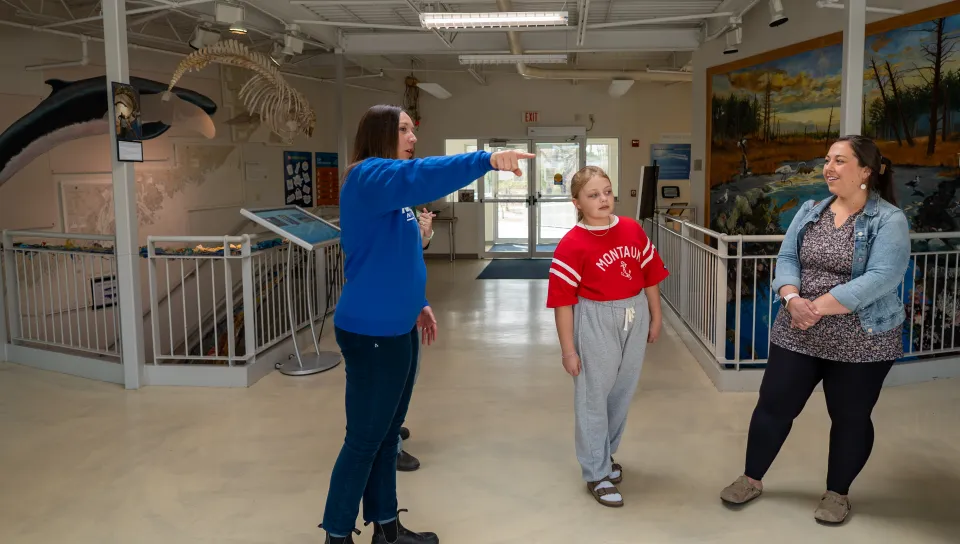
When Jaimie Arsenault of York, Maine, reached out to the staff in the University of New England Arthur P. Girard Marine Science Center asking if her 10-year-old daughter, Josie, could get a tour of the center, professional staff at the center shifted into high gear to pull together a private tour for the curious middle school student who, her mother said, “aspires to follow that path in the future.”
“I know she is still young,” Jaimie Arsenault wrote, “but she is driven and focused on her future.”
A week later, Josie and Jaimie Arsenault got an inside look at UNE’s Marine Science program with the help of two of the school’s resident experts: Assistant Professor Tricia Thibodeau and Piper Stagg (Marine Sciences, ’27).
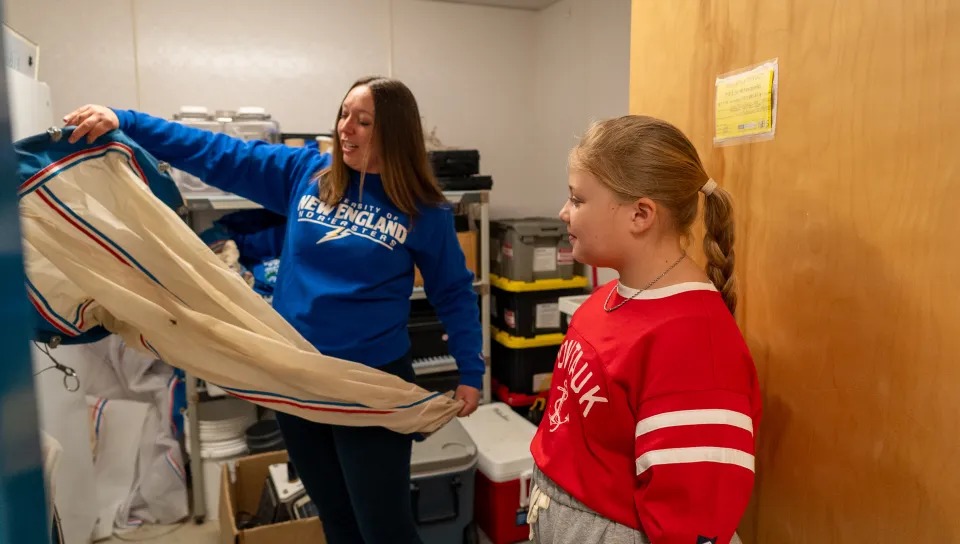
Last year, Thibodeau, Ph.D., was awarded a National Science Foundation grant to study zooplankton samples collected along the Antarctic Peninsula — from which she recently returned — work that promises to inform the future of species adaptations and conservation in the Antarctic region. Stagg has worked with Thibodeau as a research assistant.
By the time Josie Arsenault left UNE on April 22, she said Thibodeau and Stagg taught her what a university experience at a school like UNE might offer her one day: hands-on experiences doing research outdoors and even the ability to pivot and change majors without fuss.
Immediately when the Arsenaults’ tour started, Thibodeau and Stagg led them out to the Marine Science Center’s deck, which looks out to the estuary of the Saco River and ocean beyond. There, the college junior and fifth grader stood side by side and discussed opportunities at UNE as they looked toward the maritime view.
“First day of class here is on the water,” Stagg said and then pointed to Ram Island, the small rocky island in the distance UNE owns just off the coast. “So that is where we go every week to sample off the coast of Ram Island by putting our nets in the water.
“We might even spend nights on the island to study the birds — and that might be set up by the time you’re a student,” she said.
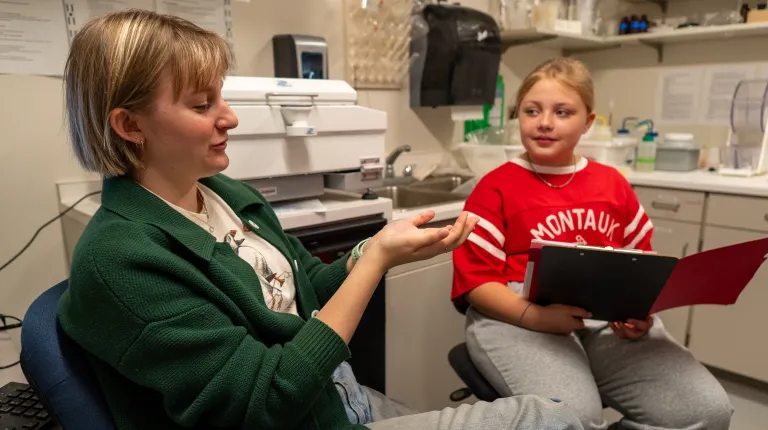
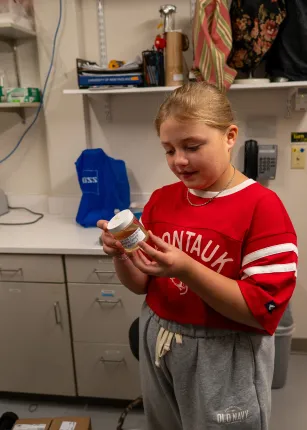
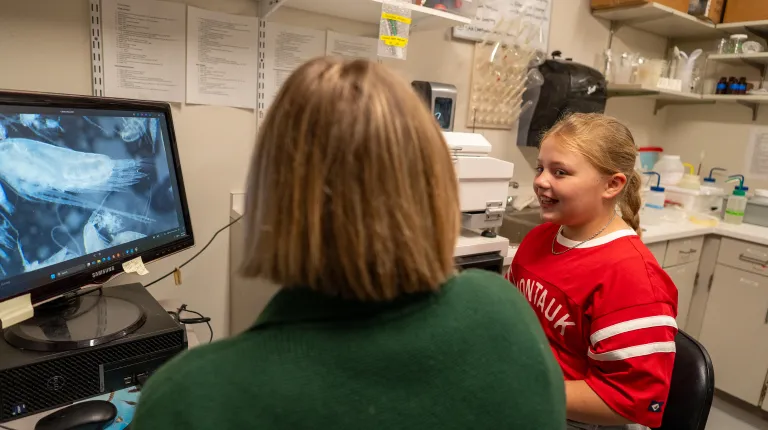
Then Thibodeau gently stepped in and picked up the story of marine and environmental science at UNE and just how fun field work can be: in the forests, wetlands, and waters surrounding campus.
“We try to get students outside as much as possible, which is one of the things I love about marine science — and why I got into it,” Thibodeau offered.
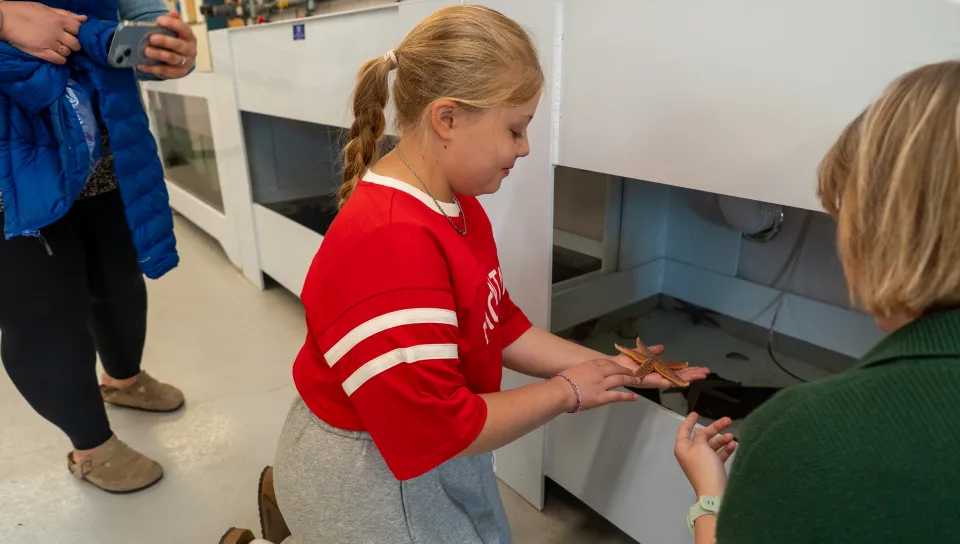
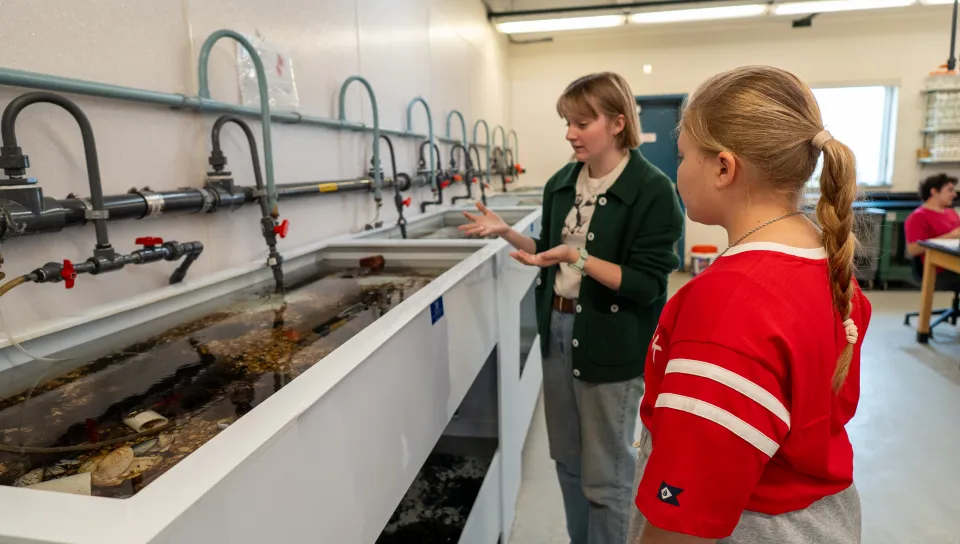
The tour took the Arsenaults through research spaces before stopping in a teaching laboratory where one wall is lined with tanks full of large and orange lobsters, sea stars, and other sea creatures that undergraduate students study for their coursework. They visited the eel enclosures in the center’s new Recirculating Aquaculture System (RAS) Room and the Ornamental Husbandry Lab that houses clown fish and corals to learn about the husbandry practices and systems that make maintaining these animals possible.
Through it all, Josie Arsenault listened intently and nodded, but held her questions until the end. Then she asked Stagg: “What makes this college really special?”
“It’s the professors, and the learning environment that we’ve created here,” Stagg responded. “Because any school can have the resources, the room to do science. But if you don’t have the really awesome people to encourage you to ask great questions, you’re not going to do very good science.”
Without missing a beat, the young Arsenault posed a follow-up question: What do UNE professors do that help students really understand the material?
It was a tough question coming from a fifth grader. However, Stagg just smiled, laughed a little, and answered in earnest.
“We get to play with the material outside. Play is so important for understanding things. If it’s not fun, your brain is not going to pick it up,” Stagg said.