
Image

This website uses cookies to understand how you use the website and to improve your experience. By continuing to use the website, you accept the University of New England’s use of cookies and similar technologies. To learn more about our use of cookies and how to manage your browser cookie settings, please review our Privacy Notice.
Harbor porpoises dart through the Gulf of Maine year-round, small and fast, largely invisible to science in this part of the world. But that's starting to change.
Michelle Caputo, Ph.D., an assistant professor in the University of New England School of Marine and Environmental Programs and a conservation biologist, has launched a systematic effort to track harbor porpoises along the Maine coast, the first such research in at least 10 years.
Through three different studies of the species she’s conducting with student researchers, Caputo is building a population baseline for a species that has gone largely unstudied in recent years in the northwest Atlantic — a species that is also a useful indicator of the broader ecosystem health in the region.
Harbor porpoises serve as a useful signal of a healthy ecosystem because the species are year-round residents in the Gulf of Maine, and their high metabolic rate means they need a consistent, rich food supply. If that supply shifts, the food source used by porpoises will show it, Caputo said.
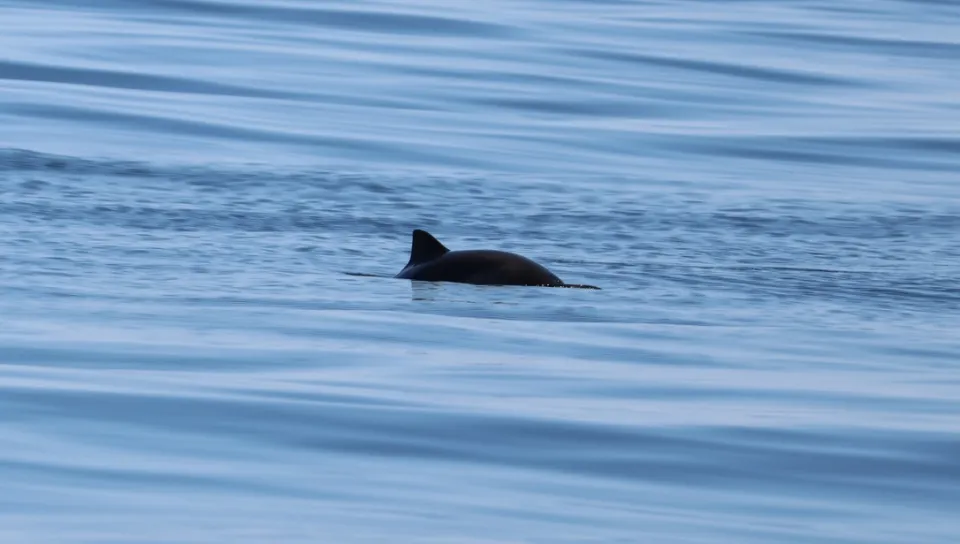
“They’re a good indicator species because they’re mesoconsumers: They have to eat a lot, and they’re here year-round. If the harbor porpoise starts leaving this area, we know they are following the fish,” Caputo said.
Since arriving at UNE in August 2024, after a decade conducting marine research in South Africa, Caputo has embarked on three different studies of the harbor porpoise, while also studying minke whales.
Recently, Caputo’s team of research assistants deployed two underwater microphones known as hydrophones — which will also be used by the University of New Hampshire — off the coast of Portland to detect the high-frequency clicks harbor porpoises use to echolocate. The study will help to gain a better understanding of the areas and habitat harbor porpoise use, Caputo said.
In addition, starting this spring, Caputo also plans to use skin and muscle samples collected from stranded harbor porpoises off Cape Cod to determine where in the food web harbor porpoises forage. The samples were provided by a network of regional marine mammal researchers and sent to Florida International University for isotope analysis, a biochemical technique that can reveal whether porpoises are eating small forage fish near the surface or larger, bottom-dwelling species offshore.
The results, expected back this month, will give the research team its first look at diet patterns in the population in the Gulf of Maine.
"For instance, we might find that harbor porpoises feed further inshore in the summer, but, in the winter, they're moving further offshore," Caputo said. “That tells us a lot about their movement patterns and what threats they might face in those habitats.”
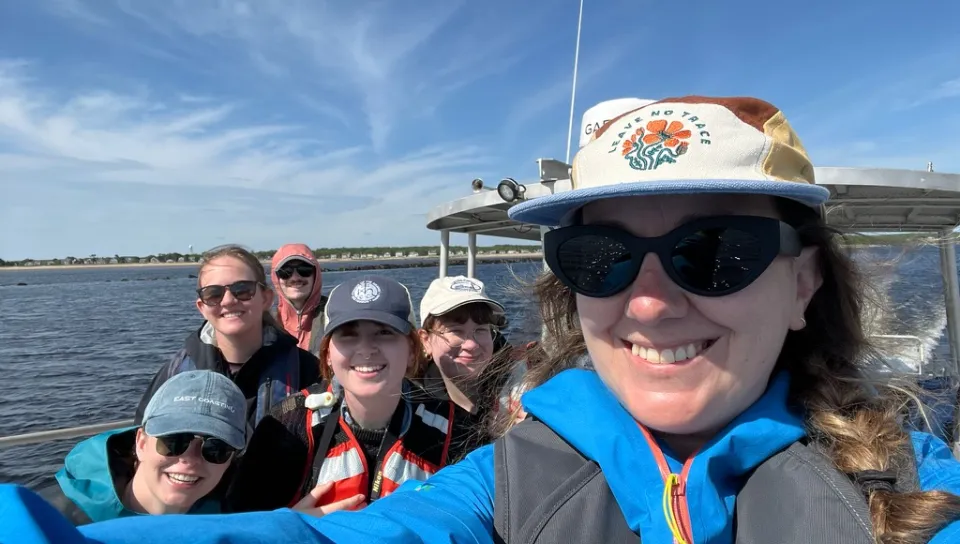
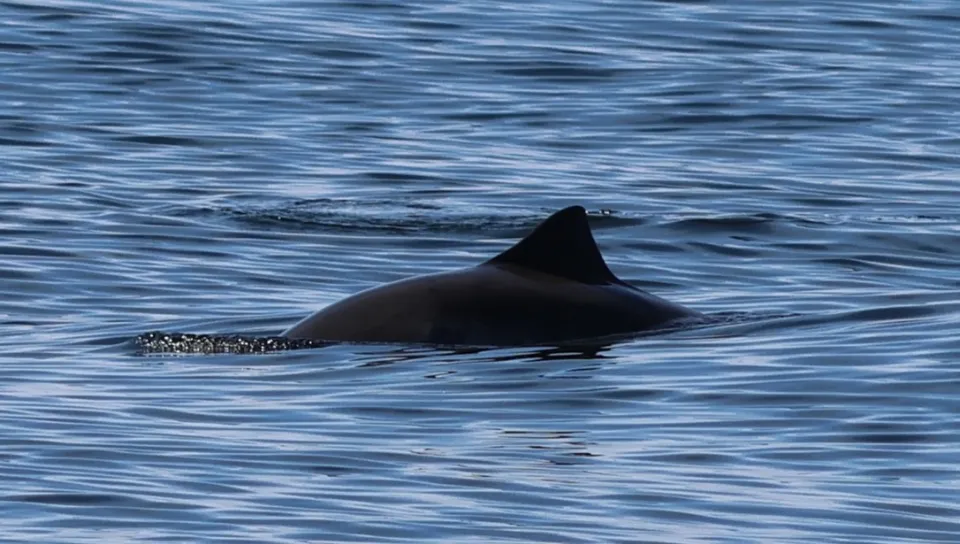
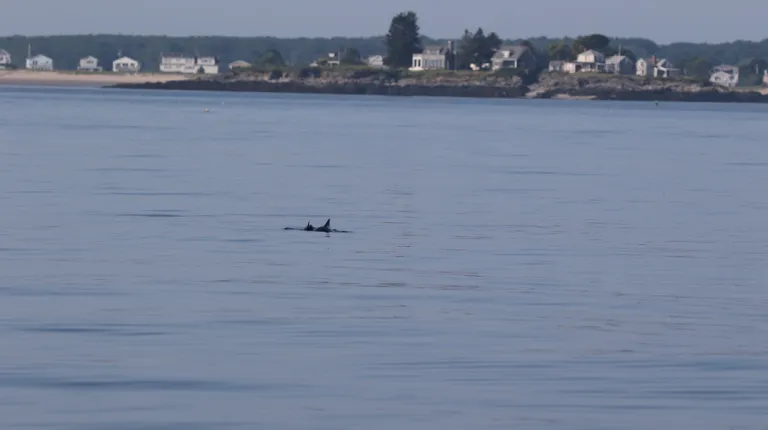
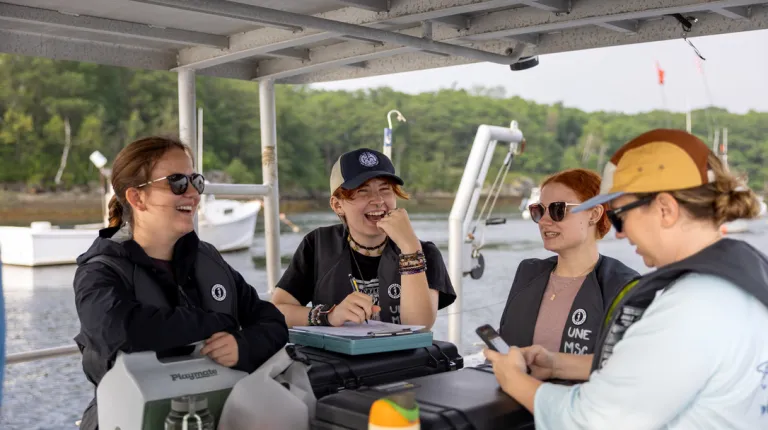
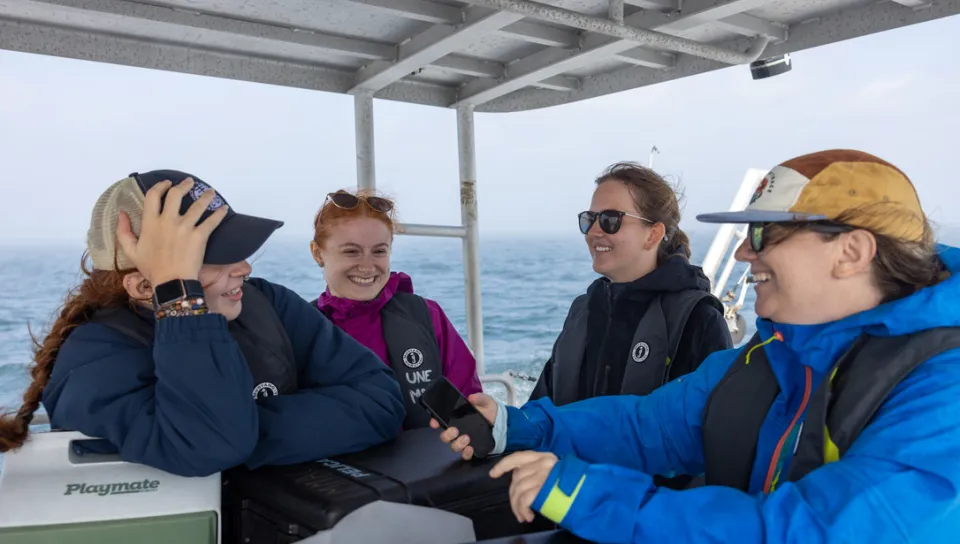
And for the past year, Caputo has conducted a year-round boat survey of harbor porpoises, taking student researchers out twice a week when weather conditions allow. Caputo and her team of graduate and undergraduate research students travel off the coast of Maine, following preset survey routes divided into four quadrants and photograph individual harbor porpoises.
Getting students out on the water, she said, also means they're studying something they can actually find. Harbor porpoises surface near the boat on nearly every outing — a reliable encounter that keeps students interested.
"I want my students to be able to have an experience where they aren't searching for something they're never going to find," she said. "We find them every time we go out, making the research rewarding and engaging."
Back in the lab, the team then identifies individuals by scars and notches on dorsal fins. Because the markings don't heal completely, those notches serve as reliable long-term identifiers of individuals. By tracking which individuals reappear, and how often, the team can apply mathematical models to estimate the total population size. Similar photo-identification methods have been used successfully in European and the western U.S., Caputo noted.
I want my students to be able to have an experience where they aren't searching for something they're never going to find. We find (porpoises) every time we go out, making the research rewarding and engaging." — UNE Assistant Professor Michelle Caputo, Ph.D.
It will take at least three years of field data before the team arrives at a confident population estimate, but, in the short term, Caputo will still encourage students to begin modeling for learning purposes, with the understanding that early results will carry wide margins of uncertainty.
"Photo-IDing harbor porpoises is extremely difficult,” Caputo said. “They're very quick on the surface, very dynamic little animals.”
For Caputo, science and teaching are inseparable in her student-centered research.
Her lab currently has two master's students and five undergraduates, and she fields multiple requests each month from students wanting to join the research team. Caputo attributes the interest to UNE's culture of hands-on learning.
And she designs her research programs with that in mind.
“When the isotope data comes back, it will become a master's student's thesis project. The photo-identification work and habitat mapping are similarly being shaped around what students want to learn and experience,” Caputo said.