Image

This website uses cookies to understand how you use the website and to improve your experience. By continuing to use the website, you accept the University of New England’s use of cookies and similar technologies. To learn more about our use of cookies and how to manage your browser cookie settings, please review our Privacy Notice.
It could be said that, this past semester at the University of New England, senior Sarah Goble lived her future career.
Goble, who is majoring in animal behavior — at one of the few universities in the country to offer such a major, knew she wanted to be a zookeeper when she went to do an internship this fall at the Maine Wildlife Park in Gray, about an hour north of UNE’s Biddeford coastal campus.
The wildlife sanctuary provides forever homes for injured wildlife that can not be released back into the wild. The animals are cared for in natural enclosures set in the Maine woods. A secondary mission of the wildlife sanctuary, which is owned by the Maine Department of Inland Fisheries and Wildlife, is to educate the public about the state’s rich wildlife populations by allowing visitors to view the park’s non-releasable birds, mammals, and reptiles between May and October.
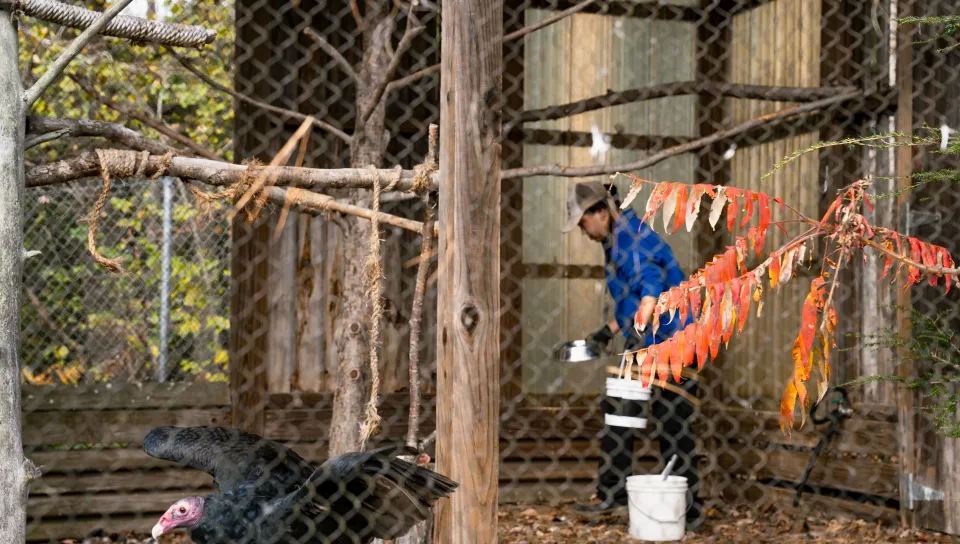
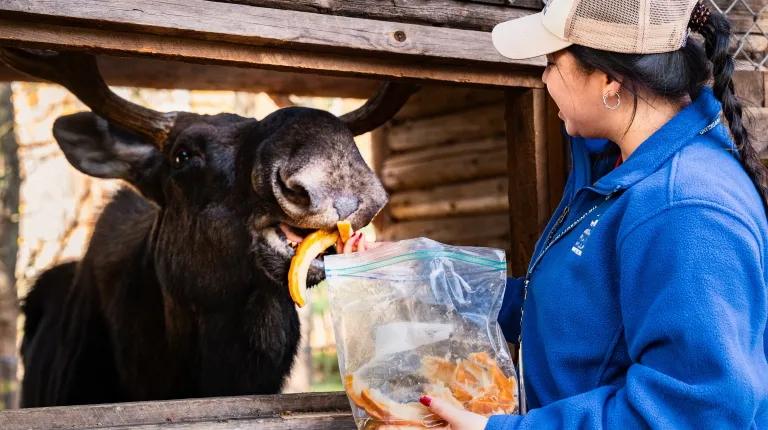
Working with the park managers and wildlife keepers, Goble, who studies in the UNE School of Psychology and Brain Science, had the chance to interact with the park’s resident wildlife, everything from barred owls, bald eagles, and hawks to white-tailed deer, Canada Lynx, black bear — and a moose affectionately known as Byron.

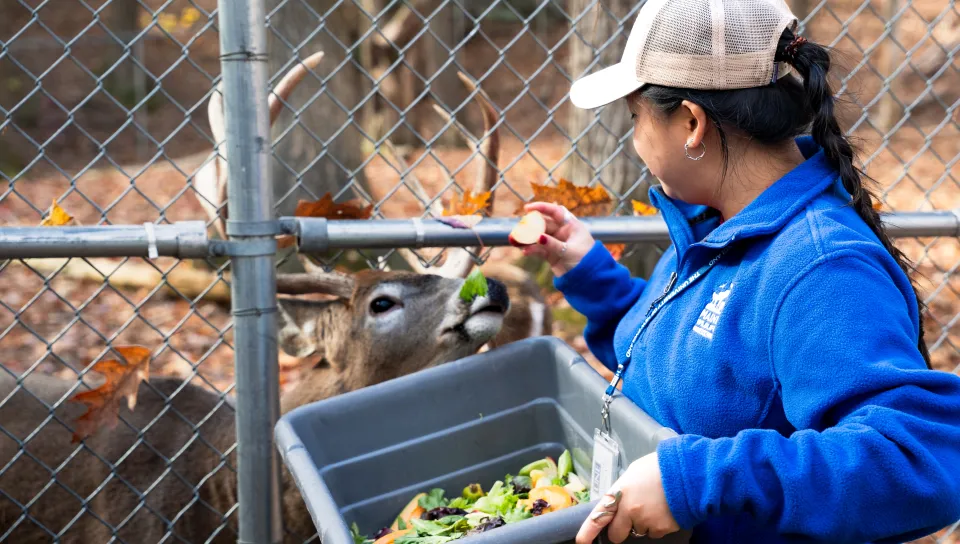
“Getting to know Byron was fun. Learning his behaviors, what’s normal, what’s not and knowing that will help me understand other animals in the future in my career – this knowledge I’ve gained here this fall has been very helpful,” Goble said. “But the raptors are my favorite. They’re a big highlight of my day. Being able to monitor their health and making sure they’re as comfortable as they can be is really fulfilling just on its own.
“I feel very honored, you know?” she added. “I feel special for being able to intern there.”
The work of cleaning cages, feeding animals, and monitoring the health of the wildlife constituted Goble’s daily chores. But for Goble, who hails from Virginia, that physical work was enlightening, inspiring, and personally meaningful — as well as a window to her future.
“Working with the keepers has been delightful,” Goble said. “A few of them are close to my age, so that’s been interesting to see how I can progress into this field on a path into the animal behavior field, even if they didn’t have my exact major. One of the keepers has been here for eight years, so seeing what a seasoned keeper looks like, and being able to work alongside her has been very helpful."
Dylan Brothers, MBA, UNE’s associate director of employer relations in the Office of Career Readiness and Workforce Development, said internships are the critical hands-on experience UNE students need to bridge the gap between classroom learning and career readiness that prepares them to hit the ground running in the industry where they want to work after they graduate.
“By the time they're leaving UNE, they have experience that already prepared them for the workforce. So, they can settle into their industry with ease,” Brothers said.



UNE Professor Michael Cripps, who helps guide students toward internships in UNE’s School of Arts and Humanities, said as many as 30% of internships pursued by UNE students show students what they don’t want to do, which Cripps said is just as valuable as internships that lead other students toward a lifelong calling.
“When I'm talking with students who are having that experience, the thing that I most emphasize is: ‘Isn't it good to know that now and not three years into your first job after college?’” Cripps pointed out.
That was not the case with Goble, who walked through the Maine Wildlife Park over the course of two months shadowing, mimicking, and, in time, taking over the jobs done by the park’s keepers — and loving every minute of it.
From Sept. 3 to Nov. 9, Maine Wildlife Park Assistant Superintendent Ben Barrett taught Goble the correct way to interact with and feed the wild animals. Other staff members shared their career paths to the park. All of it opened a world of understanding for Goble, who still asserts she wants to work with wildlife throughout her career.
Barrett said that, from day one, Goble jumped into her job and internship responsibilities at the park with both feet.
“I could tell Sarah was eager to learn. Right away, she meshed with the team, and we value that,” Barrett said. “One of the things I noticed Sarah picked up and ran with was doing morning rounds, which involves checking on all of our animals. She started doing that independently pretty quickly. We want things to work as smoothly as possible, and Sarah has been a big piece of that.”