Image

This website uses cookies to understand how you use the website and to improve your experience. By continuing to use the website, you accept the University of New England’s use of cookies and similar technologies. To learn more about our use of cookies and how to manage your browser cookie settings, please review our Privacy Notice.
The University of New England showcased its expanding role in Maine’s blue economy during a recent statewide gathering of entrepreneurs, investors, researchers, and business leaders, highlighting how its marine science and entrepreneurship programs are helping prepare the next generation of professionals driving innovation along the state’s coast.
As part of Maine Blue Economy Week, held Sept. 30 to Oct. 2, UNE hosted “Blue Economy Builders: Marine Entrepreneurship in Southern Maine,” an immersive, daylong program on Oct. 2 that brought participants to the University’s Biddeford Campus to explore research, emerging marine technologies, and collaborations between students, faculty, and industry.
The visit provided a look at how UNE is connecting academic research with commercial opportunities while positioning its students to contribute to Maine’s growing ocean economy through hands-on learning and professional development.
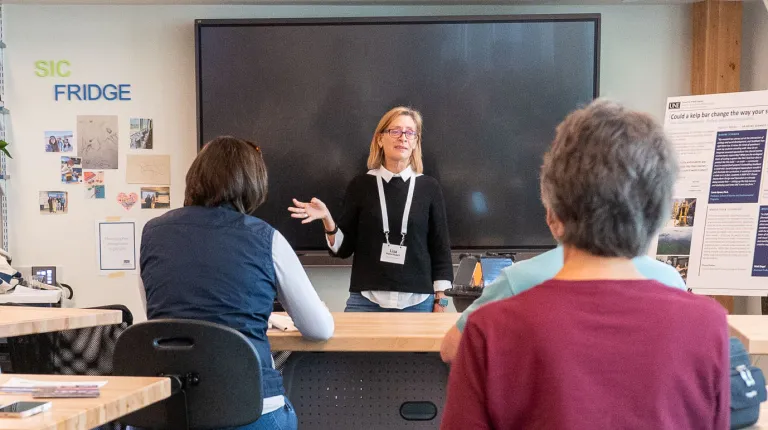
“Maine Blue Economy Week gave us something we can’t create in a classroom alone: a chance for business leaders, policymakers, and investors to step into our labs, get out on the water, and meet the students and alumni who are building Maine’s ocean economy,” said Lisa Herschbach, Ph.D., director of UNE’s Center for Innovation and Entrepreneurship (CIE) and assistant dean of Innovation and Entrepreneurship in the College of Business.
“Our students are the future of the blue economy workforce, and when visitors hear directly from them about their research and see how it’s already being put to work, the connection between UNE and the state’s economic future becomes clear,” Herschbach added.
The program brought visitors into UNE’s Sustainable Innovation Center and Arthur P. Girard Marine Science Center, where faculty and students demonstrated how research and entrepreneurship intersect in areas ranging from aquaculture and marine technology to sustainable food production and coastal monitoring.
Representatives from the School of Marine and Environmental Programs, College of Business, and CIE discussed how UNE’s interdisciplinary programs prepare students for careers in emerging marine industries.
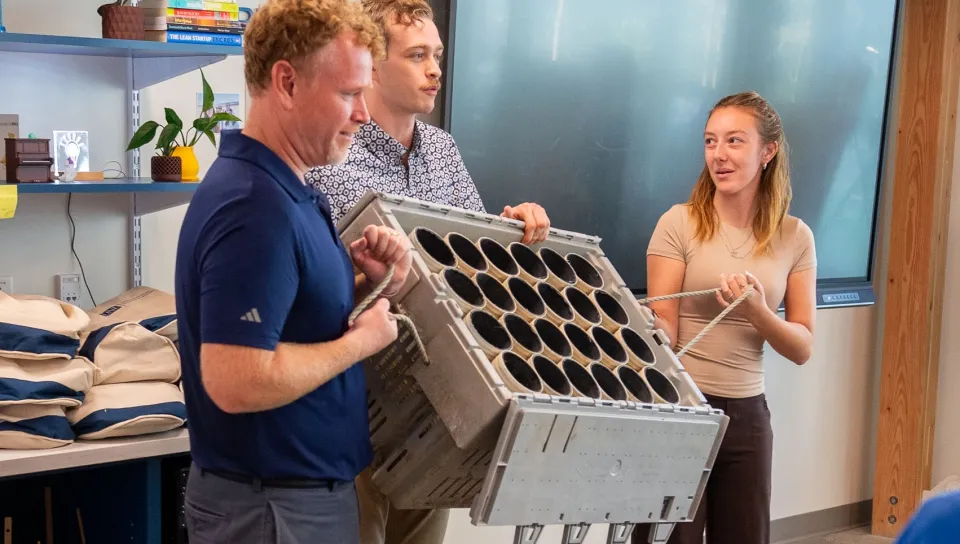
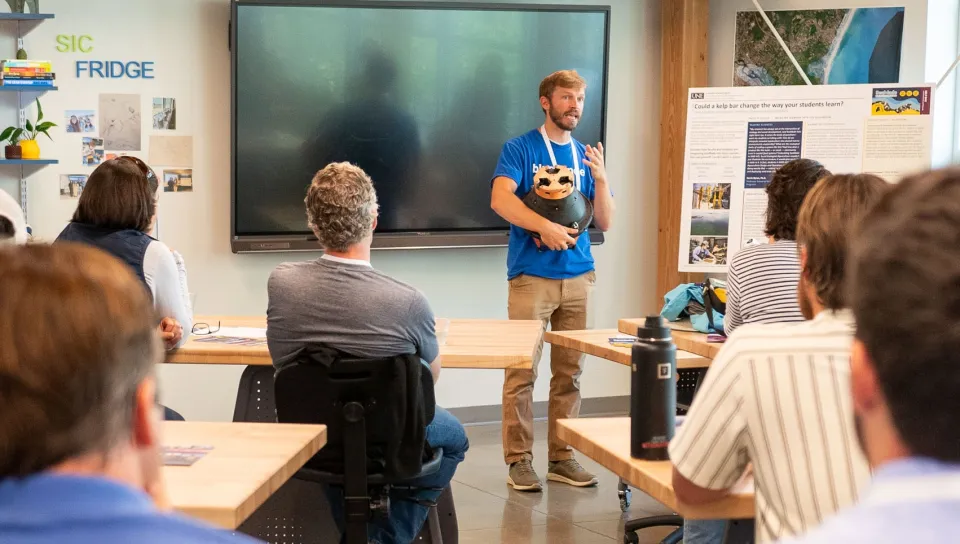
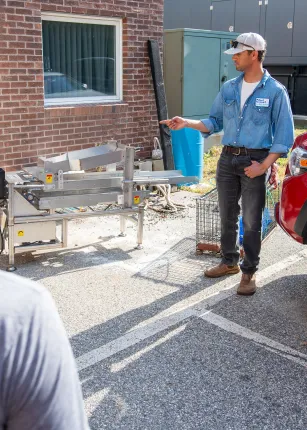
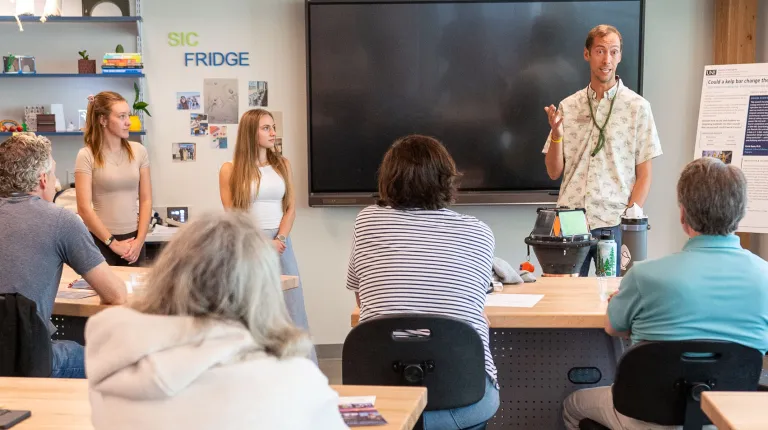
Visitors learned about the University’s recirculating aquaculture research involving American eels and heard from entrepreneurs collaborating with UNE and Northeastern University’s Roux Institute, including representatives of Saco Bay Sea Farms, Coastal Measures, and Bluesonde.
The program also featured UNE’s work in sustainable aquaculture through its SeaMade nutrition bar initiative and opportunities to explore the University’s marine research and aquaculture operations around Ram Island.
These experiences highlighted how UNE is bringing together research expertise, industry partnerships, and business education to address challenges facing Maine’s marine industries while creating opportunities for economic development.
Among the student experiences showcased was the work of Jackson Martine (’27), a marine sciences major who spent the summer working with York-based Shell+Claw through UNE’s Summer Sustainability Fellowship.
Martine helped conduct experiments evaluating green crab storage methods and molting success to determine how the labor-intensive operation might become more efficient and commercially sustainable. The company is developing a market for invasive European green crabs as a high-value seafood product, creating a potential economic opportunity while helping address an ecological threat.
Now a Shaw Innovation Fellow through CIE, Martine is continuing that work by helping redesign specialized equipment used to hold crabs as they prepare to molt.
“I am glad I got the chance to speak during Maine Blue Economy Week,” Martine said. “It means a lot to see and meet community members interested in the local aquaculture innovation and sustainability work that I am a part of.”
UNE’s Shaw Innovation Fellowship and Summer Sustainability Fellowship programs are among the University’s ventures connecting students with founders, researchers, and community partners to develop practical solutions to environmental and economic challenges, as are growing interdisciplinary academic and workforce development initiatives within the David Evans Shaw Institute for Public and Planetary Health.
For participants, the visit offered a new perspective on the scope of UNE’s contributions to Maine’s emerging marine innovation ecosystem.
Shaye Robbins, a representative of a family foundation who attended the program, praised the opportunity to meet students, alumni, and researchers and see how their work is being applied beyond the University.
“I appreciated being on site to meet the educators, students and alumni that are building the blue economy ideas and workforce in Maine,” Robbins said. “The expertise that (UNE) has been able to assemble around the blue economy is outstanding.”
Maine Blue Economy Week is a statewide initiative designed to strengthen connections among researchers, entrepreneurs, investors, and workforce organizations supporting the sustainable growth of Maine’s ocean and coastal economy. The gathering was organized through a collaboration among the Gulf of Maine Research Institute, the University of Maine, Bigelow Laboratory for Ocean Sciences, and Northeastern University’s Roux Institute.
For UNE, Herschbach said participation provided an opportunity to introduce its growing marine entrepreneurship ecosystem to prospective collaborators while demonstrating the role of experiential education in developing a skilled, innovative workforce.
“Hosting this tour let us showcase the talent being developed here and start the conversations that turn that talent into careers, companies, and lasting partnerships across Maine,” she said.