
UNE medical students learn to prescribe ‘Food as Medicine’ through culinary, community immersion
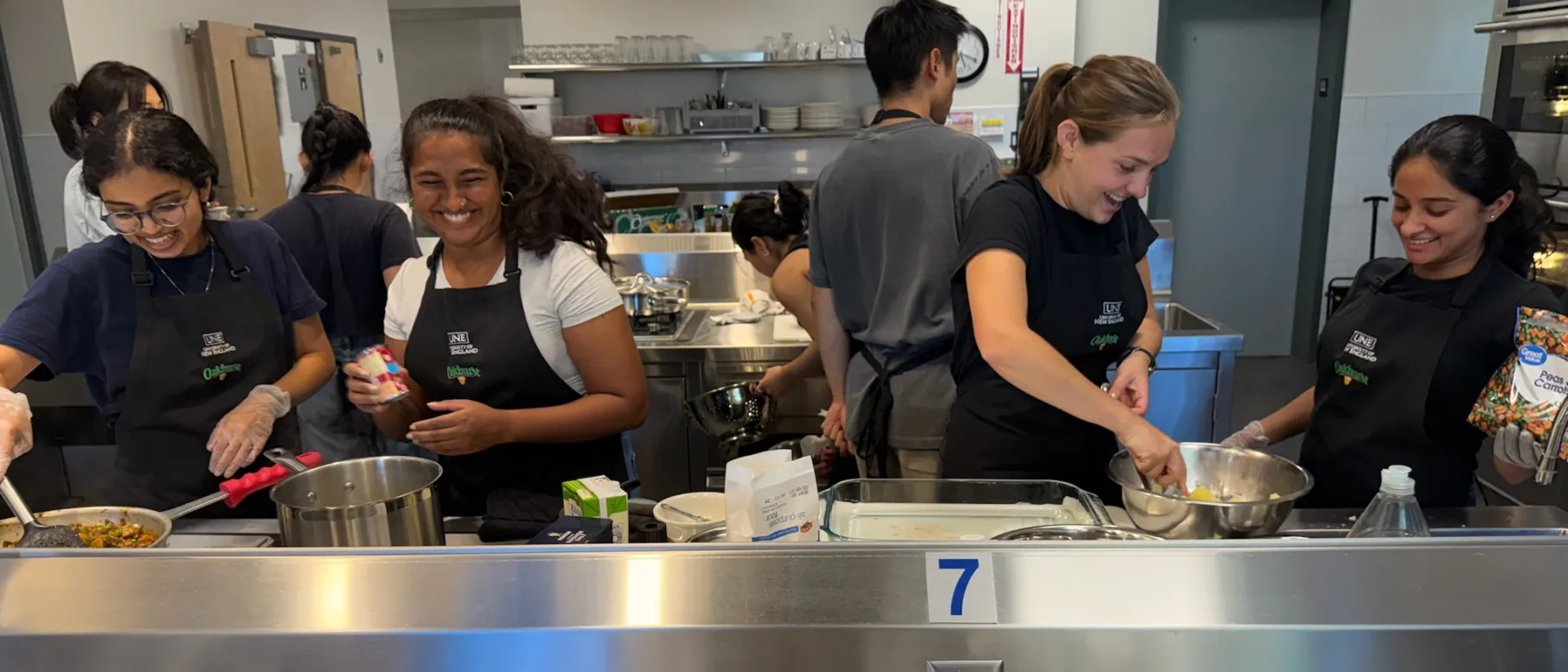
Rose Paadam carefully budgeted ingredients for a white bean chowder designed for a patient with prediabetes and high cholesterol. The challenge: Create six servings of a nutritious, anti-inflammatory meal for just $15, the reality of a SNAP budget.
“Until we lived it, it was hard to realistically understand someone else’s struggle, regardless of how much sympathy or empathy you had for them,” said Paadam (’28), a second-year student at the University of New England College of Osteopathic Medicine.
Her experience was part of Food as Medicine in Maine, a new certificate program that brought over 60 UNE medical students out of the classroom this fall to explore the powerful connection between nutrition and health. Supported by a grant from the American Association of Colleges of Osteopathic Medicine, the initiative reflects a growing national movement to address a critical gap in medical education.
Despite nutrition’s central role in preventing and managing chronic disease, most medical schools provide fewer than 20 hours of nutrition education. At UNE, which is home to Maine’s only medical school, the faculty are working to change that equation.
“This is one more way that UNE COM is looking to leverage our ability as educators to serve our community,” said Chris Callaway, Ph.D., assistant dean for pre-clinical curriculum in the college, who helped plan the project.
The five-week program, which ran from September through early November, combined online learning modules with immersive, local community experiences.
Students visited Portland-based Preble Street and Good Shepherd food pantries to understand food insecurity firsthand; toured Wolfe’s Neck Center for Agriculture & the Environment in Freeport to learn about sustainable food production; and worked alongside registered dietitian Leslie Ouellette, M.S., RD, LD, in hands-on cooking sessions that took place in the UNE Teaching Kitchen on the University’s Biddeford Campus.
For many students, visits to the food pantry proved transformative.
“It was astounding to see how that place worked like a well-oiled machine,” Paadam said of Good Shepherd. She learned that one in five children in Maine struggles with food insecurity and that, despite $40 million in recent funding increases, the state’s hunger problem persists.
Good Shepherd’s commitment to high-quality nutrition, including its refusal to accept donations that don’t meet nutritional standards, left a lasting impression, she said.
“What I learned at Good Shepherd probably taught me the most about the realities that many people of Maine go through,” Paadam said.
The program’s faculty emphasized experiential learning over textbook theory.
“Experiencing in practice the access and the options for healthy food on budget, it’s different than just discussing that theoretically in a classroom,” said Eliza Grlickova-Duzevik, M.D., Ph.D., assistant clinical professor in the college’s Department of Biomedical Sciences. “They’re going to be able to give patients specific examples. They’re not going to just tell them you need to eat healthy.”
Douglas Spicer, Ph.D., M.M.Ed.L., professor in COM, who has championed culinary medicine at UNE since 2016, agreed and highlighted another crucial lesson.
“I think that really helped some of the students realize the power of a dietician and where they come in,” Spicer said, adding that the hands-on experience provides more understanding of the patient experience. “The students are being put in the patients’ shoes ... They’re not just reading a textbook on this; they’re actually living it.”
The program culminated in a showcase where student groups presented meals designed for patients with specific conditions, all prepared within the constraints of a SNAP budget. Paadam’s group created their white bean chowder for $15.83, slightly over budget but meeting the nutritional needs of their hypothetical patient.
“The students do establish some sort of relationship with local food banks, and then they get integrated in the community,” Grlickova-Duzevik said, noting that students have sought out volunteer opportunities with these Portland-based nonprofits since the course concluded.
For Paadam, whose grandparents in rural India developed prediabetes and type 2 diabetes despite working on farms and eating mainly vegetarian diets, the program connected deeply with her motivation for becoming a physician.
“Integrating programs like Food as Medicine into our medical education helps us understand people like my grandparents, people who cannot give up their cultural foods, cannot access other types of foods, and do not have the opportunity to learn about what holistic nutrition means,” she said.
Looking ahead, program leaders plan to expand the initiative, and the response from this year’s cohort, triple the participation of previous pilot efforts, suggests strong student interest in learning practical skills they can use with future patients.
“I know how to help people make incremental steps towards a healthier lifestyle,” Paadam said. “Food as Medicine helped us learn to address more than one area of concern for practically any patient.”