
A graduating UNE medical student matches to the hospital that inspired his calling
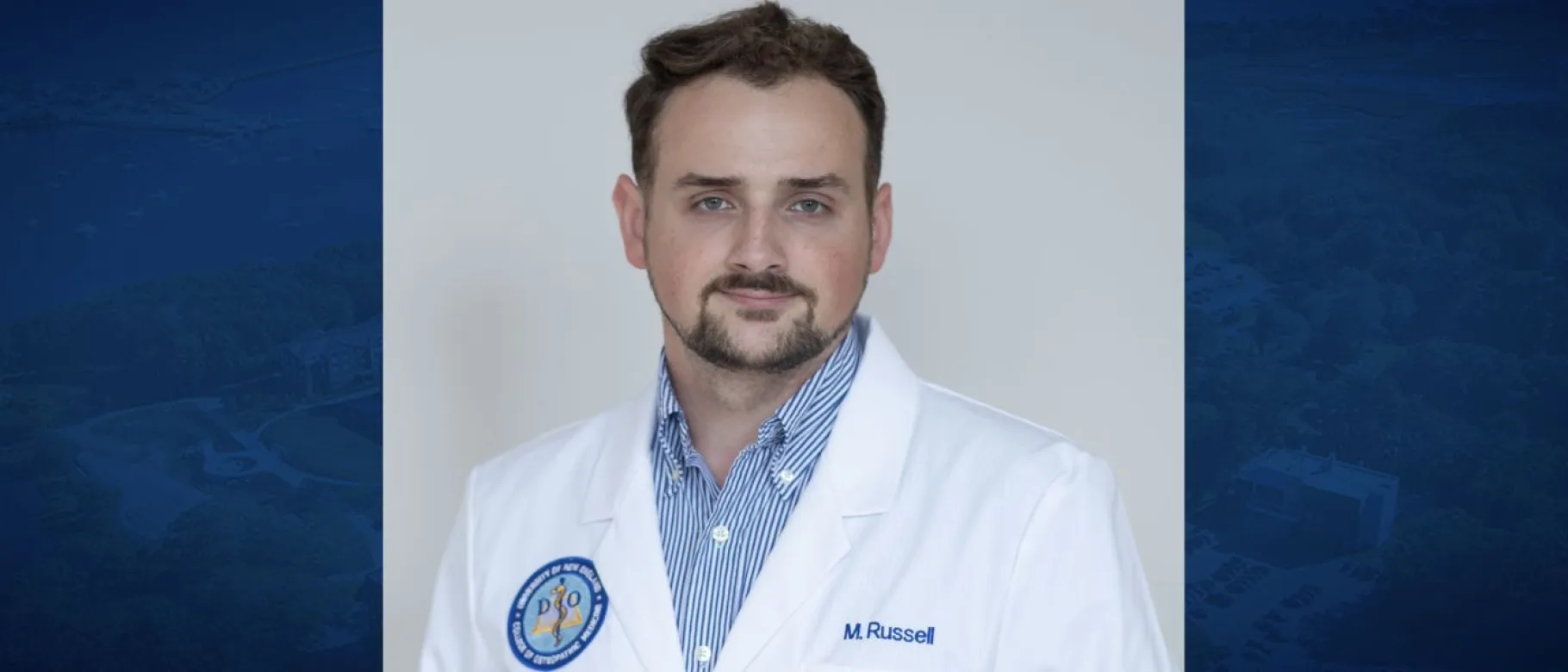
Max Russell was 12 years old when his father had a heart attack.
His father, then 39, was sent to MaineHealth Maine Medical Center in Portland, where a cardiologist placed a stent and, just as importantly to the young Russell, took the time to explain what was happening to the family in plain, reassuring terms.
“I knew, at a pretty young age, that’s what I want to do,” said Russell, B.S. ’21 (’26), a University of New England Doctor of Osteopathic Medicine student, reflecting on the experience with the cardiologist. “I want to help people like that.”
By age 16, Russell was shadowing an emergency medicine physician. And, he said, each experience confirmed what he already suspected.
“Every time I went and saw patients, it made me more interested and just really confirmed that it was what I wanted to do,” Russell said, who is from Sidney, Maine.
Russell completed his undergraduate education at UNE, with dual bachelor’s degrees in history and biology, before taking a gap year to work as a cardiac technician at MaineGeneral Medical Center in Augusta, performing stress tests, Holter monitors, and EKGs.
“UNE felt like a natural fit,” he said. “Being able to stay close to family and being able to stay in the state just made sense.”
In 2022, Russell jumped feet first into medical school, where his first two years covered foundational science, anatomy, and clinical skills, before spending his third and fourth years in hospitals and clinics across Maine.
As a Dirigo Scholar and recipient of the Doctors for Maine’s Future Scholarship, funded through the Finance Authority of Maine, Russell received financial support that meaningfully reduced the debt burden of medical school, but also guaranteed placement of clinical rotations in Maine.
The Dirigo Scholars track at UNE is a focused pathway within Maine’s medical school designed to strengthen the physician workforce in northern and rural Maine. Today, students receive early assurance of third-year clinical placement at Northern Light Eastern Maine Medical Center in Bangor, along with mentorship and early clinical exposure starting in their first year. By connecting students directly to care settings in underserved regions, the program aims to prepare future physicians to train, stay, and serve communities across Maine.
As of 2025, 62% of UNE’s Doctors for Maine’s Future graduates go on to work in Maine.
For Russell, what he encountered in clinical rotations sharpened his understanding of what medicine looks like outside a textbook.
Patients across rural Maine faced barriers that were bigger than the diagnosis itself, he said, with no way to get to an appointment, no way to afford a medication, no specialist available for months.
“The right answer might be (a specific procedure), but if they can’t get it in a year, it might not be the right answer,” he said.
That tension between what medicine can offer and what patients can access in rural parts of the state is part of what has kept him committed to Maine, he said. Growing up in a rural community, like many, he served as a medical student, which gave him a fluency he sees as part of the care he can provide.
“There’s a certain comfort level of walking into a room and talking to someone whose way of life I can understand,” he said.
In the past 10 years, UNE has added more clerkships in rural parts of Maine. Of the roughly 165 students in UNE’s medical school who do clinical rotations in their third year, about 65 to 70 remain in Maine for those clerkships — including roughly 35 who do some portion of that clerkship in a rural area.
Russell has carried his experience to the Maine State House, testifying in support of continued funding for the Dirigo Scholars program and others like it.
“Medical students just take on an incredible amount of debt,” he said. “If there’s even one student in the state who wants to become a doctor and shies away from doing it because it’s super expensive, then that’s where money should be going.”
In March, Russell matched to an internal medicine residency at MaineHealth Maine Medical Center in Portland, the same institution that cared for his father, and will cross the stage at UNE's Commencement on May 16.
The residency is the first step toward pursuing a cardiology fellowship, a specialty he has been drawn to since the night a cardiologist in Portland showed him what medicine at its best can look like.
He noted that the pattern of where physicians land tends to follow where they train and where they are from, referring to a study stating that, statistically, residents practice within 100 miles of where they completed residency. It is a principle he is living out himself, and when he reflects on what confirmed that medicine was the right path, he reaches for something quieter than one defining moment.
“It was the accrual of many, many small changes and small improvements in your patient’s lives that crystallized that this is the right career for me,” he said.