New graduate earns physical therapy doctorate to give back to her Indigenous community
Brittany Conley traveled across the country to Maine to earn her degree, but she now hopes to bring her expertise back home to the Choctaw Nation in Oklahoma
When Brittany Conley was 4 years old, her father was nearly killed in a head-on truck collision that shattered his pelvis, fractured his femur, and left him with nerve damage. A team of surgeons told James Patrick Conley he would never walk again. A rehabilitation team in Arkansas proved them wrong.
That team was the inspiration for Brittany Conley, a first-generation student, to pursue a Doctor of Physical Therapy (D.P.T.) degree at the University of New England, making Conley, who is a member of the Choctaw Nation, one of the few members of her Indigenous community to earn a terminal degree.
"If it weren't for them, I don't know if I would have been able to become a physical therapist," Conley said of the physical therapy team who were her first role models. "It just changed everything. That's my passion behind this, because as I grew, I realized that things would have been totally different for my dad.”
On May 16, Conley became one of the few people in her community to earn a doctoral degree when she graduated from UNE’s Westbrook College of Health Professions. Now she intends to bring that expertise back home to her community in Smithville, Oklahoma, a community of just 77, where there are few healthcare resources.
“I just saw firsthand how difficult it is for us to get healthcare. The nearest hospital that we had, which is a Choctaw Nation hospital, is an hour away,” Conley said.
Conley, whose great grandmother was 100% Choctaw, hopes to return to her community to serve at least part of her three-year commitment for the federally funded loan reimbursement grant, the Indian Health Service Scholarship that covered her final year at UNE.
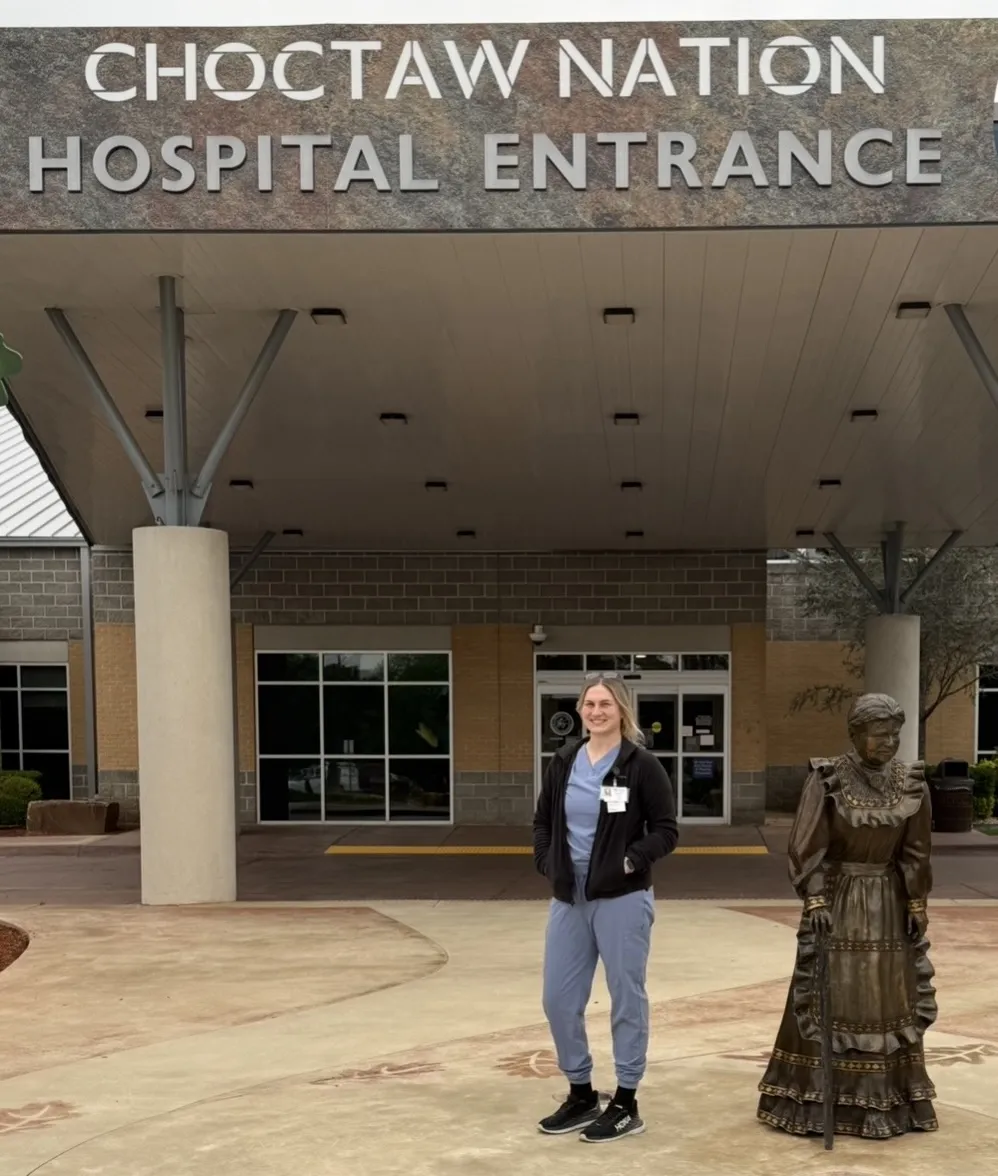
Returning to serve the Choctaw Nation was always Conley’s goal. She recently completed a clinical rotation at the Choctaw Nation's hospital in Talihina, Oklahoma, where, to her delight, patients recognized her as Debbie and James Patrick Conley’s daughter.
“I worked with age ranges from 12 to 80-plus. I got to see a lot of elders and a bunch of people from Smithville. They asked what I was doing, and I said, ‘Guess what? I’m a Doctor of Physical Therapy now.’ They thought that was pretty cool,” Conley said.
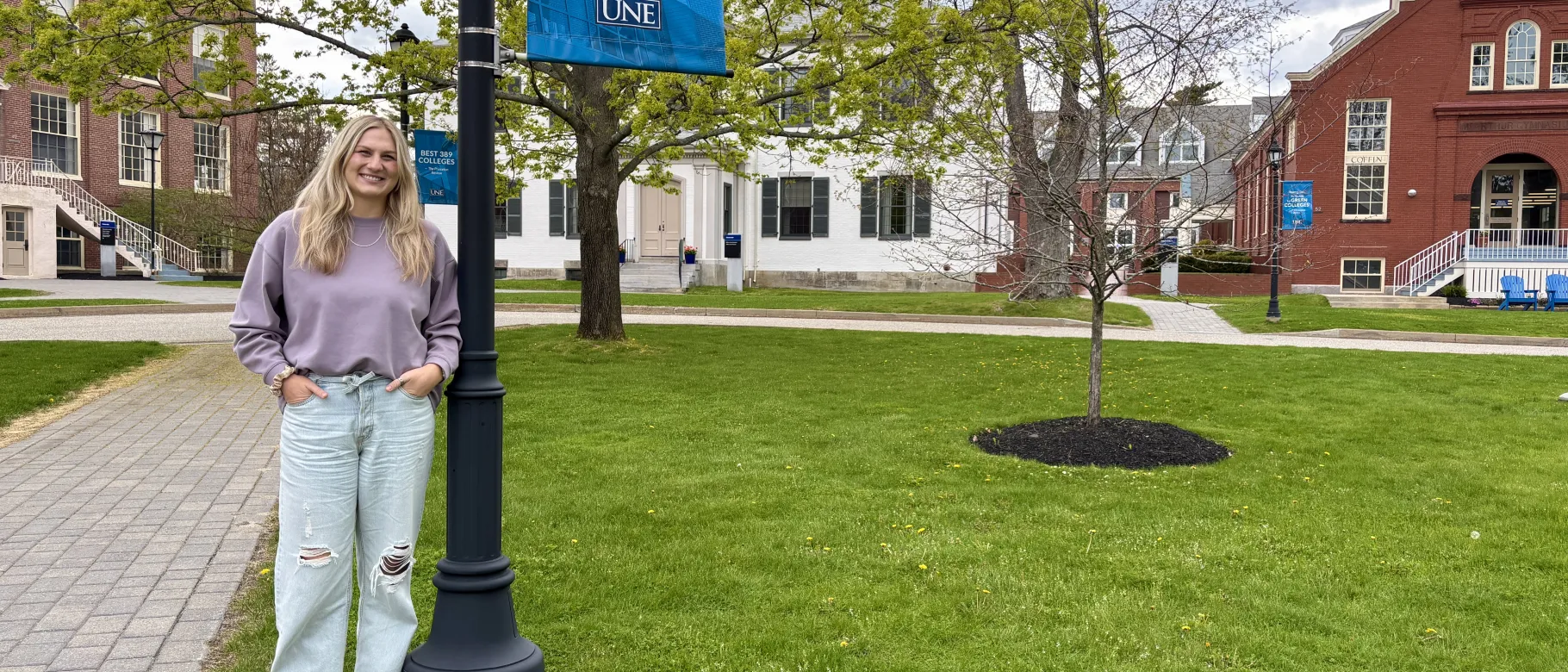
It was for a similar sense of community at UNE that Conley traveled across the country to pursue her doctorate in Maine. When she saw a video on the UNE website of current students describing how supported they felt by the faculty, Conley said she knew it was the school for her when she had to decide between the three programs she was accepted into.
“The videos showed previous students who talked about the support they got from the faculty and the staff here at UNE. That really set UNE apart as I made my decision,” Conley said. “I knew how hard it was going to be going to PT school. And I didn’t know anyone in Maine. That’s really what I was searching for: some community. Because I’d always had that.”
UNE’s faculty demonstrated that support instantly.
When Conley started her first clinical rotation in her first year, she had doubts and concerns. She turned immediately to Assistant Clinical Professor Amanda Benner, PT, D.P.T., NCS, assistant director of Clinical Education in UNE’s Department of Physical Therapy. Benner listened and helped guide Conley through the challenges.
“Thankfully, I had Amanda. She supported me. And Amanda continued to check in on me to see how things were going,” Conley said.
Benner praised Conley’s “remarkable resilience and unwavering in her commitment to learning and the physical therapy profession.”
“Watching her return to the Choctaw Nation for her final clinical experience feels like a true full-circle moment and highlights the dedication and growth she has shown throughout her journey,” Benner said.
While Conley hopes to serve at least part of her three-year commitment for the Indian Health Service Scholarship federal loan in the Choctaw Nation, she’s not worried if she must step into a new experience in a new place. She learned through her UNE journey how to face challenge and change and know all of it will help make her a better physical therapist.
“It’s funny, I’ve done all these things scared,” Conley said. “My brother, Bryan, wants to go to medical school and he’s nervous. And I’m like, ‘Just do it scared. It will be uncomfortable, but if it’s not uncomfortable, then you're not challenging yourself.’
“That's something I tell my patients now,” she said.