
UNE Center for Global Humanities announces Spring 2026 events addressing timely world topics
The center for Global Humanities tackles democratic resilience, online surveillance, microplastics in our environment and bodies, and more this spring
The Center for Global Humanities at the University of New England has unveiled its spring 2026 events schedule, inviting students, faculty, and members of the wider community to engage with pressing global issues through lectures, films, and conversations.
This spring, the Center for Global Humanities (CGH) will host seven events, including four on UNE’s Portland Campus for the Health Sciencesand three on the Biddeford Campus.
“At a time when our world is facing so many challenges and many of us feel overwhelmed, CGH provides a space where people can come together and find comfort and intellectual nourishment in lectures, films, and meaningful conversations,” said CGH Director Josh Pahigian, M.F.A. “I always leave our events feeling a little better than when I walked in.”
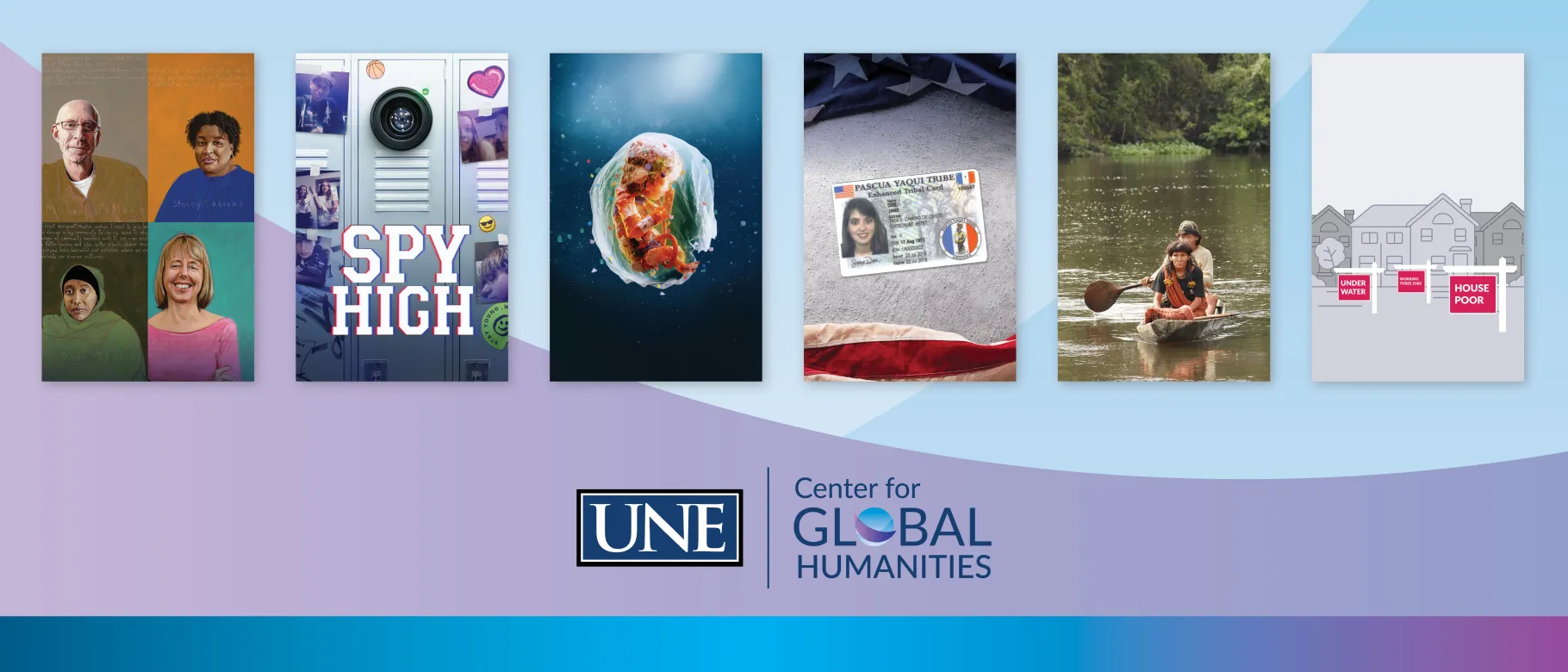
The new season opens on Jan. 26 with a lecture titled “Art in an Age of Democratic Upheaval” by Maine artist Robert Shetterly. Shetterly will detail his “Americans Who Tell the Truth” portrait project, which has taken him to more than 40 U.S. states and all around the world to share his art and reflect on how the people he paints embody American values and patriotism.
During the welcome reception before Shetterly’s talk, the center will display several portraits from the series. And, overlapping with the welcome reception in an abutting room, CGH is partnering with UNE’s Westbrook College of Health Professions and the Division of Student Affairs to present a drop-in community arts project through which visitors can create a personally meaningful piece of art that helps build a mosaic connecting us all.
Next, on Feb. 9, the Biddeford Campus hosts a special screening and conversation around “Spy High,” a documentary that catalyzes important conversations about the role of technology in school administration, online privacy, racial stereotyping, and more. After an abridged screening of the docuseries, Pahigian will lead a conversation with UNE First Lady Lynn Brandsma, Ph.D., who appears in the series as an expert commentator.
Two weeks later, on Feb. 23, the Portland Campus presents the award-winning film “Plastic People,” which explores how plastic pollution in our environment is creating disturbing amounts of microplastics in our bodies. The Center will screen the film again on March 11 at the Biddeford Campus, ensuring broader access for students and community members on both Maine campuses.
The Biddeford screening offers the Center the chance to experiment with a different event format: While the event won’t include the usual CGH welcome reception, it will feature freshly-made movie popcorn and boxes of movie candy for all to enjoy.
The series continues on March 23 in Portland with a lecture titled “Who Gets to Be Native in America?” by former Obama administration policy advisor and enrolled member of the Lumbee Tribe of North Carolina, Carrie Lowry Schuettpelz, who now directs the Native Policy Lab at the University of Iowa.
On April 1, the Biddeford Campus will host “The Amazon Beyond Extractivism: Indigenous Stories of Entangled Beings,” by Patrícia Vieira, which centers Indigenous perspectives on environmental stewardship and challenges extractive narratives that have long shaped global views of Amazonian ecology and culture.
Vieira is a research professor at the Center for Social Studies at the University of Coimbra in Portugal but is spending a semester engaged in a fellowship at a college in Massachusetts, giving CGH the opportunity to bring her to campus.
The series concludes on Tuesday, April 28, when Atlantic editor Yoni Appelbaum presents “Who Killed the American Dream?” The lecture will build off Appelbaum’s recent book, “Stuck: How the Privileged and Propertied Broke the Engine of American Opportunity,” to examine how America’s lack of affordable housing is restricting people’s geographic and social mobility.
For full details on times, locations, and the speakers, visit the Center for Global Humanities website.