
UNE Center for Global Humanities screens documentary “Plastic People” on Feb. 23
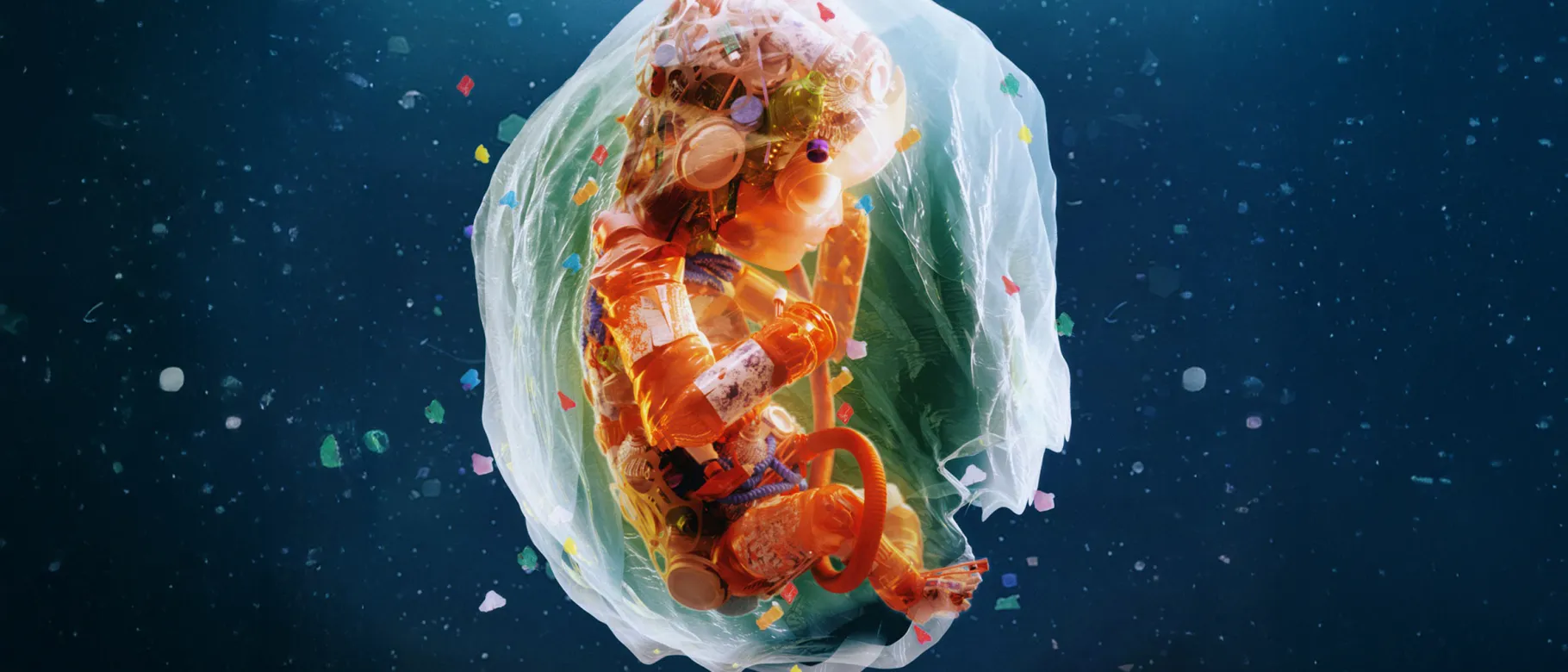
Every molecule of plastic ever created still exists on Earth in some stage of degradation. It should come as no surprise, therefore, that more and more of these molecules, known as microplastics or nanoplastics, are making their way into our food systems and ultimately our bodies.
This is the topic explored by the award-winning documentary film “Plastic People,” which will be screened by the UNE Center for Global Humanities on Feb. 23 at 6 p.m. in the WCHP Lecture Hall, located in the Parker Pavilion on the UNE Portland Campus for the Health Sciences.
The film introduces viewers to Canadian science journalist Ziya Tong, who takes a personal approach to investigating this topic by visiting scientists around the world and undergoing experiments in her home, on her food, and on her body while collaborating with director Ben Addelman in an urgent call to action for all of us to rethink our relationship with plastic.
Along the way, viewers learn more about the microscopic particles adrift in the air, floating in all bodies of water, and mixing into the soil, becoming a permanent part of the environment. Beyond this environmental impact, the film explores the health impacts on our bodies, demonstrating the extent to which these particles now exist in our organs, blood, brain tissue, and even the placentas of new mothers.
“The film explores how these invisible invaders affect our natural environment,” explained CGH Director Josh Pahigian, M.F.A., “and also how they affect our health. Both are of paramount concern at the University of New England, where we pride ourselves on supporting the health of people, communities, and the natural world.”
Indeed, the danger of microplastics is a familiar topic to some in the UNE community.
Last year, Associate Professor of Pharmacy Steven Sutton, Ph.D., released the findings of a new study conducted by his lab demonstrating that the tiny fragments of plastic increasingly present in our food may be exacerbating inflammation of the gut, especially in individuals with conditions like irritable bowel disease.
Previously, Associate Professor of Marine Affairs Susan Farady, J.D., published a paper detailing the increasing presence of plastic marine debris in our oceans and calling for urgent action to mitigate its effects.
“Plastic People” was named the winner of the Environmental Award at the Hamptons Doc Fest and the Jury Prize at the Filme für die Erde Festival in Switzerland. It was also recognized as one of Variety's Best Documentaries of 2024.
View the film’s trailer for a sneak peek.
This will be the third event of the spring semester at the Center for Global Humanities, where lectures and films are always free. For more information, please the Center for Global Humanities website.