
UNE health professions students put clinical skills into action at TD Beach to Beacon 10K
Students from multiple disciplines worked alongside practicing health professionals to provide medical support to thousands of runners at Maine’s largest road race.
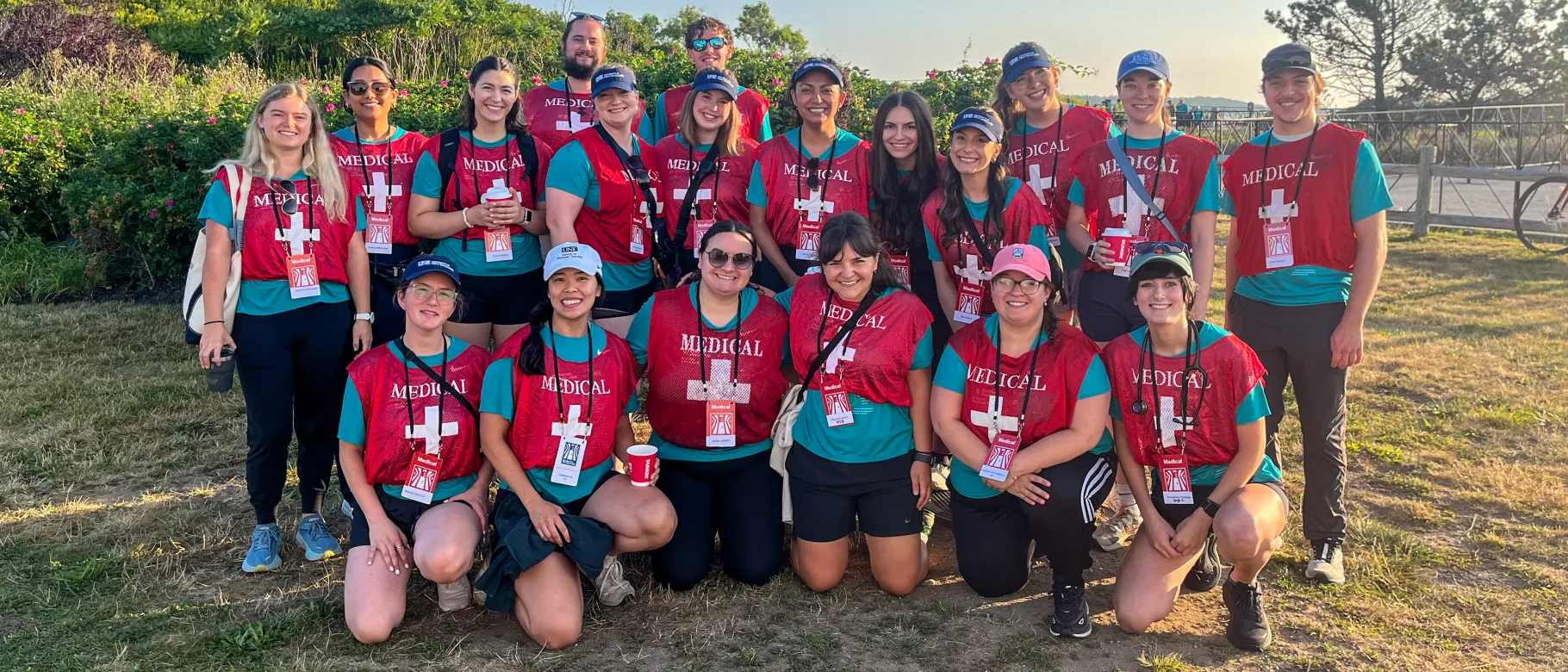
Photo courtesy of Kathleen Le
As runners crossed the finish line of the TD Beach to Beacon 10K on Aug. 1, University of New England Doctor of Physical Therapy student Jessica Gundersen (D.P.T., ’27) had little time to celebrate their accomplishment.
Instead, she was watching closely for the runners who stumbled, became disoriented, or simply could not stay on their feet.
“I was stationed at the finish line, and my job was to look out for heat illness and ensure that people who needed medical attention were brought to the medical tent,” Gundersen said. “It was a lot of catching people who were collapsing at or just after the finish line.”
Gundersen was among a group of UNE health professions students who volunteered as part of the medical team for the 28th running of the TD Beach to Beacon, putting their developing clinical skills to work while helping protect the health and well-being of nearly 6,500 runners participating in Maine’s largest road race.
Stationed both along the 6.2-mile course and at the finish in Fort Williams Park, the students worked alongside practicing health professionals to identify and assist runners experiencing heat-related illness and other medical concerns. The experience offered students from UNE’s doctorate programs in medicine and physical therapy an opportunity to serve their neighbors while encountering a fast-moving clinical environment unlike what they typically experience in a classroom or traditional care setting.
For Gundersen, who is from Houston, Texas, one of the most valuable aspects of the day was seeing both working clinicians and her peers from different health disciplines respond collectively when runners needed care.
“This experience was much more fast-paced than any clinical setting I have encountered so far,” she said. “What stood out most was the exceptional level of interprofessional collaboration. Everyone worked together very well, creating a supportive and effective team environment which ultimately ensured that so many race participants received timely care.”
That collaborative approach is central to how UNE prepares the next generation of Maine’s health care workforce. As the state’s largest educator of health professionals, UNE intentionally brings students from different disciplines together throughout their education, helping them understand not only their own professional responsibilities but also the expertise their future colleagues bring to patient care.
At the Beach to Beacon, those lessons moved from the classroom directly onto the racecourse.
Nicholas Jackson (D.O., ’29), a College of Osteopathic Medicine student from Hallowell, Maine, initially served as a scribe in the medical tent before quickly assuming additional clinical responsibilities, including checking vital signs, conducting assessments, and reporting to the supervising physician.
Jackson had previously worked the Beach to Beacon as a paramedic, but this year’s race gave him a new perspective as a future physician. He helped care for runners experiencing a range of heat-related conditions, including several who required cold-water immersion for heat stroke.
“I knew the textbook way to treat heat stroke,” Jackson said. “(But) it was an entirely different and valuable experience to see athletes presenting in extremis, performing the intervention, and watching them walk out of the tent in good health and spirit.”
For Jackson, the experience also demonstrated how the same patient can benefit from the complementary expertise of different professions.
“It was great to see how the different professions all interacted,” he said. “I appreciated seeing the physical therapists treat and comparing their techniques to our osteopathic techniques.”
That interplay was also evident along the course. Physical therapy student Alicia Rojas (D.P.T., ’27), of Salinas, California, was stationed shortly before the finish line, where runners faced an elevated risk of heat exhaustion following one of the course’s challenging inclines.
Rojas said working alongside medical students and other health professionals helped her better understand how each discipline approaches a patient. While physicians, nurses, and emergency medical personnel may initially focus on vital signs, she said, physical therapists can contribute additional observations about movement, breathing, and functional ability. The experience gave her a new appreciation for how those perspectives can complement one another in a high-pressure environment, she said.
In an effort led by Erin Hartigan, PT, D.P.T., Ph.D., professor in UNE’s Department of Physical Therapy and UNE's Center to Advance Interprofessional Education and Practice, the students joined a longstanding volunteer effort that is essential to staging the internationally recognized race. More than 800 volunteers support the Beach to Beacon each year, including medical professionals who staff the finish area and positions along the course to quickly identify runners in distress.
For UNE students, the opportunity also reflects a broader responsibility that comes with entering the health professions: using their education in service to the places and people around them.
Erin Hartigan said experiences like the Beach to Beacon allow students to develop that sense of responsibility while building the confidence and judgment they will need as practicing clinicians.
“A hallmark of our D.P.T. program is providing students with opportunities to apply their classroom knowledge in real-world settings,” Hartigan said. “Experiences like volunteering at the Beach to Beacon build clinical confidence, sharpen clinical reasoning, and reinforce the compassion, teamwork, and interprofessional collaboration that define exceptional physical therapists.”
The immediacy of race-day medicine, Hartigan added, gives students something that cannot be replicated through lectures alone.
“No lecture can prepare a student for the moment they recognize a runner in distress and help get that individual to the medical tent, where rapid cooling could save a life,” she said. “Experiences like these transform knowledge into confidence, judgment, and compassion, preparing our students to enter practice ready to make an immediate impact in their communities.”
Kathleen Le, D.P.T. ’19, a working physical therapist with varied experience in neurological, orthopedic, and home health care, volunteered as a student coordinator and said the experience was a valuable learning opportunity for her, as well.
“I think students are so fun, and I learn from them just as much as they learn from their experience,” she said. “I was really surprised at how well the students jumped into the chaos and embraced the madness. They all did really great.”
For Gundersen, the experience affirmed that the interprofessional education she is receiving at UNE translates well beyond campus.
“UNE has done a great job creating interprofessional learning opportunities that have helped me develop the skills and confidence needed to succeed in a variety of settings, including Beach to Beacon,” she said.
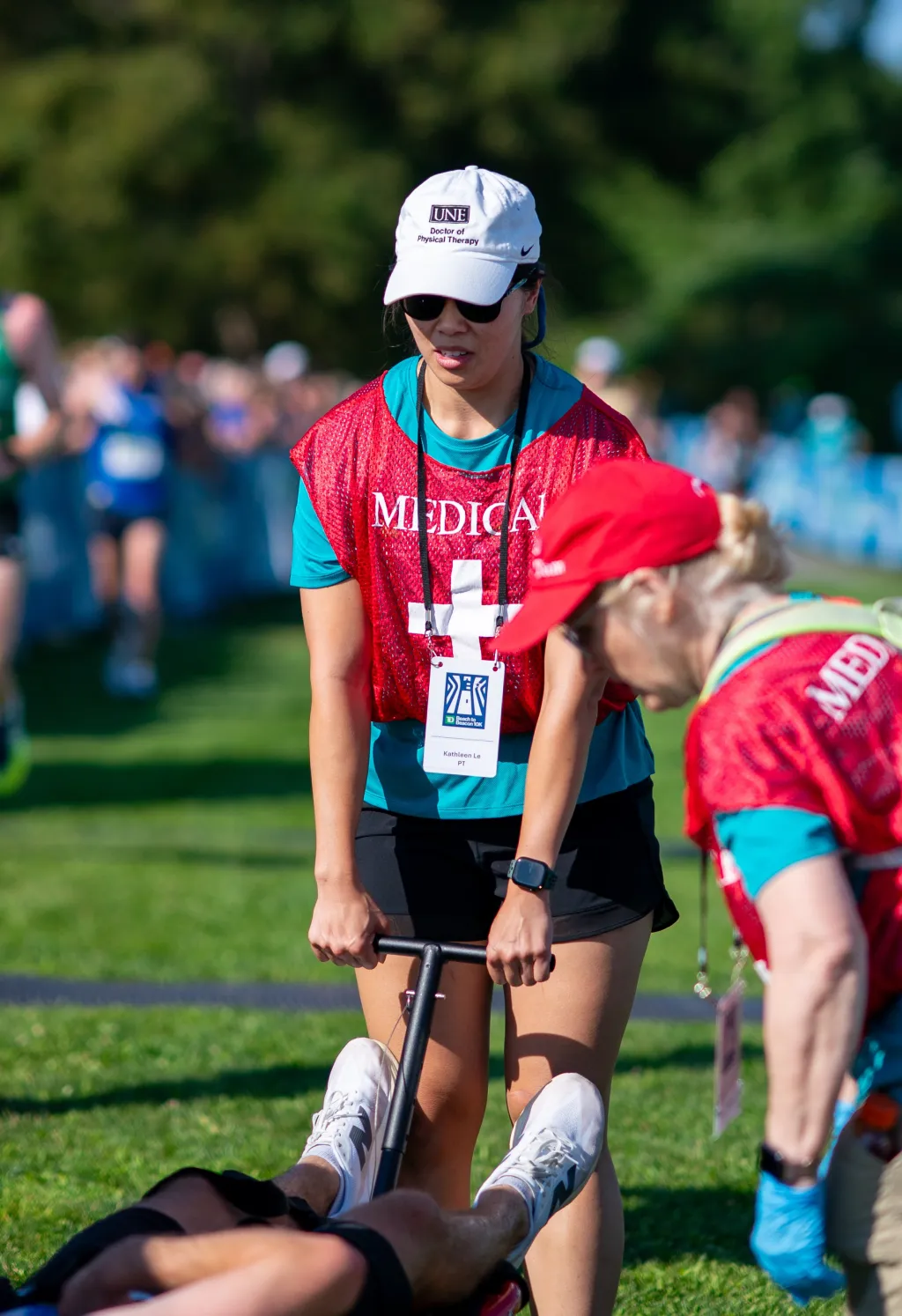
Kathleen Le, D.P.T. ’19, assists an injured runner at Beach to Beacon 2026