
UNE researcher's chestnut trees planted at President’s Park in conservation milestone
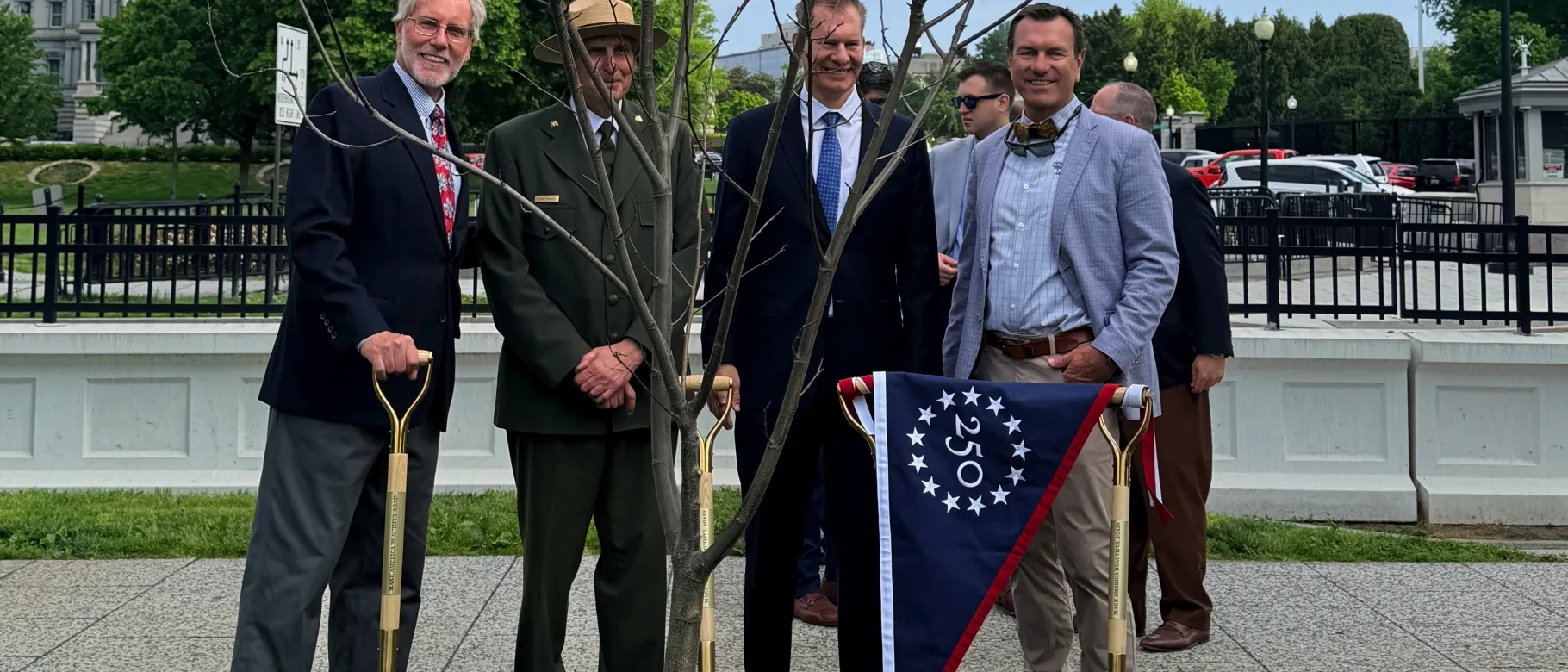
Two blight-tolerant American chestnut trees bred from pollen cultivated in a University of New England lab were planted by the National Park Service and the U.S. Forest Service in front of the White House in Washington, D.C., on April 24—Arbor Day—in what researchers are calling a landmark moment in one of the most ambitious ecological restoration efforts in American history.
The trees, both from the Darling 54 line of American chestnut, were transplanted from a test orchard in Cape Elizabeth, Maine, where they had been part of ongoing field trials conducted by Tom Klak, Ph.D., a professor in UNE's School of Marine and Environmental Programs, and his students. At five years old, each tree stands 15 feet tall.
The trees were donated to the American people by SilvaBio, the biotechnology company advancing the Darling breakthrough beyond the lab into scalable, real-world application to restore and safeguard America’s hardwood forests. As a Public Benefit Company committed to responsible reforestation, SilvaBio works closely with researchers at UNE, the State University of New York, and partners across participating institutions to help ensure the long-term success of the American chestnut’s return.
"The historic planting of UNE blight-tolerant American chestnuts on White House grounds are the first transgenic plants ever on federal land and they were enthusiastically received by the various federal agencies involved and that celebrated the event," said Klak. "It's an exciting moment in American chestnut research and restoration."
Klak’s research assistant, Shelby Budzko (Environmental Science, ’27), said seeing the planting take place in such a public space was gratifying.
“It is an incredibly rewarding experience to work towards restoring a functionally extinct species and contribute to this unique project. Meticulously pollinating the trees and holding the next generation of chestnuts in your hands is such an incredible feeling,” Budzko said.
The ceremony on the Ellipse, also called President's Park, featured remarks from officials at the National Park Service, U.S. Forest Service, the U.S. Environmental Protection Agency, and SilvaBio. Attendees included representatives from federal agencies, national forestry and conservation organizations, biomass and energy industry groups, and private landowners–highlighting a shared commitment to restore this treasured part of the country’s natural heritage.
National Park Service Acting Director Jessica Bowron described the loss of the American chestnut as "one of the largest ecological disasters in our nation's history," noting that the species once stretched across more than 200 million acres of eastern forest before a blight accidentally imported from Asia in the early 1900s wiped out an estimated 4 billion trees.
Klak and his students have spent more than a decade working toward this kind of moment. At UNE, he and his student research teams have tested hundreds of lineages of wild and genetically enhanced chestnuts and developed a speed-growing technique using grow lights that compresses the time needed to bring a seedling to maturity from four or more years to just 12 months.
The pollen used to breed the White House trees was cultivated in UNE's Arthur P. Girard Marine Science Center on the Biddeford Campus. The Darling 54 strain, developed by scientists at SUNY's College of Environmental Science and Forestry, carries a wheat gene intended to confer tolerance to the chestnut blight fungus.
The trees were dug and then transported from Maine to Washington, D.C., under the care of Bartlett Tree Experts from Scarborough, Maine.
SilvaBio CEO Michael Bloom also called the moment historic.
"On the eve of our nation's 250th anniversary, I can think of no better place to mark that occasion than here — on the grounds of President's Park, steps from the White House, with these trees," he said.