UNE senior conducts research on the Arctic, in the Arctic, through UNE exchange program
Photos courtesy of Lydia Jones
A self-directed research project carried out thousands of miles from Maine’s shores is helping a University of New England senior — and a network of global researchers — better understand Arctic marine ecosystems, while informing her own future in science.
Lydia Jones (Marine Sciences, ’26) spent the fall semester studying at UiT The Arctic University of Norway in Tromsø through UNE’s North2North Exchange, a global education program designed to connect students with institutions in northern regions.
While abroad, Jones independently arranged to complete an undergraduate thesis under the guidance of Bodil Bluhm, Ph.D., a professor of marine and Arctic ecology at Tromsø, analyzing previously unexamined seafloor imagery from a 2024 research cruise in the Canadian Arctic.
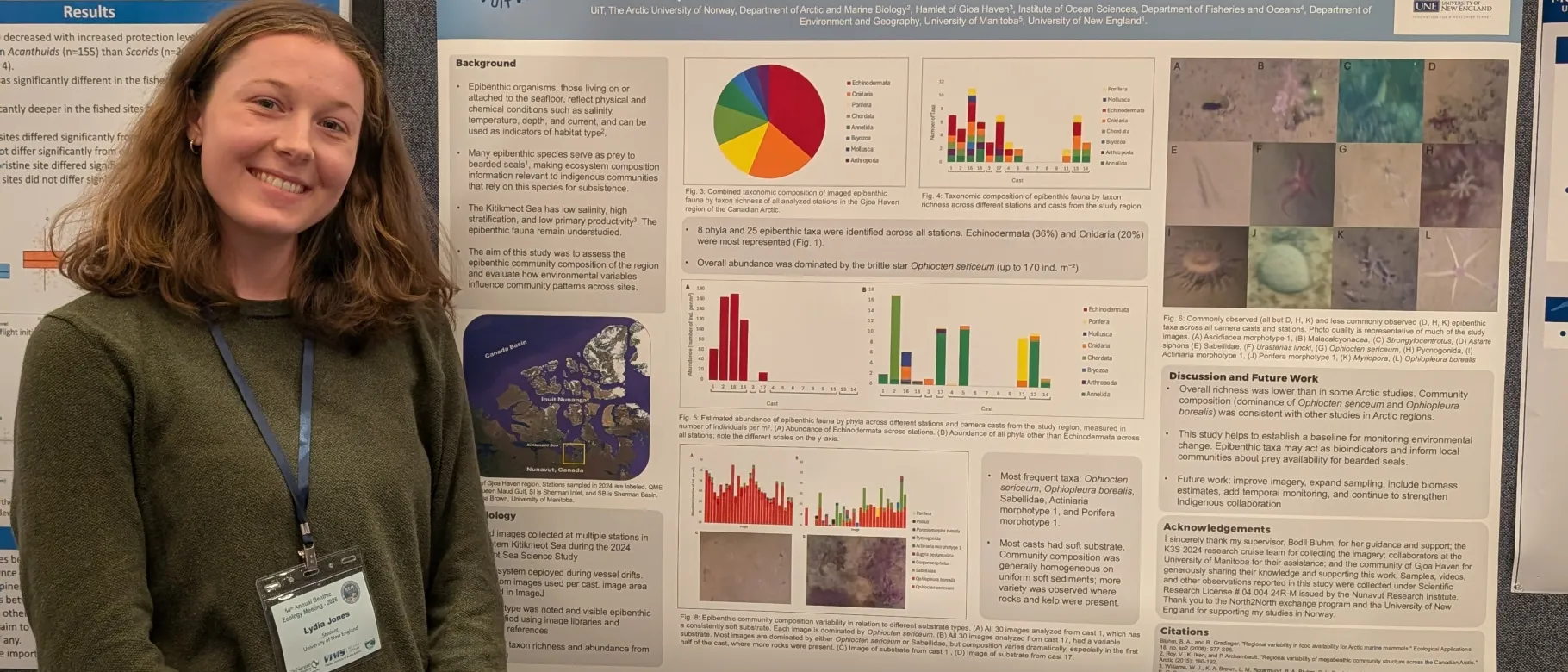
Her project focused on identifying and counting organisms living on the ocean floor, a process that involved reviewing photographs taken along underwater transects every few seconds. By calculating how many individuals of each species appeared within a defined area, Jones said, she was able to estimate species abundance and compare community composition across different seafloor substrates.
“We were essentially building a clearer picture of what’s down there,” Jones explained. “It sounds simple — counting organisms and trying to identify them — but it can be challenging when imagery is blurry or species are difficult to distinguish. Still, we were able to identify a wide range of life, especially echinoderms like brittle stars and sea stars, along with sea cucumbers, worms, and corals.”
The work contributes to baseline ecological knowledge in Canada’s Kitikmeot Sea, a region that remains largely understudied but is experiencing rapid environmental change linked to warming Arctic conditions. Establishing current species distributions and abundance can help scientists track future shifts and inform conservation and resource management strategies.
Jones noted that the research also holds practical relevance for Indigenous communities in the region. Many of the organisms she studied serve as prey for bearded seals, an important subsistence species. Understanding where these prey species are most abundant can provide insights into seal behavior and migration patterns that support traditional hunting practices.
Jones credits the University’s global programming and supportive academic environment for empowering her to pursue the opportunity. After a previous semester abroad in Iceland, she sought out the North2North Exchange as a way to continue combining her interests in marine science, travel, and northern ecosystems.
Jones recently presented her findings at the 2026 Benthic Ecology Meeting in Virginia Beach, Virginia, gaining feedback from researchers across the field and building confidence in her ability to contribute to ongoing scientific conversations. Looking ahead, she plans to pursue a master’s degree, ideally abroad, building on the international experience and research skills she developed through her thesis work.
Her experience reflects UNE’s broader commitment to providing students with hands-on learning opportunities. Over 40% of UNE students participate in undergraduate research opportunities during their studies, and 95% of graduates are employed or enrolled in continuing education within one year of graduation, outcomes Jones says feel increasingly within reach as she prepares for the next step in her academic journey.
“Doing research as an undergraduate gave me a much better sense of the scientific process,” she said. “It showed me areas where I still want to grow, but it also encouraged me that I’m on the right path.”
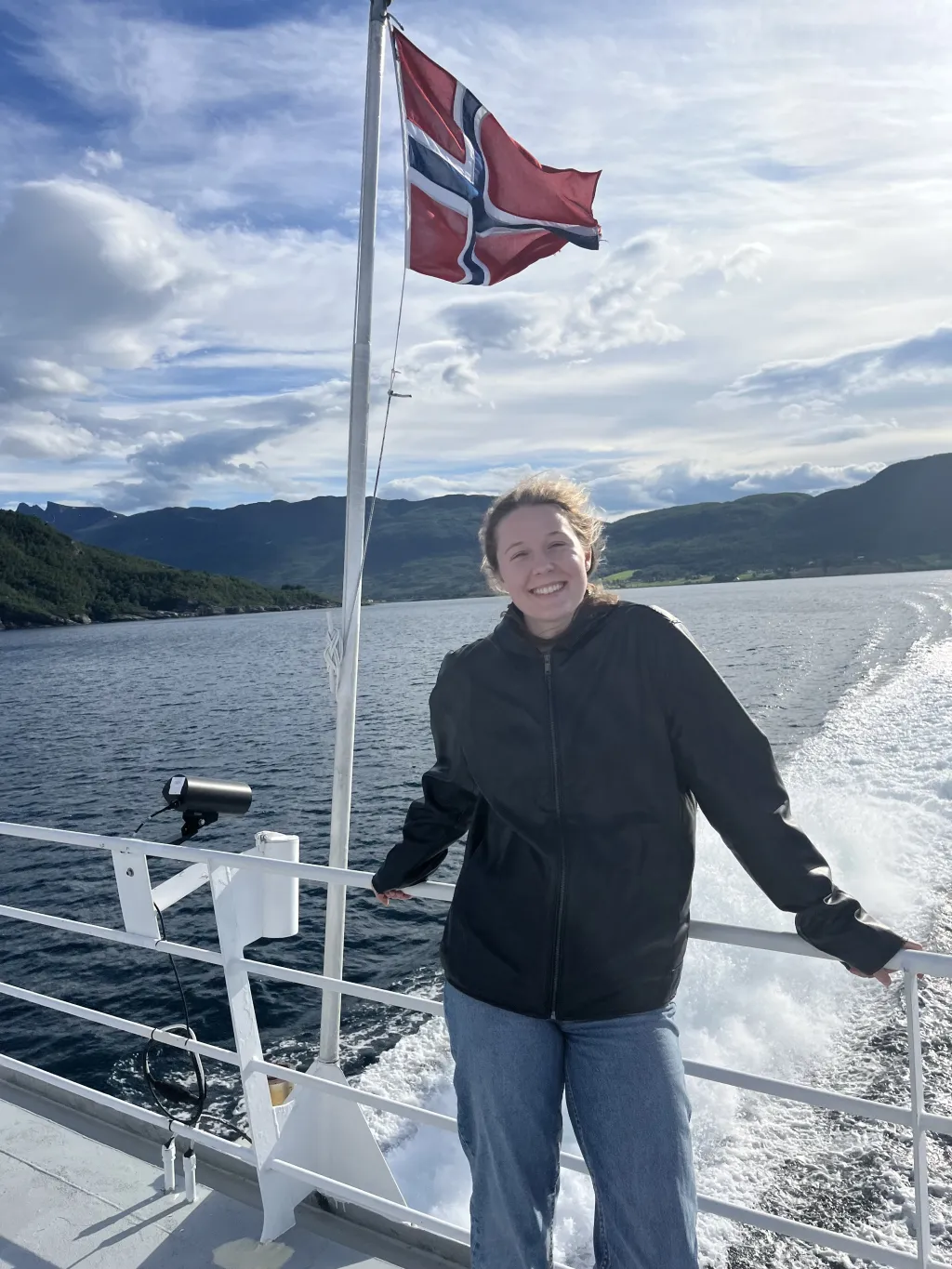
Lydia Jones ’26 off the Norwegian coast