
UNE’s Eva Rose Balog joins statewide industry leaders for ‘Women in Bioscience’ discussion in Portland
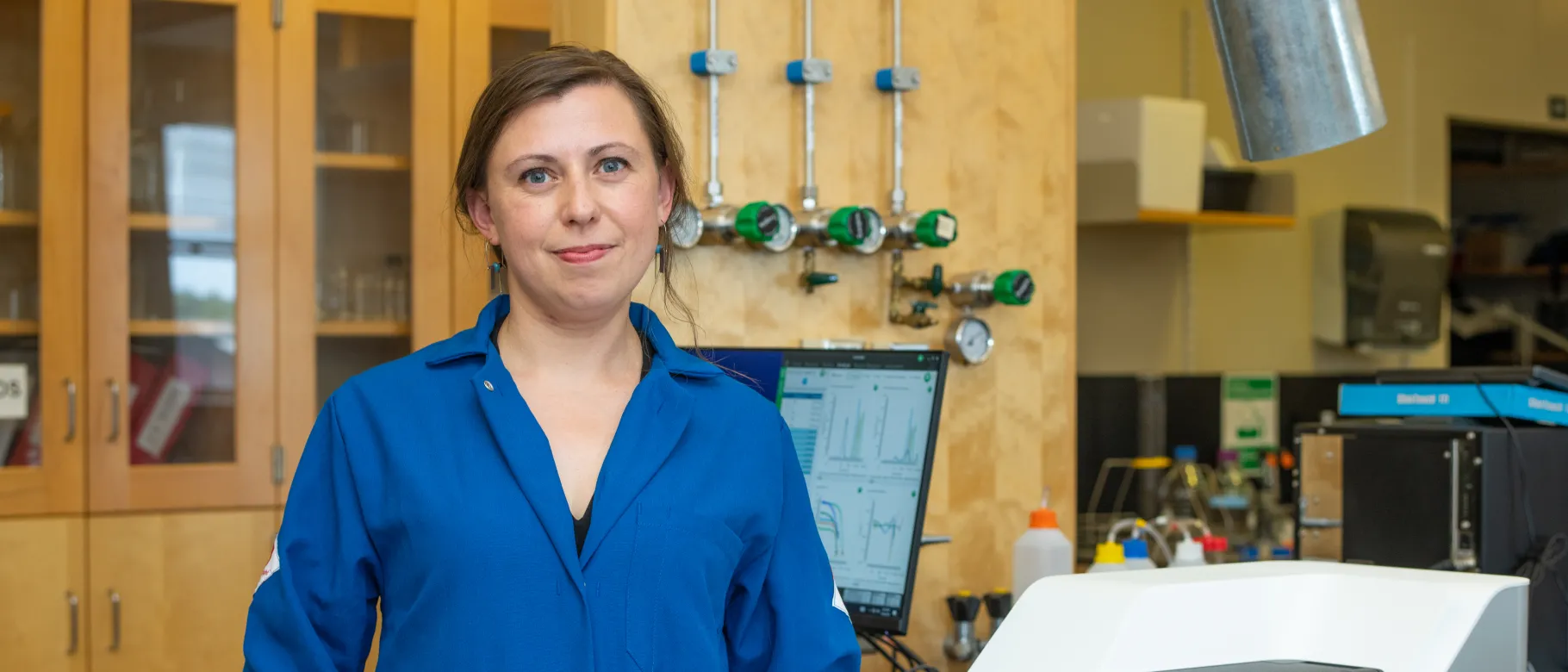
The role of women researchers in Maine’s burgeoning life sciences industry was the sole focus of a recent panel hosted by the Bioscience Association of Maine (BioME) and featuring the University of New England’s Eva Rose Balog, Ph.D., as a leading voice in the discussion.
Balog, professor of chemistry in UNE’s College of Arts and Sciences, joined fellow leaders from across the state’s research community for the association’s ninth annual “Women in Bioscience” event, held June 10 at Allagash Brewing Company in Portland. The evening brought together scientists, entrepreneurs, students, and industry professionals to discuss leadership, mentorship, career development, and the evolving opportunities available to women in Maine’s growing life sciences sector.
Moderated by Janet Yancey-Wrona of the University of Maine, the panel featured Balog alongside representatives from Bigelow Laboratory for Ocean Sciences, BBI Solutions, and MDI Biological Laboratory. Panelists shared their professional journeys and perspectives on topics ranging from scientific leadership and resilience to mentorship, self-advocacy, and supporting the next generation of “Women in Bioscience.”
Reflecting on the event, Balog said she was struck by the breadth of Maine’s bioscience community represented in the room.
“There were both men and women present, but probably 90-plus percent women, of all ages and career stages and situations, from undergrads to interns, grad students, postdocs, start-ups, and well-known established businesses,” she said. “Really, the whole diverse ecosystem of Maine life sciences was represented, past, present, and future. I was incredibly honored to be among the panelists.”
Balog’s research interests lie in engineering protein systems for advanced biomaterials and biotechnology. One recent project aims to develop protein sensors to improve quality control in cell and tissue biomanufacturing.
She is a well-known fixture of UNE’s research ecosystem, having secured grant funding from the National Science Foundation to bolster Maine’s biotechnology industry, serving as one of three inaugural members of the Portland Laboratory for Biotechnology and Health Sciences, and representing CAS as one of four project leaders in the newly launched Center for Cell Signaling Research (CCSR), UNE’s second National Institutes of Health-funded Center of Biomedical Research Excellence.
During the discussion, Balog emphasized the importance of fostering supportive professional networks and ensuring women scientists have the mentorship and encouragement needed to thrive.
“At UNE I have been incredibly fortunate to have received excellent professional mentorship and support from women in STEM,” she said. “UNE has amazing female leaders and scholars worth celebrating and thanking for all they do, not only to support individuals, but also to effect systemic change toward greater equity of opportunity and recognition for women.”
Hosted annually by BioME, “Women in Bioscience” celebrates the women advancing Maine’s life sciences industry while creating opportunities for networking, mentorship, and collaboration across academia, research institutions, and private industry. This year’s event highlighted the growing strength of the state’s bioscience ecosystem and the role researchers like Balog continue to play in shaping its future.
For Balog, participating in the panel reflected more than an opportunity to share her own experiences. It also highlighted the increasingly prominent role UNE researchers are playing in advancing Maine’s bioscience sector through research, innovation, and workforce development.
She said that, as UNE continues to expand its research enterprise, faculty participation in statewide conversations like “Women in Bioscience” reflects the University’s growing role in advancing Maine’s life sciences industry while preparing the next generation of scientists and innovators for researchers like her.
“Increased visibility for me as a researcher invites unpredictable opportunities, connections, and collaborations for the future,” Balog said. “Those relationships ultimately strengthen not only my own work, but also the broader research ecosystem that supports scientific discovery and economic growth across Maine.”