
Image

This website uses cookies to understand how you use the website and to improve your experience. By continuing to use the website, you accept the University of New England’s use of cookies and similar technologies. To learn more about our use of cookies and how to manage your browser cookie settings, please review our Privacy Notice.
Undergraduate students recently took center stage at the University of New England’s Fall Art and Research Symposium on the Biddeford Campus, an entirely student-organized event coordinated by the Research Experience Club.
More than 40 students from the College of Arts and Sciences and the College of Business presented research spanning marine science, neuroscience, business innovation, environmental policy, and artistic interpretations of scientific concepts.
The turnout nearly tripled the projects from the previous year, reflecting the club’s mission to grow a culture of connections across UNE’s academic programs, said Ginika Onyemelukwe (Biological Sciences, ’25), president of the Research Experience Club and a research assistant working with faculty in the School of Biological Sciences, who will be graduating at the end of the month.
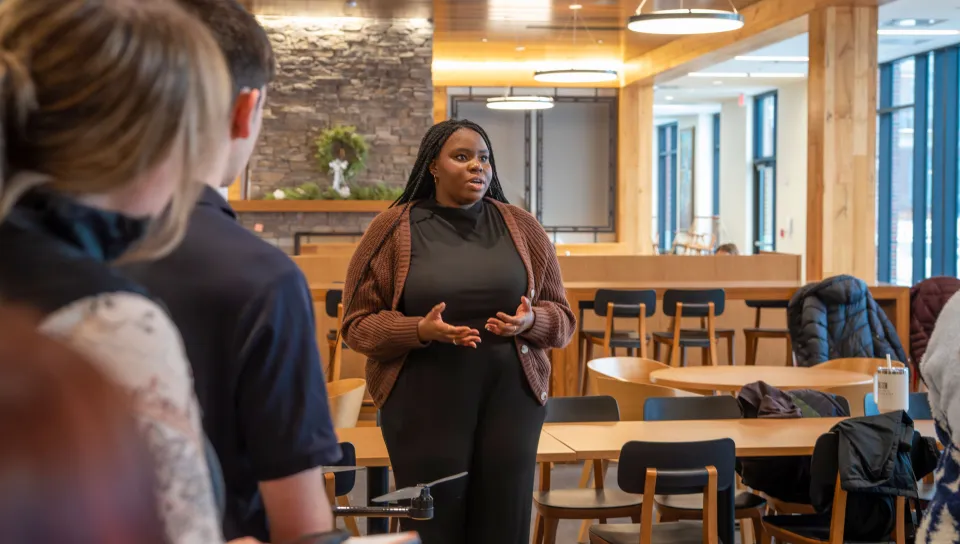
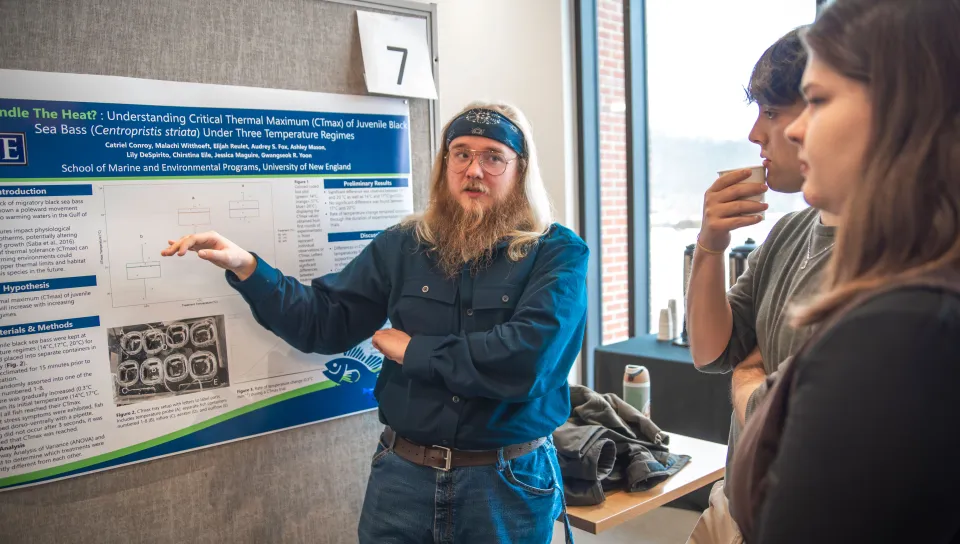
Left photo: Ginika Onyemelukwe (Biological Sciences, ’25), president of the Research Experience Club, addresses the crowd at the Fall Art and Research Symposium
Onyemelukwe said the club aims to make research accessible to every undergraduate at UNE, regardless of their major or experience level.
“Every single work here is meaningful, and it has a positive impact,” she said. “Whether it’s through medicine, if it’s through biology, chemistry, (or) art, every single work here matters.”
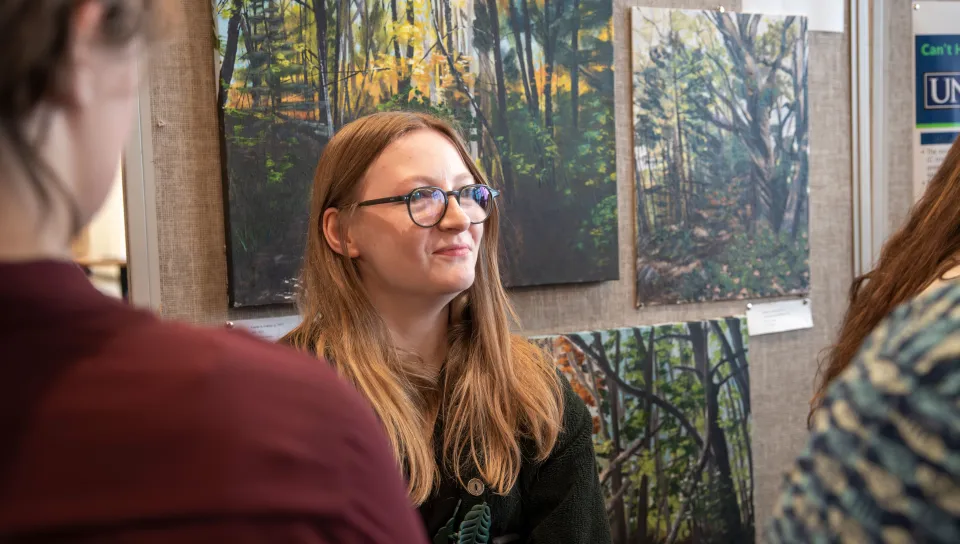
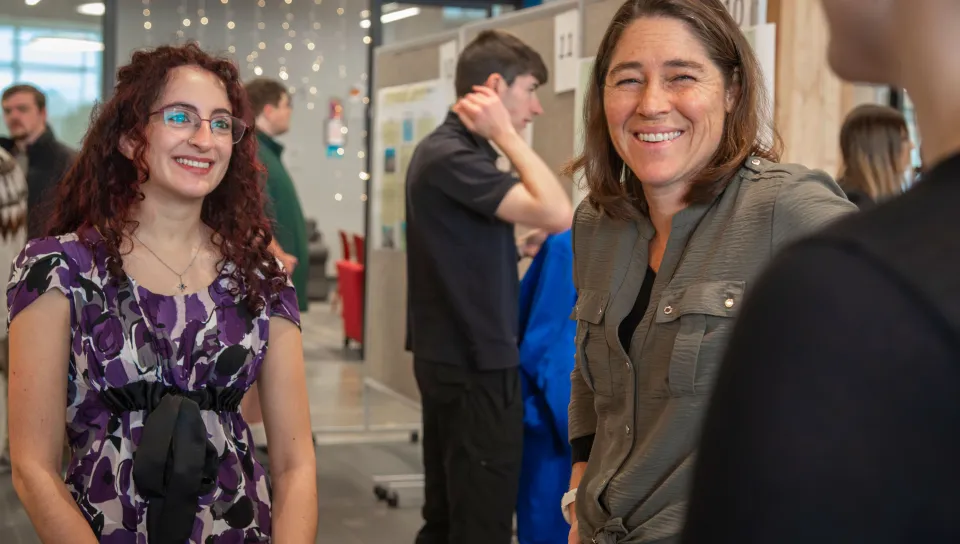
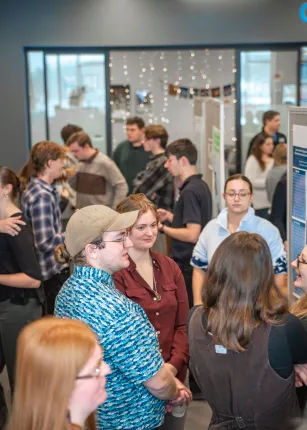
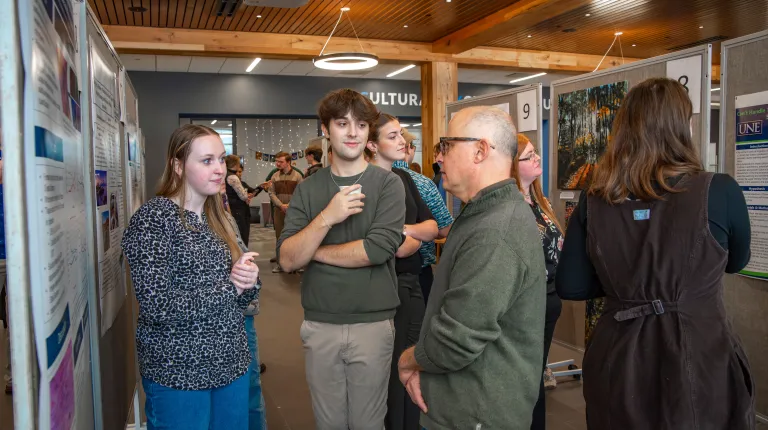
During the event, students presented completed research projects, works in progress, class capstone projects, and artistic renditions of scientific research topics. Students participating in the event discussed their work directly with members of the UNE community, including faculty, professional staff, and student peers.
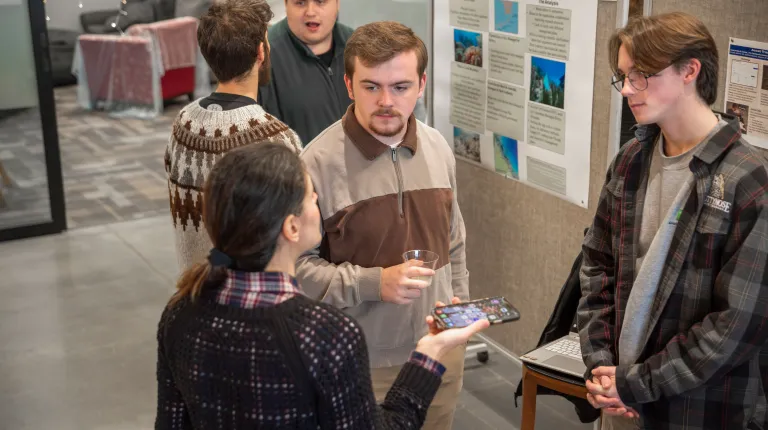
For Isaac Jordan (Business Administration, ’27), the symposium provided a platform to present work he’s developing with Assistant Professor Golshan Madraki, Ph.D., director of UNE’s Center for Supply Chain Management.
Jordan, along with classmates Christian Rasmussen (Marketing, ’27) and Dalton Donovan (Data Science, ’27), created a prototype asset-tracking system for UNE’s Interprofessional Simulation and Innovation Center (ISIC) on the Portland Campus for the Health Sciences. The team used artificial intelligence tools to develop a proof of concept without hiring coders.
The system tracks equipment location, maintenance status, and loan schedules to solve a real problem for facilities with multiple rooms and an extensive catalog of medical training equipment.
Jordan said that creating a solution people will use has elevated what he’s gained from the project and, ultimately, his course of study in the College of Business.
“It’s not like a class where you present and it’s done,” Jordan said. “We built something that’s actually being implemented.”
The team hopes to scale the platform for use across UNE departments, said Rasmussen.
“We’re focusing on creating a user-friendly interface,” Rasmussen said. “Other asset-tracking apps are so complicated that it takes 10 minutes just to turn something in.”
Madraki added that the platform has potential to become a commercial product that could serve universities and workplaces beyond UNE.
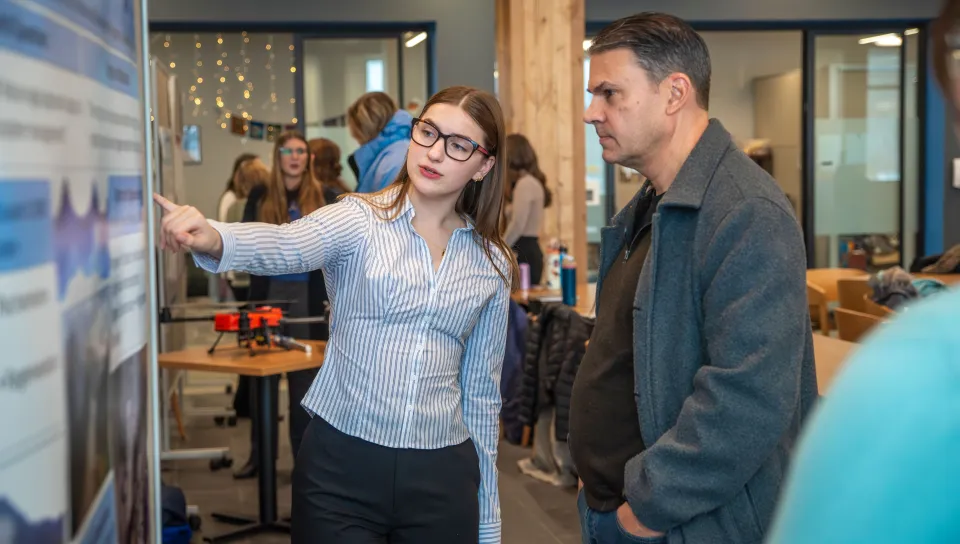
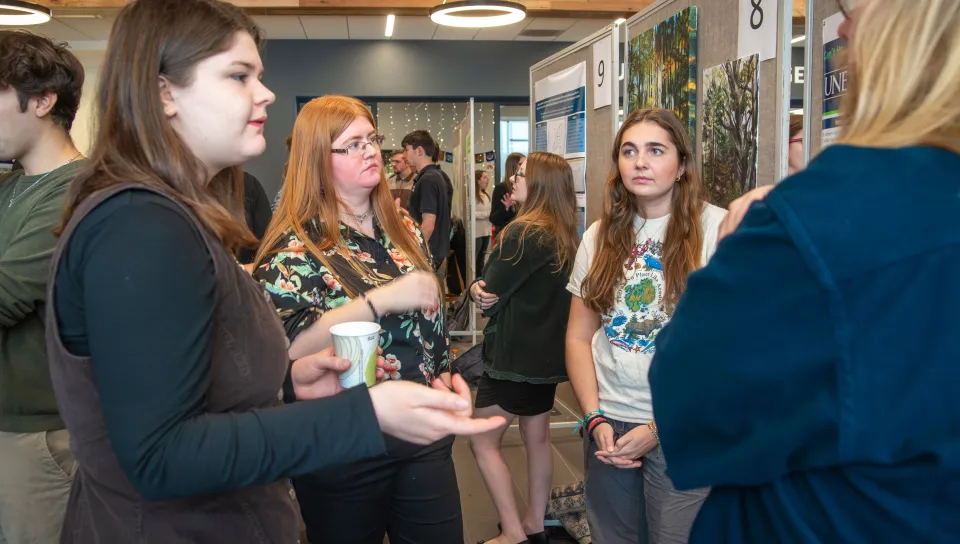
For many participants, the symposium offered more than a presentation opportunity — it was a chance to discover new research happening across campus and connect with potential collaborators. Anna Stratton (Animal Behavior, ’28) attended her first Research Experience Club meeting after seeing the symposium advertised. She said that students used the club to ask questions about finding research opportunities, discuss ongoing projects, and connect with students who have research experience.
Elizabeth O’Brien (Marine Sciences, ’29) credits the club with helping her launch her research experience. She represents a growing trend at UNE, where 46% of undergraduate students conduct research, twice the national average.
“They’ve shown me and other club members how to reach out to professors and come up with our own ideas for research,” said O’Brien, who used the club’s guidance to connect with faculty and join a project to monitor ocean conditions through a recently launched research buoy.
The Research Experience Club is open to all UNE undergraduates. Interested students can contact the club through the University Student Government or attend biweekly study halls.