
Image

This website uses cookies to understand how you use the website and to improve your experience. By continuing to use the website, you accept the University of New England’s use of cookies and similar technologies. To learn more about our use of cookies and how to manage your browser cookie settings, please review our Privacy Notice.
Nearly six years after students first stepped onto the rocks of a cove along the Saco River, at the frontage of the University of New England’s Biddeford Campus, to survey the possibilities of constructing a more resilient coast, UNE’s “Living Shoreline” project is beginning its transition from possibility to reality.
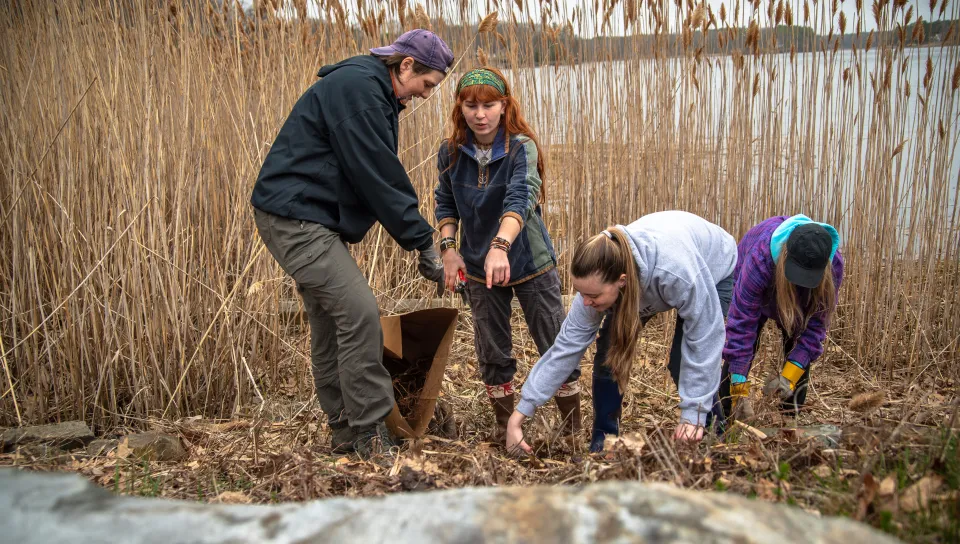
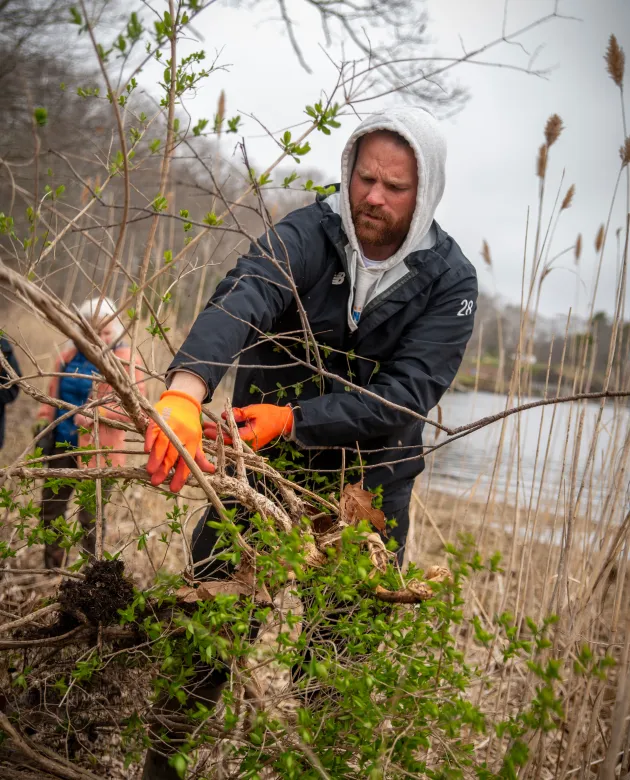
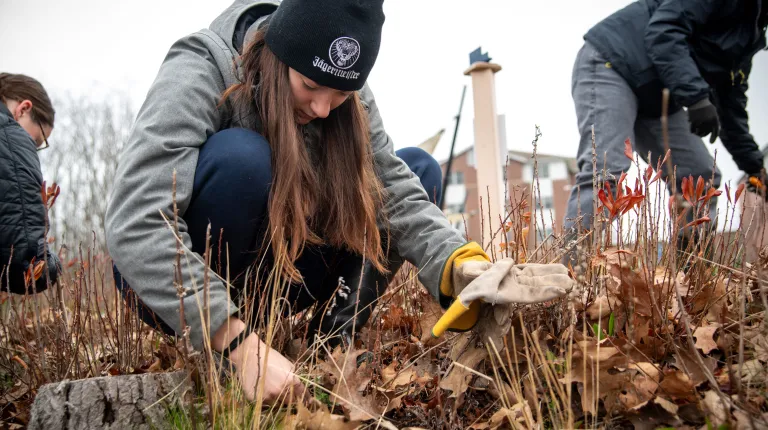
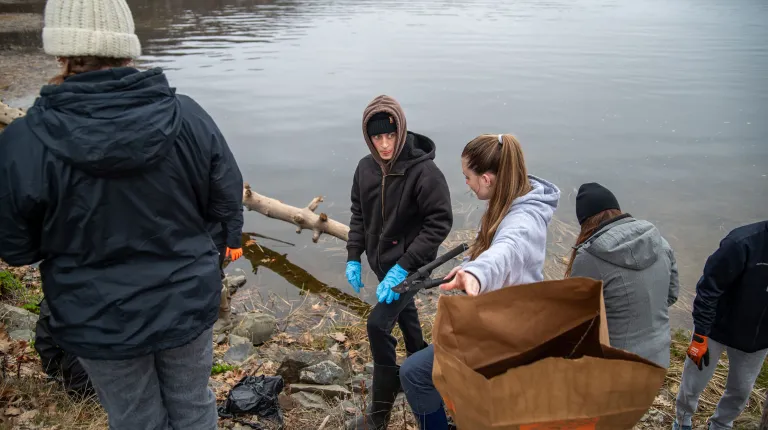
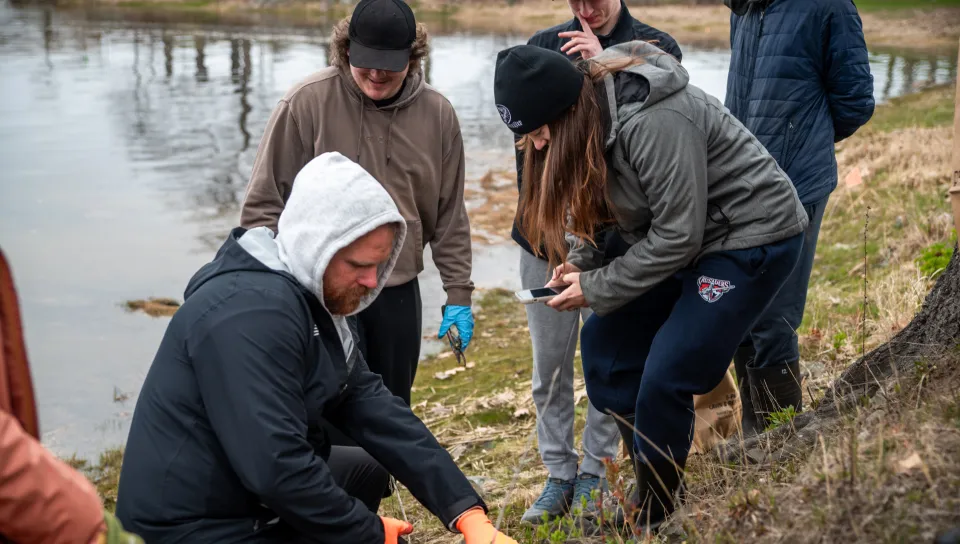
On April 29, nearly 20 students from Assistant Professor Jennifer Brousseau’s field class on climate change adaptation participated in “Restore the Shore,” entailing the cleanup and removal of invasive plant species from the jagged shore in preparation for the construction of the living shoreline, which is designed to buffer the impacts of waves and storms on the already-eroding coastline.
Living, or “green,” shorelines use plants or other natural elements to stabilize endangered coastlines and, over time, restore coastal ecosystems. Such solutions are preferred over harder, “gray” shoreline structures like bulkheads and rock revetments, which decrease shoreline biodiversity and can contribute to erosion of the sea floor.
UNE’s project was recently supported with nearly $140,000 in grant funding from the Builders Initiative and the Broad Reach Fund, through the Maine Community Foundation, to protect a shoreline researchers say has been marred by climate change, including the degradation of salt marshes caused by rising seas and increasingly severe storms.
Faculty members like Brousseau, Ph.D., who teaches in UNE’s School of Marine and Environmental Programs, say that, while construction of the living shoreline is still a way out, engineers have formalized designs to mitigate those effects.
Such methods include the construction of pyramid-shaped pilons of logs, secured to the seafloor, to absorb wave energy; native plant species, including marsh grasses and salt-tolerant shrubs like bayberry, to reduce erosion from wind; and the strategic placement of rocks along the shoreline.
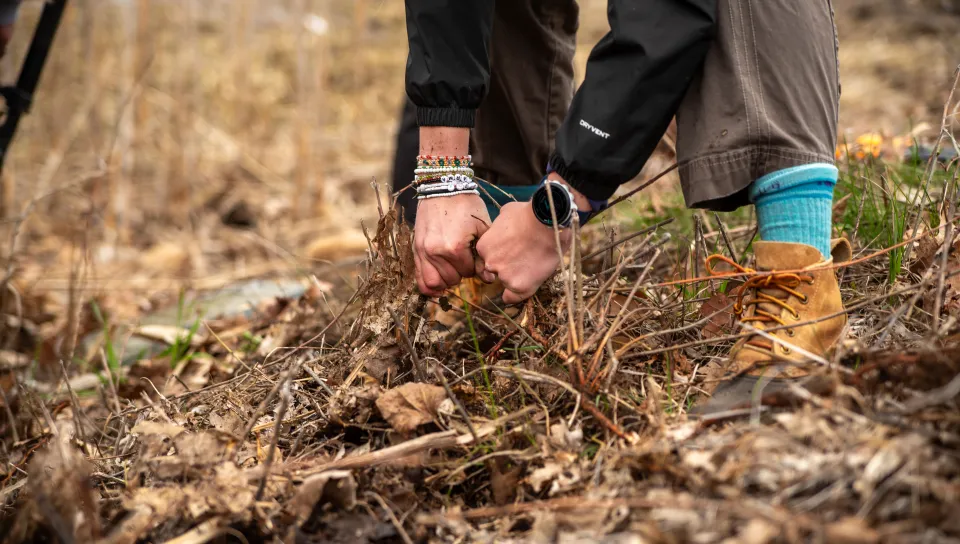
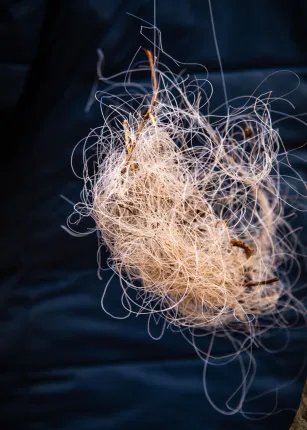
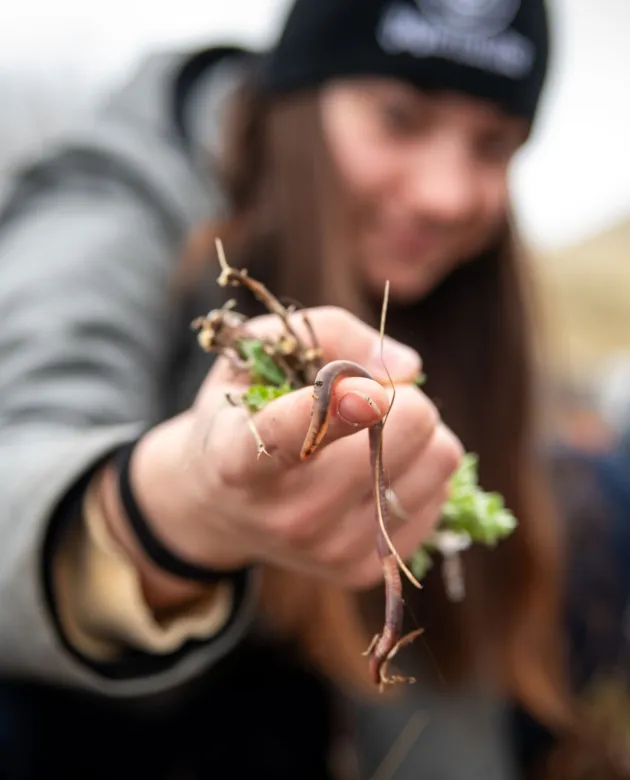
In preparation for this eventual construction, students set out on one of their final days of the spring semester to uproot invasive species, including honeysuckle, mugwort, and more. They also removed debris caught in the bramble — among the finds, a massive tangle of fishing line resembling a spider’s web — and identified traces of migratory birds, including the golden tailfeathers of a Northern Flicker.
The cleanup served more than one practical purpose; for students, it was a chance to step beyond classroom theory and into the kind of hands-on work that defines the UNE experience: the meaningful, hands-on problem-solving they will carry into their careers.
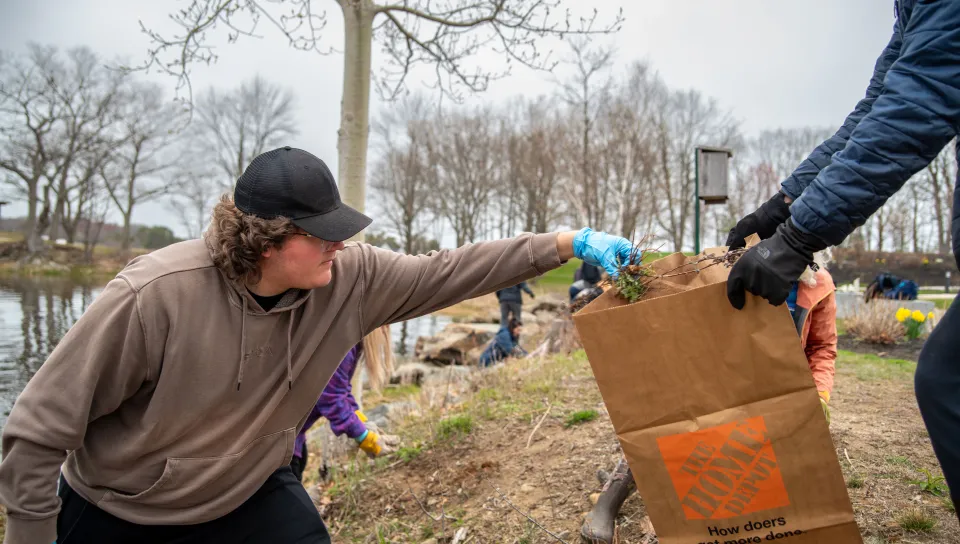
That experience resonated deeply with senior environmental science major Jamison Saunders (’26), whose path to UNE has been anything but traditional. A veteran who returned to school after serving in the Army, Saunders said the opportunity to engage in restoration work has helped shape his next chapter: improving the natural environment of his home state.
“This whole experience has been really rewarding,” said Saunders, of Bath, Maine, a coastal city in Maine’s Mid-Coast region. “This whole senior year has been a lot more hands-on, and it’s meant a lot more to me to get into the dirt and see the real-world applications of everything we’ve learned and continue helping our environment for the future.”
Saunders’ home region is also seeing the disastrous effects of climate change firsthand and has even served as a pilot for some of the state’s first living shoreline efforts. Growing up there, Saunders said he has long felt a personal connection to the natural environment, even before he had the language to describe it.
Now, he said, UNE has helped turn that passion into a potential career.
“I’ve always loved being outdoors, but I never really knew how to make sense of that or turn it into something,” he said. “This experience, this program, has helped me figure out how I can take that passion and use it to help the environment and my community.”
Brousseau said that sense of ownership is exactly the point.
“These are long-term projects that take preparation, planning, and consistent effort,” Brousseau said. “Students are learning not just the concept of climate adaptation, but what it takes to implement a resilience project — while giving back to their campus and gaining experience they can carry into communities across Maine and beyond.”