Image

This website uses cookies to understand how you use the website and to improve your experience. By continuing to use the website, you accept the University of New England’s use of cookies and similar technologies. To learn more about our use of cookies and how to manage your browser cookie settings, please review our Privacy Notice.
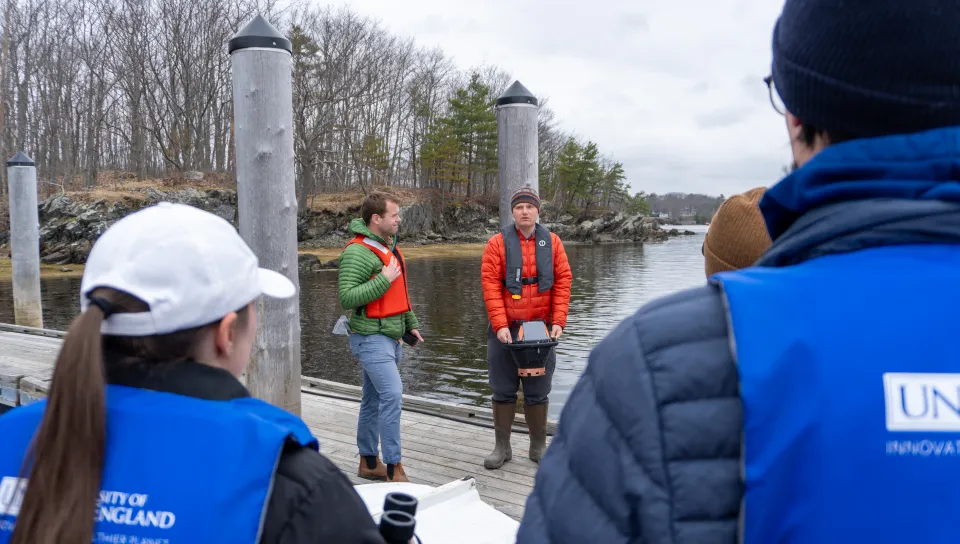
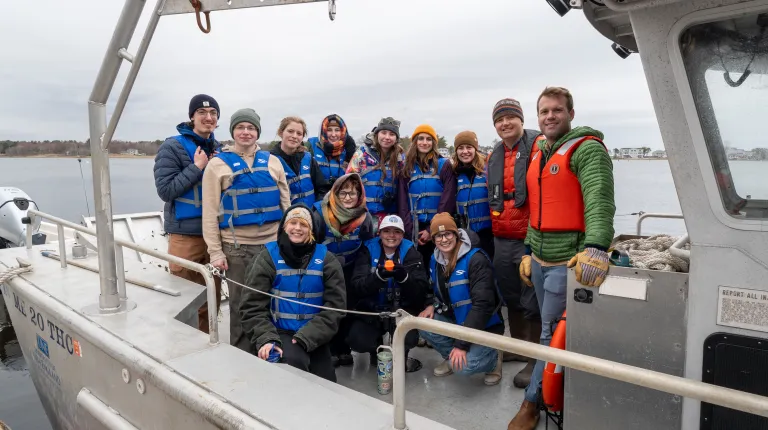
When a dozen University of New England students boarded a research vessel on April 22, they weren't just completing a lab assignment: They were deploying technology designed to reveal how the ocean conditions in Saco Bay are changing — and to get an inside look at what it takes to build a marine-science startup from scratch.
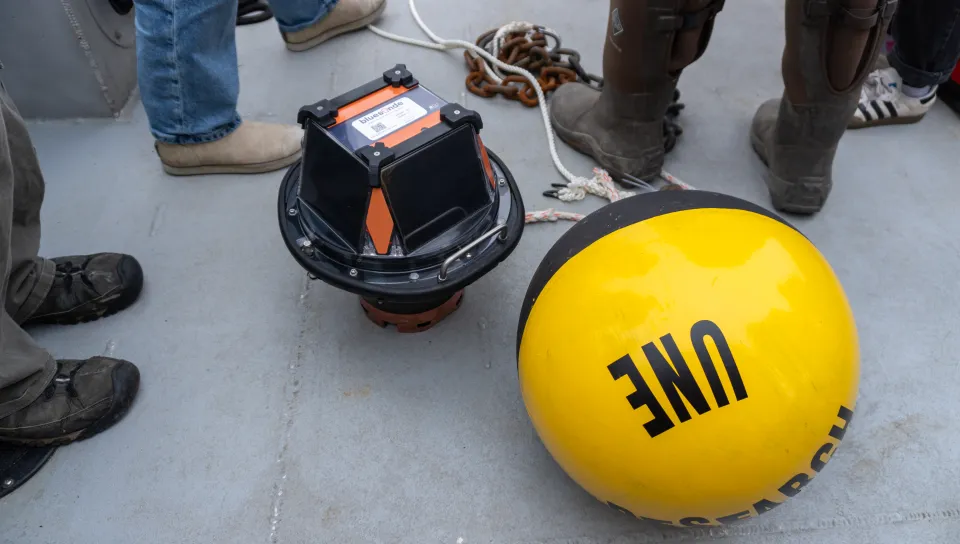
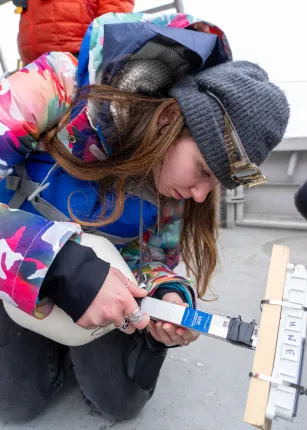
The trip was part of the Geographic Information System (GIS) course “AI for Geospatial Problems” taught by Assistant Professor Will Kochtitzky in UNE's School of Marine and Environmental Programs. The class deployed four buoys in total: three drifter buoys purchased through a $5,000 Maine Space Grant Consortium grant that are designed to record GPS positions by satellite as they float freely, and a water quality monitoring buoy built by Bluesonde, a Portland-based startup co-founded by mechanical engineer John Williams.
The drifter buoys are intended to map coastal current patterns in Saco Bay, data that Kochtitzky said will help better understand the warming climate in the Gulf of Maine, which scientists have determined is warming faster than most of the world’s oceans due, in part, to a shift in the Labrador Current. As the buoys travel, they'll relay real-time location data back to the research team — potentially for months.
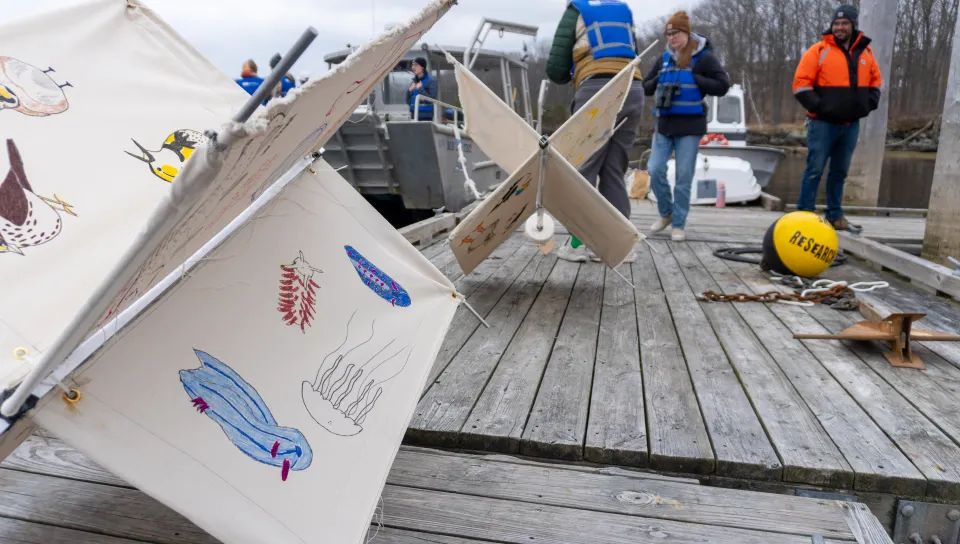
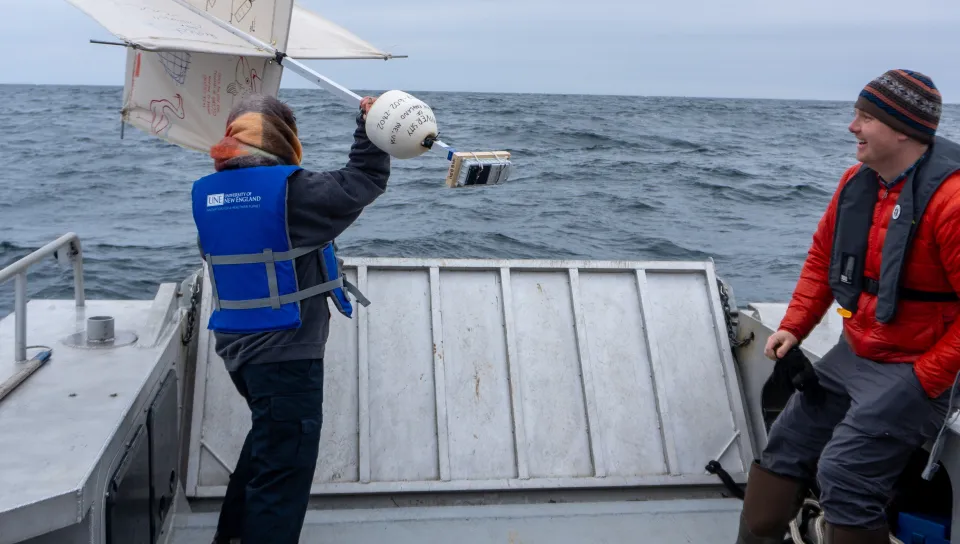
"The buoys just uplink a signal of where they are, and so over the next few months they'll get taken out into the ocean and we'll get all that data back," said Ethan Bombard (’27), a junior majoring in marine sciences who helped deploy one of the drifter buoys by heaving it over the side of the research vessel.
As soon as the first buoy hit the water nearly a mile off the Biddeford coast, students started guessing where the currents might carry it. Someone shouted Portugal — and that wasn't far-fetched.
"That's just because of how the Gulf Stream and how the currents work in the Atlantic," Bombard explained. "In theory, it should make it up there."
The Bluesonde buoy adds a different dimension to the monitoring effort.
All of these stations are revealing changes happening in the world around us that are critical to inform regional decision making, support our community, and educate our students.” — Assistant Professor Will Kochtitzky
Equipped with sensors that track temperature, dissolved oxygen, turbidity, chlorophyll, and salinity, it's designed to track water quality in real-time, something Kochtitzky, Ph.D., in the College of Arts and Sciences plans to use in ongoing research as part of a larger web of weather monitoring stations he’s assembled on and around UNE’s campus.
To date, Kochtitzky and his GIS students have assembled and deployed nine monitoring stations in the past year including, on Ram Island, off the coast of Saco; in the University's 363-acre forest; and on coastal land owned by the Biddeford Conservation Trust, with the land trust’s permission.
And he’s not done.
“All of these stations are revealing changes happening in the world around us that are critical to inform regional decision making, support our community, and educate our students,” Kochtitzky said. “The insights we are gathering will inform our knowledge of this amazing place for decades to come.”
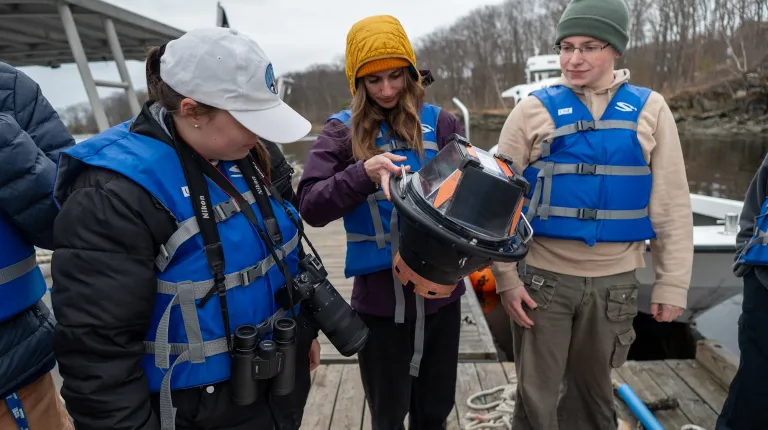
Williams, the Bluesonde co-founder joined the trip on April 22 and spent time fielding questions from students about how the buoy works and how he founded his company along with partners Andrew Thompson and Tim Dyson — all hardware engineers who previously worked for another company building buoy systems that focused on ocean-based carbon removal.
Since Bluesonde launched in July 2024, Williams said UNE is among its first customers to put one of its buoys in the water. The company developed a working prototype within three to four months that other researchers helped test, but figuring out the business side took longer, an origin story that fascinated and inspired the 11 GIS students on the boat trip.
When asked by one student if his company was only interested in hiring engineers, Williams responded: Not at all. He envisions in the not-too-distant-future hiring marine science experts who can help inform the kind of cutting-edge marine research his company’s products will make possible, an area of expansion that led many students to nod their heads as they considered this unique career path.
For students like Bombard, the chance to talk directly with someone who designed the research equipment that will help UNE researchers track climate change in the Gulf of Maine added something a classroom lab couldn't.
"It's one thing to just take a buoy that we bought and go toss it in the ocean, but to learn more about the process of making it was really amazing," Bombard said.