
Image

This website uses cookies to understand how you use the website and to improve your experience. By continuing to use the website, you accept the University of New England’s use of cookies and similar technologies. To learn more about our use of cookies and how to manage your browser cookie settings, please review our Privacy Notice.
A third University of New England weather station is now documenting conditions across the woods, waters, and waves of southern Maine, marking a significant expansion of the University’s growing environmental monitoring network aimed at building more climate-resilient communities.
Installed in UNE’s 363-acre forest, the new station joins existing monitoring systems in Saco Bay that form an integrated network that captures how environmental change unfolds across interconnected ecosystems.
Led by Will Kochtitzky, Ph.D., assistant professor in UNE’s School of Marine and Environmental Programs, the effort reflects a coordinated push to better understand how Maine’s landscapes, from inland forests to coastal waters, are responding to a rapidly changing climate.
“Now, we’re going to complete our trifecta here with our forest network,” Kochtitzky said. “Students are really going to be able to understand how these environments change from the forest to the sea.”
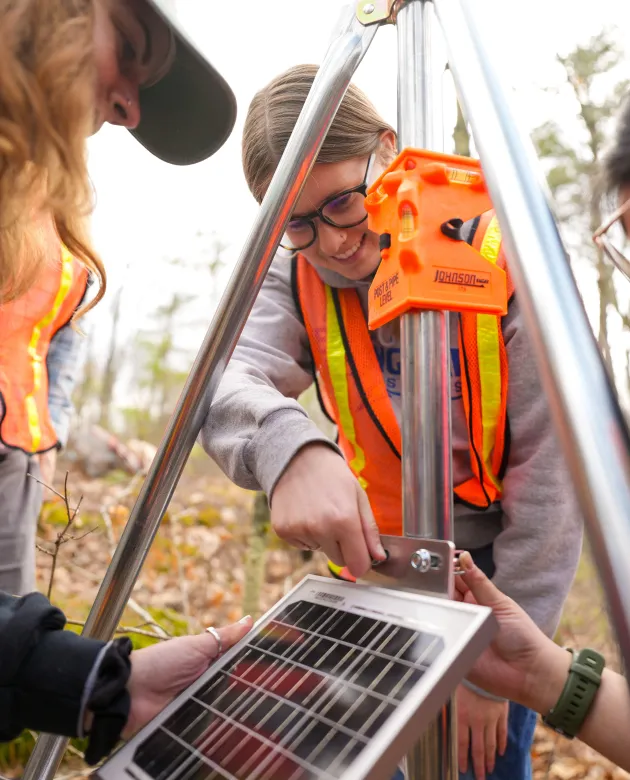
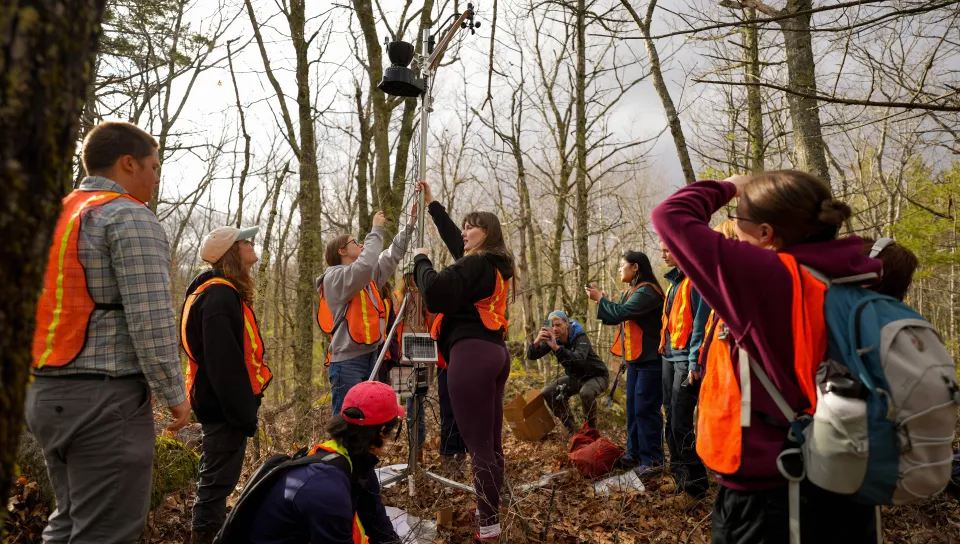
The weather station was assembled over a mile into UNE’s 363-acre forest, an outdoor classroom and living laboratory for environmental research on UNE’s Biddeford Campus.
Existing systems have focused on coastal monitoring efforts.
Offshore, UNE researchers have deployed a high-tech buoy equipped to measure wave activity, ocean currents, temperature, and dissolved oxygen, transmitting real-time data from the Gulf of Maine.
That system complements a pair of wave gauges installed near the Saco jetty, across from UNE’s Biddeford Campus, to track how coastal engineering projects may influence shoreline conditions and erosion in the nearby oceanfront community of Camp Ellis, where shifting currents and destructive storms have long contributed to erosion and infrastructure challenges.
Recently, researchers installed an anemometer in Biddeford Pool to assess the impact of wind speeds on seaside dune grass. And, in September, a separate weather station was constructed on UNE’s Ram Island, a research station just offshore from campus.
Inland, the new forest station adds a critical missing piece, capturing how drought, temperature shifts, and other climate-driven changes affect terrestrial ecosystems.
Kochtitzky said that, together, the systems offer a more complete picture of environmental conditions shaping communities like Saco and Biddeford, where shifting weather patterns, coastal erosion, and changing ecosystems are increasingly visible.
“One of our goals is to provide data that’s real-time and actionable — that allows us to make decisions to improve the health of our ecosystem,” Kochtitzky said.
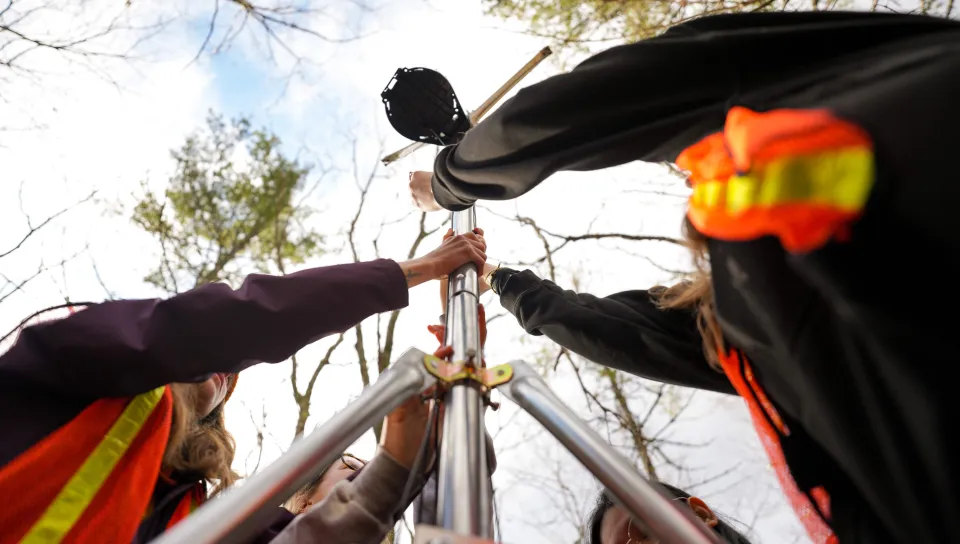
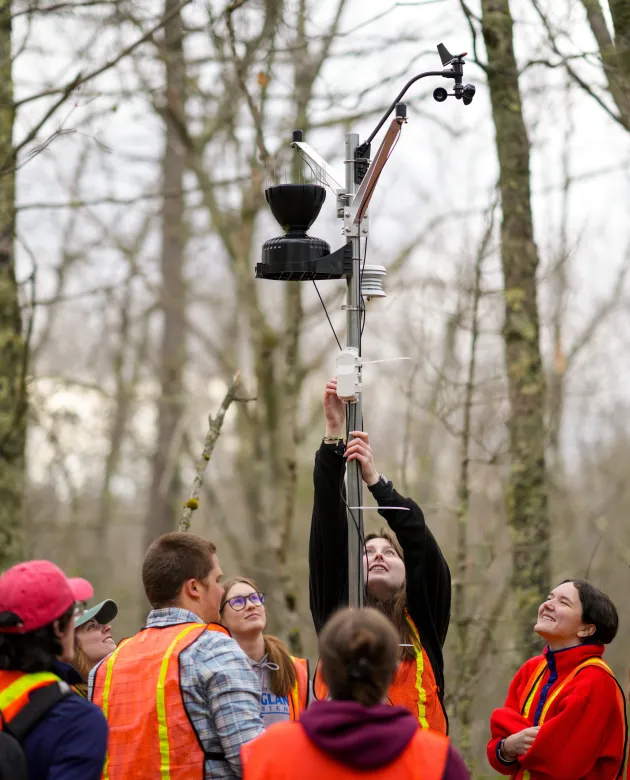
Each student had a role in assembling individual components of the weather station but came together as a unified group to assemble the completed meteorological post.
The station was installed by students in Kochtitzky’s “AI for Geospatial Problems” course, who worked in teams to deploy sensors measuring soil moisture and temperature, wind and rainfall, solar radiation, and humidity beneath a canopy of oak and pine.
Marine sciences student Erik Swenson (’26) said the experience of building the system themselves adds a deeper level of understanding.
“It’s really exciting to be able to go out and set up sensor networks and be part of getting that data firsthand and then pulling it to analyze it,” he said.
That full-cycle experience, from installation to analysis, is central to the project, Kochtitzky said. Data from the forest station streams in real time, allowing students to identify patterns and compare conditions across UNE’s expanding network of monitoring sites.
The forest site will also soon connect to nearby vernal pool research areas, offering opportunities to study how seasonal and environmental changes influence both terrestrial and aquatic habitats.
For environmental studies major Bailey Gosse (’26), the hands-on nature of the work has been transformative.
“Once you have the hands-on experience, you become so much more confident in what you can do,” she said.
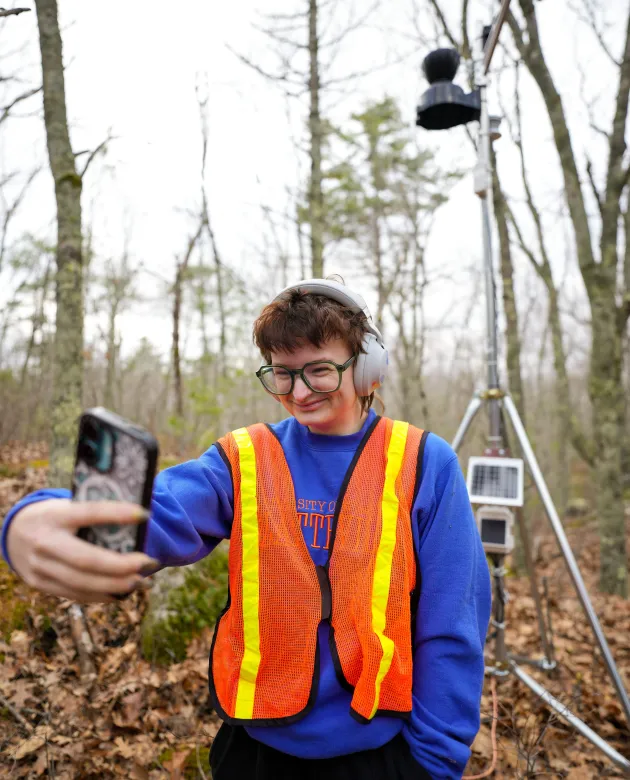
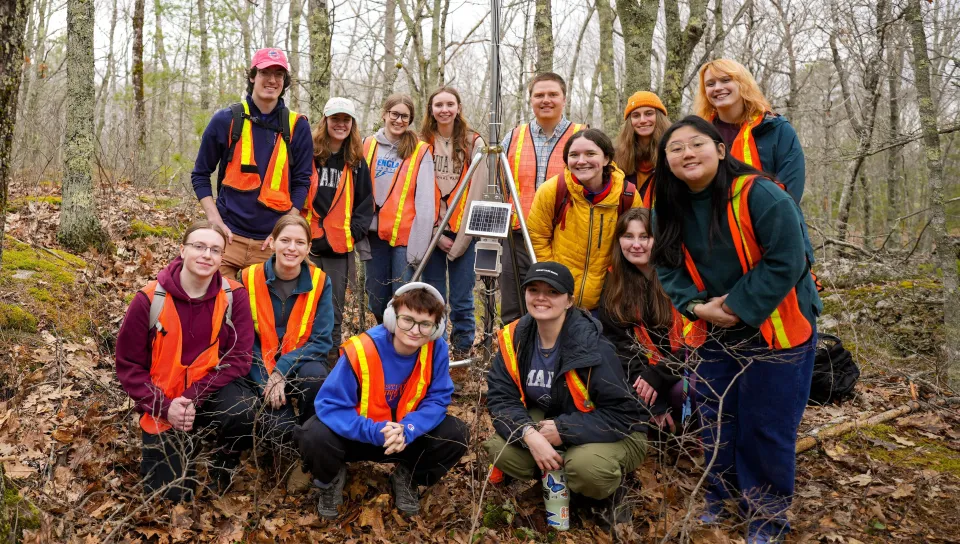
Students celebrate a hard day’s work with selfies and group photos.
In the coming weeks, UNE students will expand the network even further. Through a grant from the Maine Space Grant Consortium, Kochtitzky and his class will head into Saco Bay to deploy drifter buoys — floating instruments that transmit their position via satellite to track coastal currents in real time. That data will help researchers better understand how water moves through the bay, with a particular focus on areas like Camp Ellis.
Taken together, the forest station, offshore buoy, wave gauges, and upcoming drifter deployments represent a coordinated, systems-level approach to environmental monitoring — one Kochtitzky said is designed not only to advance research, but to serve the communities that depend on these ecosystems.
By capturing conditions across all ecosystems from the forest to coast, UNE is building a living laboratory that equips students with practical skills while generating the data needed to inform local decision-making in an era of environmental uncertainty.
“This is why we’re here,” Kochtitzky said. “We love being outside, working in these environments, trying to understand them — and helping improve them.”