
Image

This website uses cookies to understand how you use the website and to improve your experience. By continuing to use the website, you accept the University of New England’s use of cookies and similar technologies. To learn more about our use of cookies and how to manage your browser cookie settings, please review our Privacy Notice.
Students at the University of New England recently helped redesign an eel enclosure in a contest aimed at enriching a vivarium tank that holds eels, to make the fish less stressed — even “happy” — as explained in an instructional video for the contest produced by Assistant Professor Gwangseok Rex Yoon, Ph.D.
The American Eel Habitat Enrichment Competition marked the first time a student-driven contest was held at UNE to enhance an enclosure for a fish species housed in the Arthur P. Girard Marine Science Center, drawing students in both the School of Marine and Environmental Programs and students majoring in animal behavior, a program in UNE’s School of Psychology and Brain Science in the College of Arts and Sciences.
The eel vivarium at UNE is kept in a large, dark lab in the center of a recirculating aquaculture system that filters saltwater to maintain a high-quality living environment. As conceived by Vivarium Manager Erin Ducharme, M.S., in the Office of Research and Innovation, contest entrants were charged with creating enrichment designs for the tank that would benefit the eels by providing elements similar to what the fish would find in the wild, but enrichments that would not harm the eels.
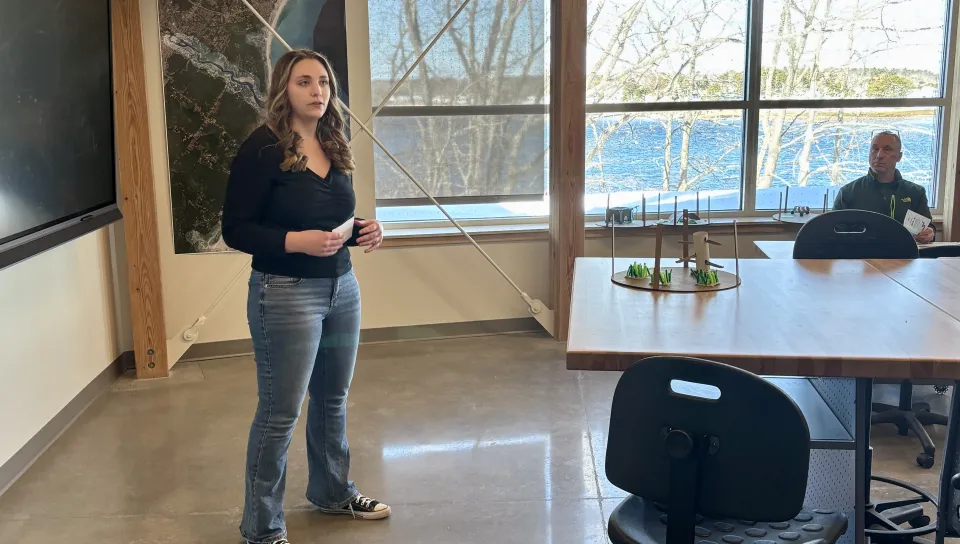

The competition took place in the Sustainable Innovation Center (SIC), one of UNE’s newest spaces that encourages innovation, cross-disciplinary collaboration, and the fusion of different fields of study to produce better outcomes in research and learning. The SIC, which is located in the heart of the center with views of the Saco River through bird-safe windows, will connect students from the sciences to new perspectives from other disciplines, such as business, said Emily Wood, M.E.M, the SIC coordinator.
“Through the American Eel Habitat Enrichment Competition, we have accomplished this by bringing all participating students through the ideation workshops and the pitch competition. It’s the first of many events like this to come into the space,” Wood said.
The presentations were preceded by workshops held in the SIC that emphasized innovation — a foundation of UNE’s mission — as students were tasked with ideating creative solutions and researching materials and designs that would enrich the tanks for the eels. Then the students presented their designs with cardboard models on Feb. 26.
The contest drew 13 teams made up of 35 students, many of whom were marine science majors. But, in the end, it was pair of interdisciplinary students who won: Sammi Slonecker (’26), an animal behavior major who won with teammate Jeff Manata (’27), a double major in environmental and marine sciences.


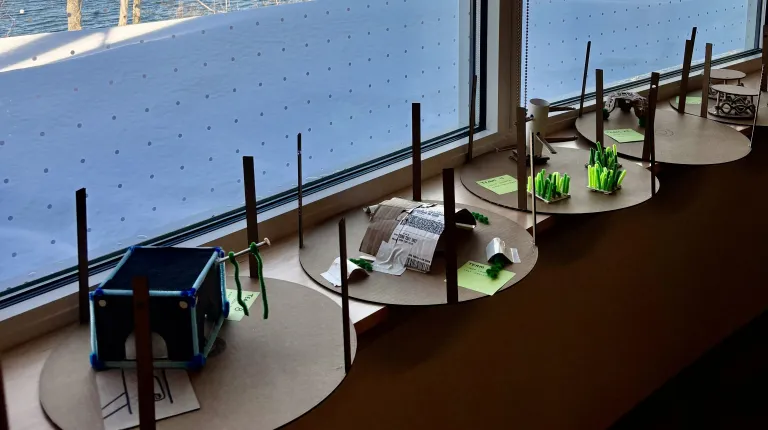
What set Slonecker and Manata apart, the judges said, was the realistic eel grass they proposed spreading throughout the tank and around a tube that was added to provide the eels with a space to hide.
“One of the things that really stood out about Sammi's presentation is that she did some research on enrichment theory and on the behavioral needs of eels and then supported that using literature within her presentation. Her design was more rooted in the needs of the animals,” said Brian Greco, Ph.D., one of the four judges and an assistant professor of animal behavior.
Slonecker and Manata researched natural-looking eel grass made from a synthetic material that is not biodegradable — but also non-toxic. They found the ideal imitation eel grass manufactured by a company in New York.
“The eel grass would be somewhat rigid so it stays up, but not at any risk that it would cut them. With the current from the outflow tank, we also would see the natural movement,” Slonecker explained in her presentation.
Slonecker and Manata won $250 and will build out their enrichment tank design in the P.D. Merrill Makerspace with the support of Makerspace Coordinator Sophia Crockett-Current.
“We will work with the student team to build out the winning concept to enhance the environment in the (vivarium) to promote eel health and happiness and increase its utility for teaching and research,” said Lisa Herschbach, Ph.D., the director of UNE’s Center for Innovation and Entrepreneurship and the assistant dean of the UNE College of Business.