
Image

This website uses cookies to understand how you use the website and to improve your experience. By continuing to use the website, you accept the University of New England’s use of cookies and similar technologies. To learn more about our use of cookies and how to manage your browser cookie settings, please review our Privacy Notice.
The College of Arts and Sciences at the University of New England has announced its highest annual faculty honors: the 2026-2027 Ludcke Chair of Arts and Sciences and the Distinguished Academic Service Award.
Carrie J. Byron, Ph.D., professor of marine science in the School of Marine and Environmental Programs, has been named Ludcke Chair, while Jerome Mullin, Ph.D., professor emeritus of chemistry, is the recipient of the Distinguished Academic Service Award.
Ludcke Chair Carrie J. Byron, Ph.D.
Funded by a generous bequest from the estate of Eleanor Ludcke (Westbrook College Class of 1926), the Ludcke Chair honors senior faculty members in the College of Arts and Sciences who are among UNE’s most distinguished scholars and teachers. The Ludcke Chair recognizes faculty members who connect and infuse their scholarship within the teaching mission of the college to a level of excellence beyond the typical use of scholarship in teaching and who model that activity for their students.
Byron is an internationally recognized marine ecologist whose work on the ecological carrying capacity of aquaculture has informed management, policy, and practice well beyond the University. As a member of the UNE faculty since 2013, she has built a research program at the intersection of marine ecology, aquaculture, sustainability, and food systems, asking how the coastal ocean environment can support farming rather than only how farming affects the environment.
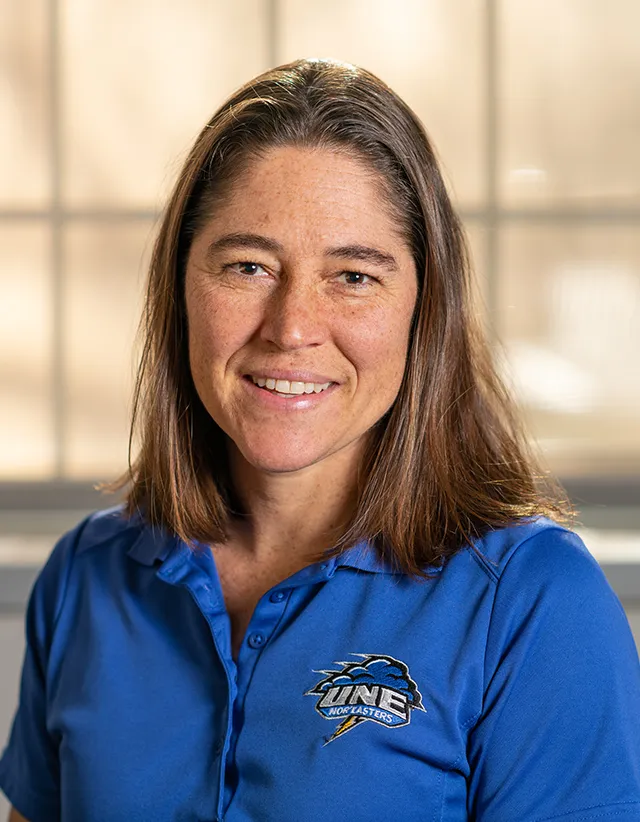
Carrie J. Byron, Ph.D.
Byron’s standing in the field is reflected in her leadership with the International Council for the Exploration of the Sea (ICES), where she served as chair of the Working Group on Ecological Carrying Capacity of Aquaculture and currently serves as an editor of the ICES Journal of Marine Science. She has delivered plenary talks at international conferences, including a February 2026 address on UNE’s student-run business, SeaMade Kelp Bars, to more than 1,500 registrants at Aquaculture America.
Byron has brought nearly $1 million in external funding to UNE over the past decade and has authored nearly 50 peer-reviewed articles, roughly half of which include undergraduate or graduate students as co-authors. She holds a bachelor’s from the University of Wisconsin-Madison, a master’s from the University of Massachusetts-Boston, and a Ph.D. in environmental science from the University of Rhode Island. According to the nomination materials, she was recommended for the Ludcke Chair for scholarship that is both scientifically rigorous and societally consequential and for a teaching practice that treats students as genuine research collaborators.
Byron led the development of UNE’s sustainable ecological aquaculture (SEA) major and has integrated her sea farms in Saco Bay directly into the curriculum, giving students hands-on experience in ocean farming from nursery to harvest. She has mentored dozens of undergraduate and graduate researchers, many of whom have presented at national conferences and published in peer-reviewed journals.
“While most aquaculture research focuses on how farming affects the environment, my research turns that around to ask how the ocean environment supports farming, and the best part is getting to do that alongside students,” said Byron, reflecting on the award and her work, adding that her students have taken her research in directions she never expected. “I try to help students think critically within their own discipline and across others.
“I hope they carry that with them, the confidence to keep asking questions and keep learning long after they leave UNE,” she said.
Distinguished Academic Service Winner Jerome Mullin, Ph.D.
Since 1986, the Distinguished Academic Service Award, also known as the “Kenneally Cup” after the award’s first recipient, Raymond Kenneally, has provided the opportunity for members of the College of Arts and Sciences to recognize one of its own for exceptional performance or contributions in at least two of the following areas: teaching and advising, professional or program development, and service.
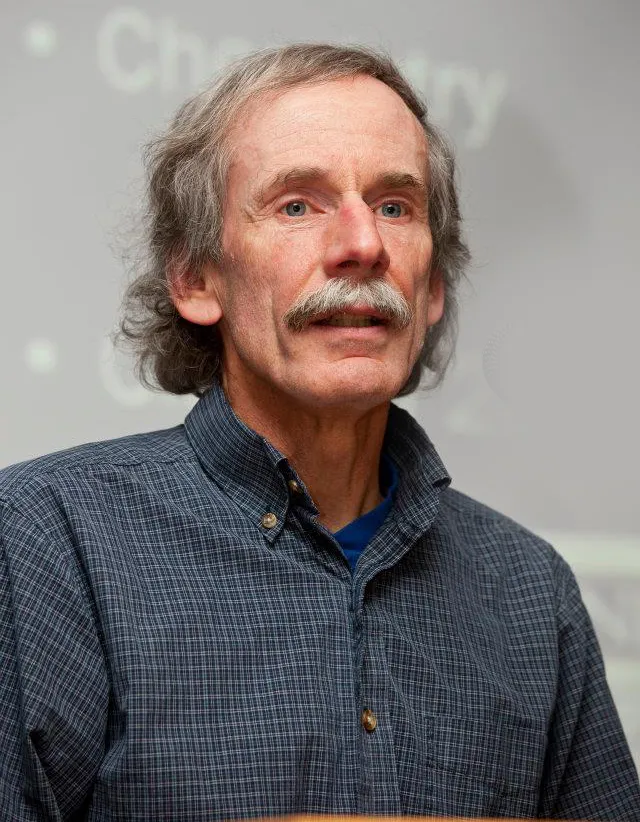
Jerome Mullin, Ph.D.
Mullin, an analytical chemist who joined UNE in 1990 and retires this year after a career spanning more than 35 years, was the founding chair of the Department of Chemistry and Physics (now the School of Molecular and Physical Sciences), serving as department head for a decade.
He earned his Ph.D. in analytical chemistry from the University of New Hampshire and was himself named Ludcke Chair for 2012-13.
Mullin was nominated for his sustained excellence across teaching, advising, program development, and service to college and the wider University. Over his career, he taught chemistry across the curriculum, from foundational general chemistry taken by science and health professions students to upper-level courses in quantitative analysis and instrumental methods. His laboratory courses asked students to apply analytical techniques to real-world scenarios and to write reports akin to those expected in professional settings, and many alumni credit that work as instrumental to their transition into the workforce.
Mullin has mentored over 40 undergraduate researchers and published more than 20 peer-reviewed articles, many with undergraduate co-authors, including collaborative work on novel photoluminescent materials supported by the National Science Foundation. As UNE’s campus coordinator for the Maine Space Grant Consortium since 2006, he has channeled hundreds of thousands of dollars toward the college’s Summer Undergraduate Research Experience program, funding students across disciplines well beyond his own field.
Beyond the classroom and lab, Mullin shaped much of the infrastructure that chemistry teaching and research at UNE rely on today, contributing to the design of lab spaces across three decades, and he served as head and later assistant coach of the men’s and women’s cross-country teams for nearly 20 years. Colleagues note that he mentored faculty across disciplines, advised the nascent pre-pharmacy program, and advanced the case for UNE’s chemistry programs to earn American Chemical Society approval, much of it done quietly and without fanfare.
“I am tremendously honored and humbled to have been awarded the 2026 Kenneally Cup for Distinguished Academic Service,” said Mullin, reflecting on his storied career at UNE. “I’ve had the opportunity to start and lead the development of rigorous academic programs in chemistry, biochemistry, and lab sciences and to advocate for a culture of undergraduate research, scholarship, and creative activity. This award is a very affirming capstone to my UNE career as I move into retirement as professor emeritus of chemistry.”