
Image

This website uses cookies to understand how you use the website and to improve your experience. By continuing to use the website, you accept the University of New England’s use of cookies and similar technologies. To learn more about our use of cookies and how to manage your browser cookie settings, please review our Privacy Notice.
Johanna Birchem didn’t come to the University of New England planning to study people. In fact, it was the exact opposite.
“I always tell people, if you had asked me four years ago, I would’ve said I don’t want to work with humans whatsoever. I wanted to be catching fish, studying fish — just the natural world,” said the graduating environmental science major from Lake of the Woods, Minnesota.
But somewhere between long drives up the Maine coast, conversations with seaweed harvesters, and a summer of fieldwork, that perspective began to shift.
“At UNE, I realized you can’t separate the two,” Birchem said. “In order to understand the natural world, you have to understand how humans interact with it.”
That realization would go on to shape her academic path — and ultimately earn her one of the nation’s most competitive research honors.
Birchem was recently awarded a prestigious National Science Foundation Graduate Research Fellowship. Her proposed project, “Examining socio-ecological interactions between harvesters and rockweed in Maine’s intertidal ecosystems,” explores how human activity and environmental systems influence one another along Maine’s coast.
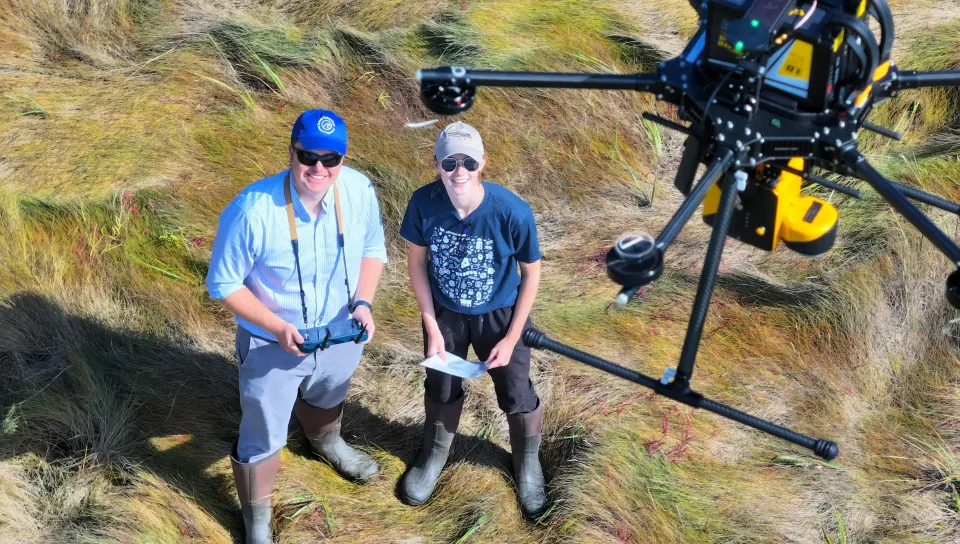
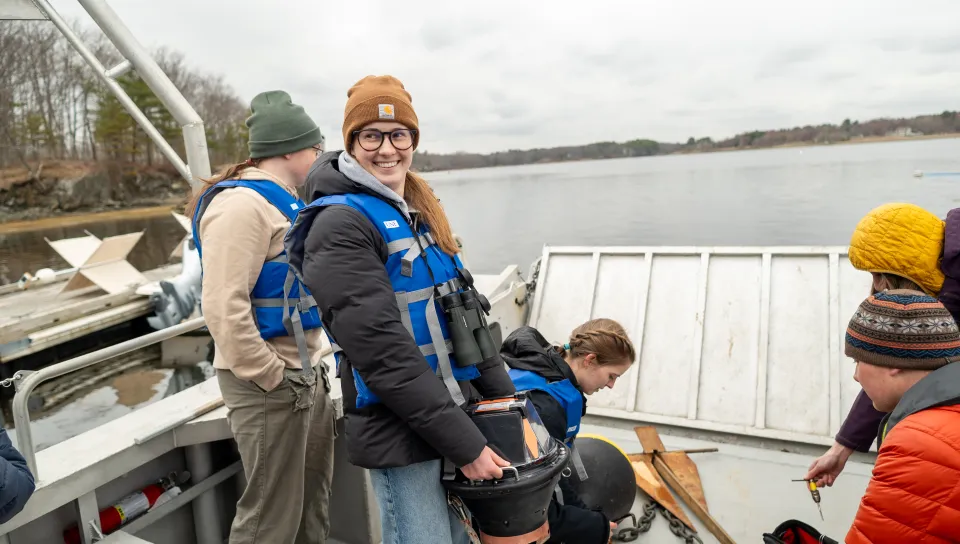
(Left): Johanna Birchem (’26) flies a drone with Assistant Professor GIS Will Kochtitzky, Ph.D. (Right): A smile aboard one of Birchem’s myriad research vessel trips.
The NSF Graduate Research Fellowship Program is one of the nation’s most prestigious and competitive awards for graduate students in STEM fields, with thousands of applicants each year and only a small percentage selected for funding.
Birchem’s work will build directly on research she began at UNE through a Summer Undergraduate Research Experience fellowship, where she partnered with Sarah Ebel, Ph.D., a cultural anthropologist studying the relationships between communities and natural resources and an assistant teacher in the UNE School of Marine and Environmental Programs. During that summer, Birchem and Ebel traveled across coastal Maine, interviewing wild seaweed harvesters and examining how policy, economic pressures, and environmental change shape the industry.
“We saw a real need for more research on wild seaweed harvesting in Maine,” Birchem said. “That experience gave us the inspiration to develop this project.”
It also introduced Birchem to a new way of thinking about environmental science.
“You’re not managing where the seaweed grows; you’re managing how humans interact with it,” she said. “That really opened my eyes.”
Ebel’s mentorship proved pivotal, helping Birchem bridge the gap between ecological science and anthropology while developing practical research skills.
“She taught me how to interview people, how to do participant observation, but also how to think about the bigger picture,” Birchem said. “She’s been the most influential part of all of this.”
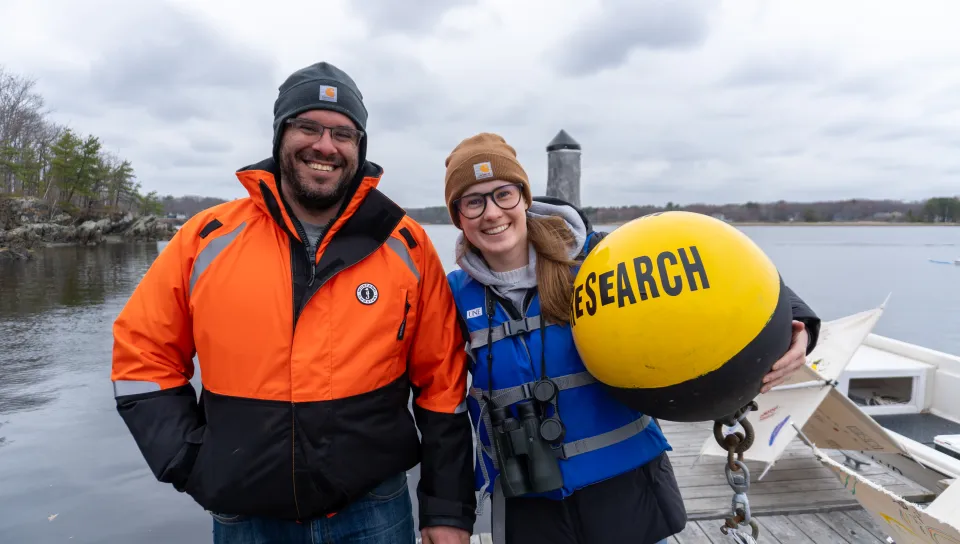
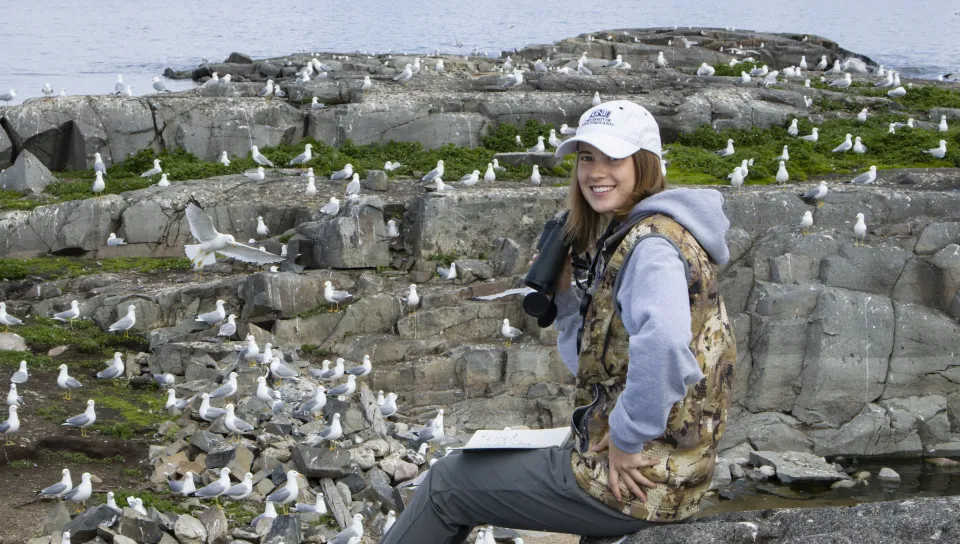
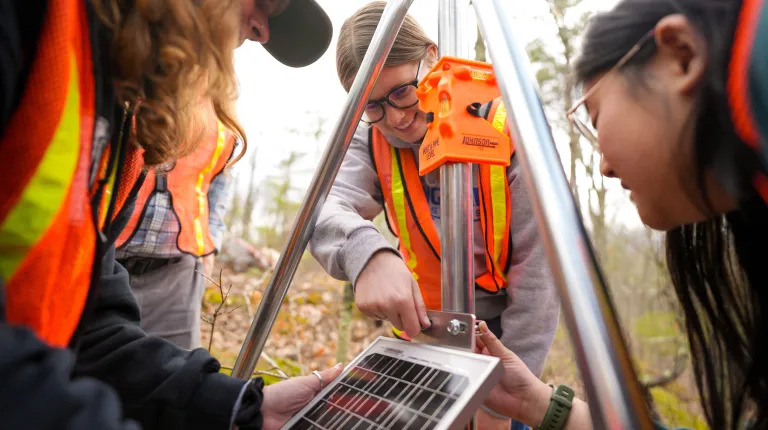
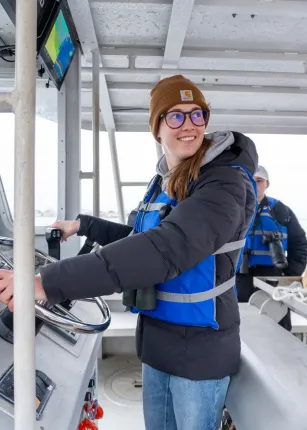
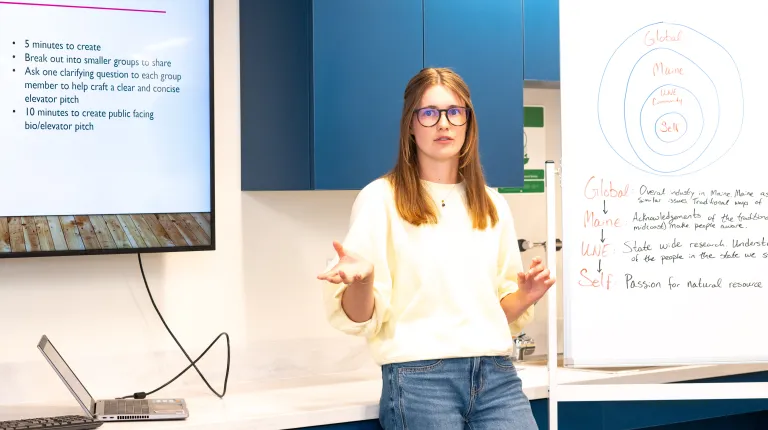
Birchem has amassed a storied research career at UNE, conducting groundbreaking research off coastlines in Maine and Minnesota, tracking weather patterns in Maine’s forests, and presenting research in UNE’s innovation centers.
Ebel said Birchem’s curiosity for the natural world, and “her desire to create real solutions to the problems humanity and ecosystems face,” will serve her well in her fellowship — and beyond.
“With her coursework in UNE’s environmental sciences, combined with her training in anthropology, Johanna is the ideal kind of young scientist to take on such a complex and dynamic research project that will further our scientific understanding of the interconnectedness between social and ecological systems and offer insight into potential solutions,” Ebel said. “We are all looking forward to seeing the outcomes of Johanna’s future work.”
The combination of mentorship and hands-on learning opportunity is something Birchem said defines the UNE experience. Throughout her time at the University, she sought out opportunities across disciplines, from environmental monitoring projects to drone-based research she published, intentionally exploring different paths.
“I’ve tried out a bunch of different labs and put myself in different scenarios to figure out what I like and, almost more importantly, what I don’t like,” she said.
UNE’s supportive, flexible environment made that exploration possible, Birchem said.
“It’s always been the vibe of, ‘If you don’t like it, you can change it,’” Birchem said of UNE’s adaptable academic programming. “Faculty here want you to try things and find what fits.”
Originally from a rural community of fewer than 1,000 people near the Canadian border, Birchem said she considered colleges across the country. What set UNE apart, she said, was the opportunity to build close relationships with faculty and take an active role in research from the start.
“I could’ve gone anywhere,” she said. “But here, I wasn’t just a face in a lab. Faculty were invested in helping me do what I wanted to do.”
That investment helped position her for success beyond graduation. In addition to the NSF fellowship, Birchem secured further funding to support graduate studies and will continue her work this summer as she begins a Ph.D. program in anthropology and environmental policy at the University of Maine.
In 2024, Johanna Birchem (’26) returned home to Lake of the Woods for the summer to participate in two paid research projects with the Minnesota Department of Natural Resources to study and protect native bird populations.
Looking ahead, Birchem plans to continue exploring how environmental policy, resource management, and human behavior intersect, with growing importance in a changing climate, she said.
Her journey, she said, reflects what can happen when students are given the space to explore.
“Trying different things and embracing that uncertainty — that’s what helped me figure out where I want to go,” Birchem said.