UNE health professions students deepen understanding of eating-disorder care in real-life simulations
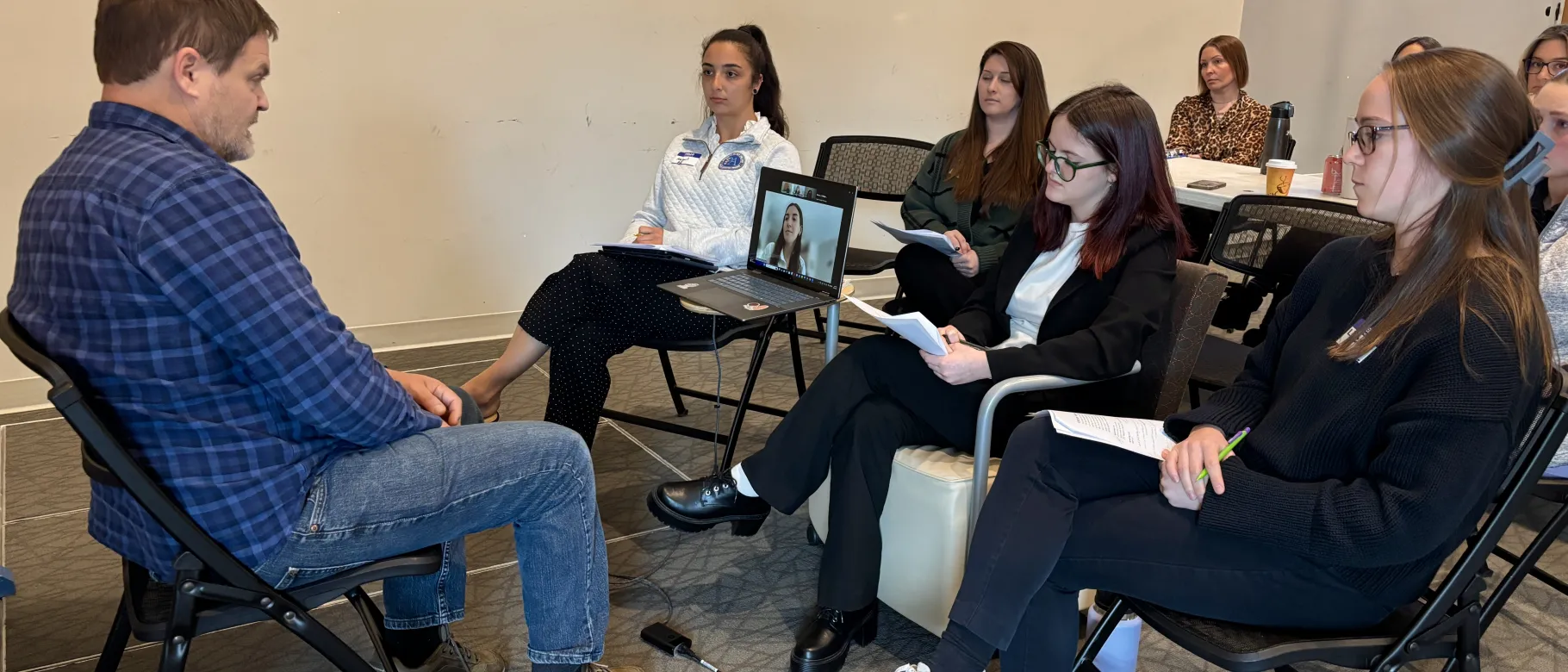
On March 28, University of New England students across 11 health professions programs used an interprofessional approach to learning eating-disorder care in simulations using standardized patients in Arthur P. Girard Innovation Hall on the UNE Portland Campus for the Health Sciences, learning in real time how a team approach can better treat eating disorders like bulimia and anorexia nervosa.
The UNE health professions students, including students in UNE’s Master of Science Physician Assistant (M.S.P.A.) degree program — Maine’s only physician assistant program — and Maine’s only medical school, the UNE College of Osteopathic Medicine, spent several hours working with patient-actors who feigned hidden health conditions.
Six teams comprising 57 students screened, diagnosed, and referred standardized patients to other health care providers during the simulations taking place simultaneously behind screened walls in the great hall.
Coordinated by the UNE Center for Public Health Practice and the Center to Advance Interprofessional Education and Practice (CAIEP), the day-long event concluded with a group debriefing covering the lessons learned. Chief among them, said Devon Anne Sherwood, Pharm.D., BCPP, an associate professor in UNE’s School of Pharmacy, was that interprofessional training leads to better treatment and fewer errors in health care.
“It’s about leaving the ego at the door,” said Sherwood, who teaches clinical psychopharmacology in the state’s only pharmacy school. “When you actually have the ability to look at what your interprofessional team brings and everybody's role, you end up having less errors, you end up having better means to catch problems. It’s patient-centered care with the team approach.”
Rodney Nason of North Yarmouth, a standardized patient who presented as a male patient who was suffering from bulimia, was impressed with the students’ ability to listen, to take time to learn his ailments, and willingness to be nimble and investigate a new diagnosis.
“They’re responding to my answers with concerns that would lead them to specialists outside of their own field, such as a dental specialist or, if the patient is feeling overwhelmed, a social worker. There is a lot of live, active care taking place,” Nason said.
Steph Bange (M.S.O.T., ’27) said the team immersion event was helpful in preparing her for her future health care career by demonstrating how different professions collaborate to provide comprehensive patient care.
“It allowed me to see perspectives I may not have otherwise considered and highlighted a variety of approaches that can be used to address a single diagnosis,” Bange said. “Understanding what each profession has to contribute will help me be a better clinician by encouraging collaboration, improving communication, and supporting a more holistic approach to patient treatment.”
The interprofessional team immersions have been offered to health professions students at UNE every semester since 2014.
During the COVID-19 pandemic, the event pivoted to an online format but was able to return to an in-person format this year with support for distance learners thanks to the Primary Care Training and Enhancement: Physician Assistant Rural Training (PCTE-PAR) grant from the UNE Center for Public Health Practice, said Kris Hall, M.F.A., PMP, UNE CAEIP director.
“Team-based practice is not a novel concept. We know that teams work together in health care all the time and people get excellent care. But teams can also fail in health care and cause medical errors,” Hall said. “And that's what we're doing here. We're practicing making those mistakes, recovering from those mistakes, coming together as a team, and synthesizing the knowledge that everyone brings to the team for better patient outcomes.”
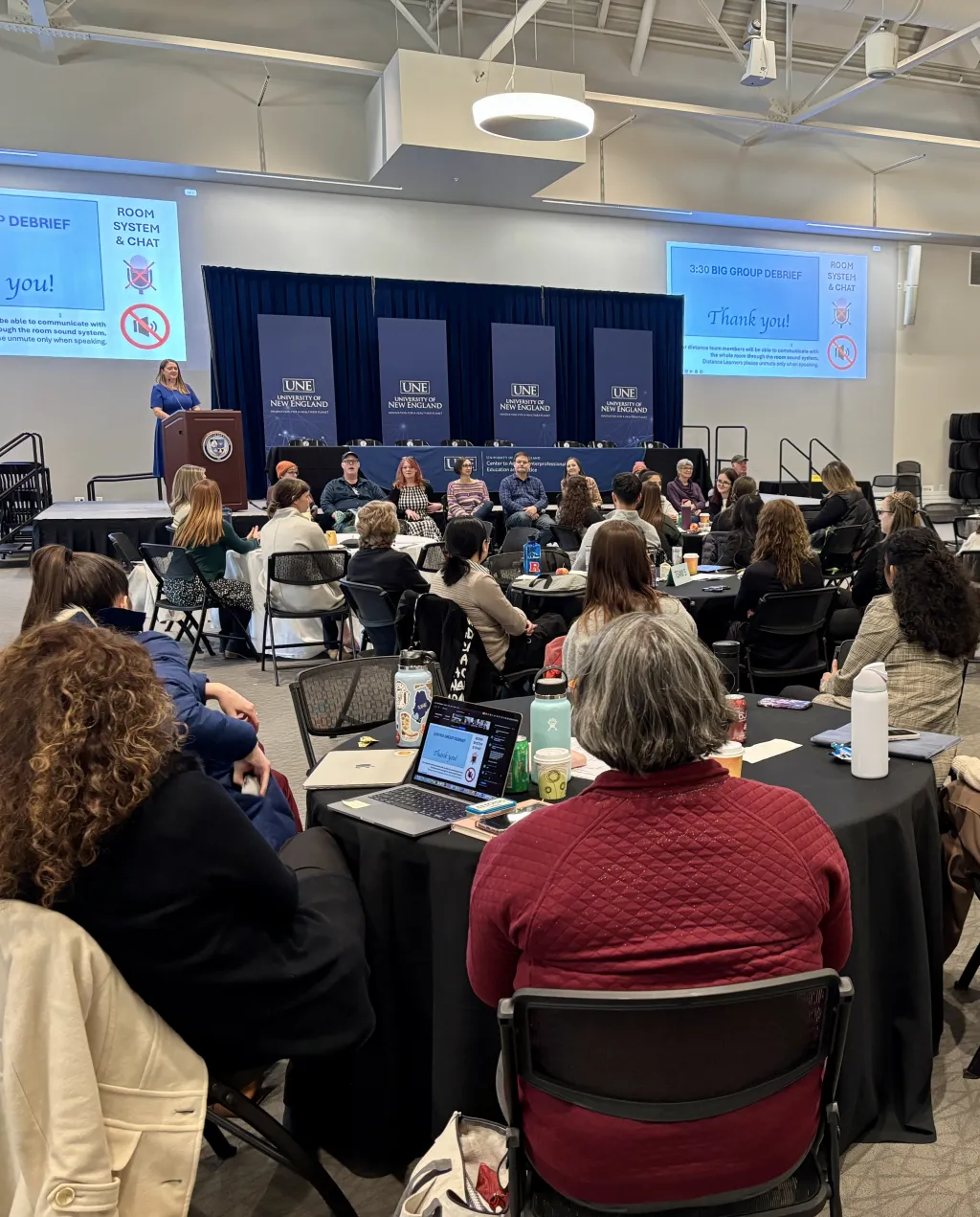
Interprofessional teams share lessons learned.