
UNE medical students learn firsthand the challenges, rewards of rural health care
A statewide health care workforce development network housed at UNE provides a taste of rural practice to Maine’s medical students
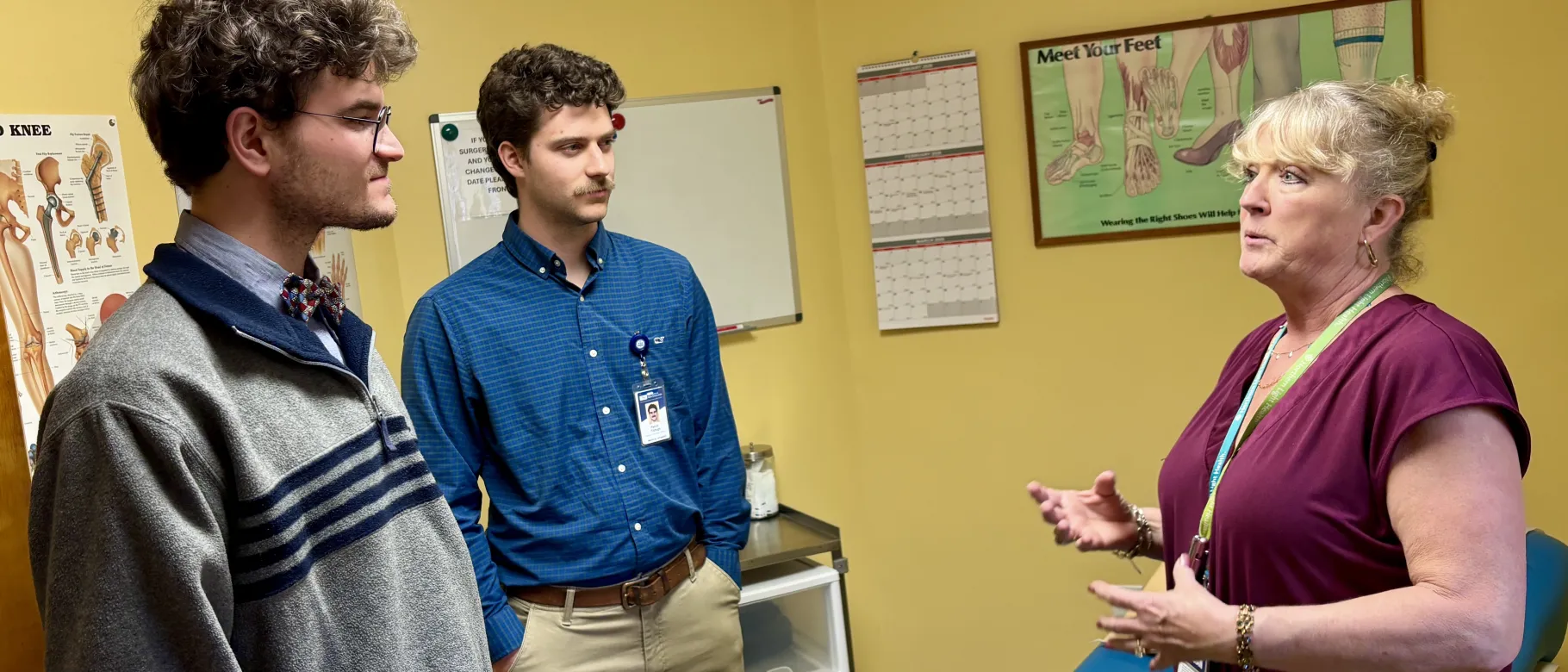
University of New England medical student Patrick Fitzhugh (D.O., ’29), already had a sense that he wanted to practice medicine in a rural area, a place where he and his fiancé could also start a farm. But the hospitality, thoughtfulness, and outright friendliness that Fitzhugh witnessed at Northern Light Mayo Hospital in Dover-Foxcroft, Maine, on March 11 surprised him.
“This was eye-opening to see just how nice it can be to practice in a place like this, how close-knit. It piqued my interest even more,” Fitzhugh said. “The best example I can offer is how the patients seemed like friends (with the doctor). All of them were talking about snowmobiling, kids, families, hobbies. It’s a lot more personable.”
With five other medical students from UNE’s College of Osteopathic Medicine and three from Tufts University School of Medicine Maine Track program, Fitzhugh had a firsthand look at the challenges and rewards of work as a rural health care provider during a Rural Health Immersion (RHI) trip coordinated by the Northern Center of the Maine Area Health Education Center (AHEC) Network, a statewide health care workforce development network based at UNE.
The Rural Health Immersion is aimed at introducing Maine medical students and other health care professions students to life in rural Maine communities to encourage them to consider a career in rural medicine in Maine, an effort that’s become more critical during a time of workforce shortages throughout the health care professions.
Each year, Maine AHEC sends health professions students enrolled in their Scholars Program on multi-day tours of rural Maine communities to meet community leaders, learn about local culture, and shadow health care providers. The trips are carefully curated experiences.
Kristen Dickison, the director of the Northern Maine AHEC Center at Eastern Maine Medical Center, coordinated the three-day trip to Dover-Foxcroft where the medical students, among other things, toured an addiction-treatment center and met the director of a regional food pantry. Similar rural immersions took place this month near the Downeast coast and in southwestern Maine.
Micaela Maynard, the AHEC Scholars program manager, said these immersion trips provide opportunities for health profession students to experience the unique characteristics, culture, and charm of Maine’s diverse rural areas — and often, Maynard said, a close look is all they need.
“From our post-graduation follow-up surveys from 2020 to 2024 we know that 28% of AHEC Scholar alumni are working as health providers in Maine,” said Maynard with Maine AHEC, which is housed in the UNE Center for Community and Public Health in the Westbrook College of Health Professions.
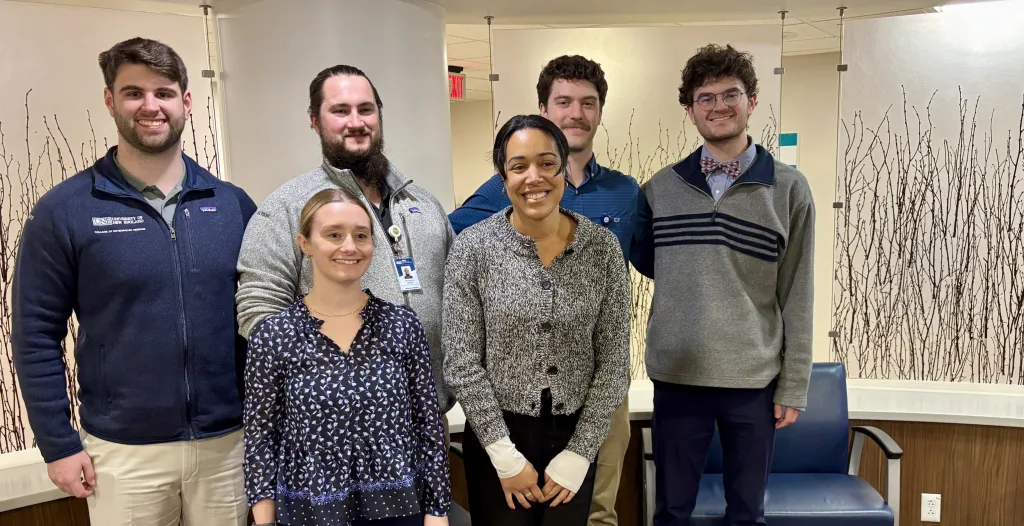
UNE medical school students: (Back, L-to-R) Mathew St. Hilaire, Nick Jackson, Patrick Fitzhugh, and Callum Boudreau; (Front, L-to-R) Sarah Savoy and Maya Clemons
Claire Dudek, M.S.P.A. ’24, who now works at Mount Desert Island Hospital in Hancock County, Maine, went on the Rural Health Immersion trip to Mount Desert Island in 2023. She said it was instrumental in her going to work there after she graduated from UNE.
In fact, Dudek said had she not done a rural immersion trip to the coastal Maine island, she’s not sure she would have applied for and taken a job to work there.
“My tour during the AHEC RHI gave me firsthand confirmation that MDIH is truly invested in their new grads. Furthermore, I knew that I would enjoy living on MDI as I had already been introduced to the community,” Dudek said.
The local hospital in Dover-Foxcroft, located at the doorstep of the North Maine Woods, is a solid hour to the nearest trauma center in Bangor. There, nine medical students last week were schooled in the challenges rural health care providers face with limited resources — and limited staff — but also the rewards they enjoy.
Maya Clemons, (D.O., ’29) who hails from Orange County, California, shadowed an obstetrician-gynecologist in Dover-Foxcroft and was blown away by the commitment, resourcefulness, and professional success the doctor she followed on calls enjoyed.
“She was talking about how their work is so important and, in some cases, where there is a lack of resources, it’s hard sometimes to provide the full care that you would provide if you were in Boston,” Clemons said. “But she’s able to adapt and make it work by communicating with the providers around her to figure out if there’s a solution that’s the safest for the patient.
“It was very interesting and amazing to hear her perspective on that,” she said.
Fitzhugh shadowed podiatrist Shannon Meredith, D.P.M., along with Callum Boudreau (D.O., ’29) and the two medical students watched in awe as Meredith met with 14 patients — and chatted with 12 of them about their children, families, snowmobiling, and Meredith’s upcoming family wedding.
Both students said the slower pace and personal investment Meredith had in her work and her patient's lives showed how rewarding a career in rural health care could be.
Meredith worked for 21 years in Portland, Maine, before she was recruited to work in northern Maine 11 years ago. Then she jumped at the chance for the improved quality of life it offered.
“For me, the work-life balance is really what brought me here. Then the community is what keeps me here,” Meredith told Fitzhugh and Boudreau. “You get to know your patients really well. They’re your neighbors and sometimes your friends. It’s very rewarding emotionally — and, I think, mentally.”

Northern Light Mayo Hospital