UNE mentors Maine high school students at annual Health Careers Exploration Camp
Growing up in Portland, Maine, Georgia Sommer, B.S. ’22 (Medical Biology), knew she wanted to be a dentist because she wanted to pursue a career in a healthcare field where she’d see instant results — and Sommer also wanted to add to a workforce where women were in the minority.
“It wasn’t until I was 15 that I saw a woman dentist. My orthodontist inspired me,” said Sommer, who continued her education at UNE and is now a fourth-year student in the College of Dental Medicine at the University of New England.
Sommer recently shared with 30 Maine high school students her personal story of how she came to pursue dentistry at Maine’s only dental college, when Sommer fielded questions about her career choice at the UNE Health Careers Exploration Camp.
This year’s camp hosted students from 12 Maine high schools from as far east as Belfast on June 27 and 28, continuing UNE’s mission to expose students from underserved areas to the health professions in order to build Maine’s healthcare workforce.
Now 16 years running, the camp is coordinated by the Maine Area Health Education Center (AHEC) Network, a statewide healthcare workforce development network based at UNE. AHEC’s careers camp provides hands-on, interactive lessons taught by UNE faculty and students on the Portland Campus for Health Sciences in an array of health care fields — all of it offered at no cost to the high school students with support from Martin’s Point Health Care.
Given the shortages among healthcare providers in Maine — including dental hygienists, dentists, physician assistants, and primary care physicians — the interactive, introductory program helps to create a viable, meaningful pathway for Maine high school students to explore careers in several healthcare fields.
“What started as a Dental Career Exploration camp in 2010 quickly grew to include many more health professions, creating an immersive experience for 480 students to consider a wide variety of careers with the long-term goal of addressing the healthcare workforce shortages in the state,” said Zoe Hull, M.P.H., director of the Maine AHEC Network, which is housed within the David Evans Shaw Institute of Public and Planetary Health.
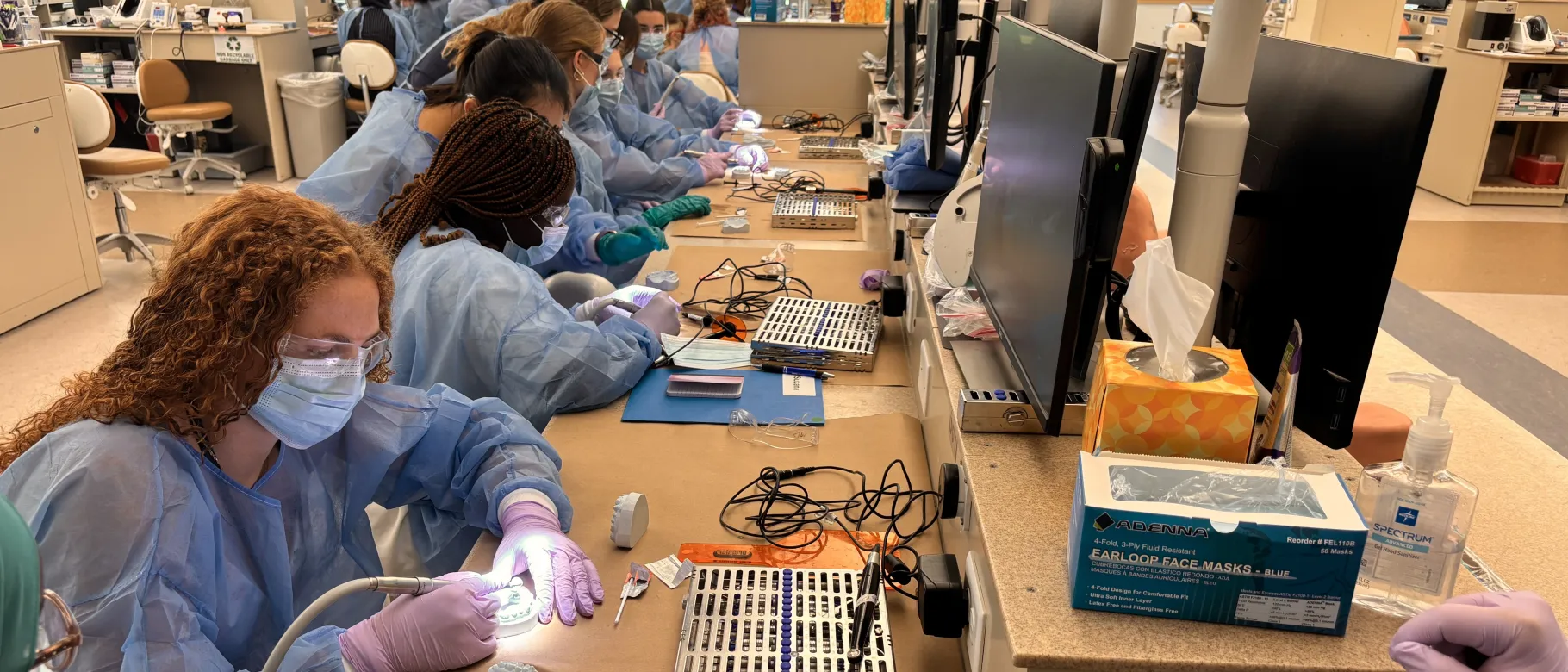
On the morning of Saturday, June 28, at the College of Dental Medicine’s Oral Health Center, high school students mentored by UNE students and faculty learned how to apply dental fluoride, place dental sealants, and prepare and restore teeth on dental models. Dressed in gowns, protective goggles, masks, and gloves, the high school students used UNE-made models of teeth and dental instruments as they followed along with faculty instructors to complete dental work on their own.
“Early exposure like this can be transformative, and we hope this dynamic, immersive experience inspires participants to explore careers in the health professions,” said UNE College of Dental Medicine Dean Nicole Kimmes, D.D.S., who helped at the camp.
Third-year dental student Emily Holmes also wanted to share her story with the high school students and readily answered questions at the end of the lesson in the Oral Health Center simulation lab. Speaking frankly, Holmes described how she first learned of the public good dentistry can provide when she shadowed a dentist as a high school student, witnessing first-hand how a man with diabetes and dentures was provided with a new set of teeth and, with that, a healthier outlook on life.
“People who are not confident and not healthy due to issues with their teeth come in and then something you can do for them changes their life, their confidence level, and their health,” Holmes said. “Some of those interactions you have with patients are incredibly meaningful.”