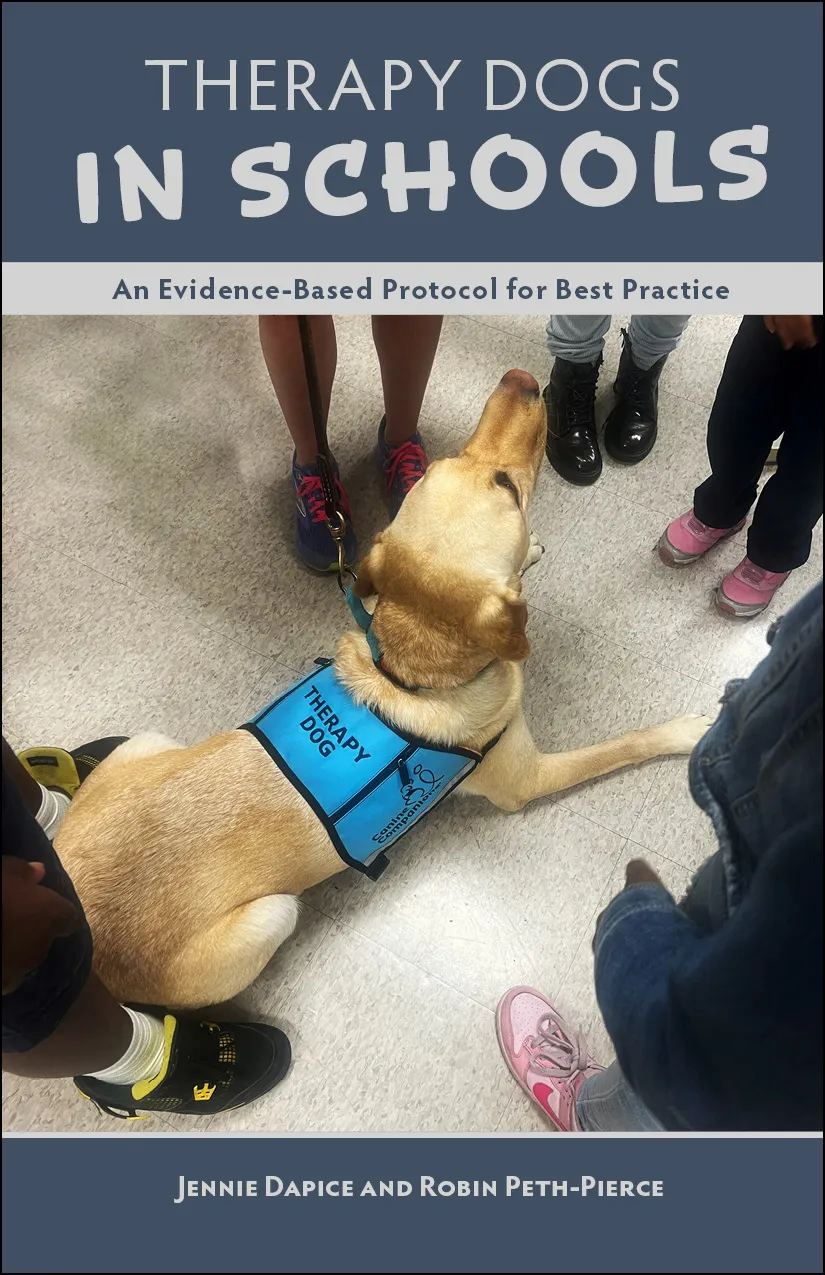
UNE professor co-authors first evidence-based guide for school therapy dog programs

University of New England Assistant Professor Jennie Dapice, Ph.D., recently co-authored what is believed to be the first book outlining evidence-based protocols for school-based therapy dog programs, offering K–12 educators and administrators a standardized framework. The book published this month by Purdue University Press comes at a time when more dogs are being allowed in schools as a means for providing emotional and educational support for children and youth.
Dapice, who teaches in the Department of Occupational Therapy at UNE's Westbrook College of Health Professions, co-authored "Therapy Dogs in Schools: An Evidence-Based Protocol for Best Practice" with Robin Peth-Pierce, a veterinary social work student at Cleveland State University and founder and CEO of Public Health Communications Consulting.
The book outlines the Professional Application of Therapy dogs in Schools, or PATS, protocol — a structured sequence for planning, implementing, and evaluating school therapy dog programs with a focus on community safety, animal welfare, and measurable results. The goals of the standardized approach include improved emotional, behavioral, and academic outcomes for students, as well as a more positive culture in schools.
Therapy dogs in school settings are typically considered a form of Canine-Assisted Education (CAE), a subset of animal-assisted interventions. Research has shown CAE programs can positively influence students' confidence, frame of mind, social interactions, and communication skills.
Currently, no laws govern the incorporation of therapy dogs in schools, so policies are developed by individual schools and school districts, resulting in wide variability, Dapice said. The PATS protocol is intended to address that need by giving administrators, staff, and therapy dog handlers a common set of tools and resources to implement high quality, safe therapy dog programs. The book also covers how to maintain a therapy dog program over time and how to support the school community when a therapy dog retires.
The foreword was written by Dr. Aubrey Fine, who is widely credited as one of the originators of animal-assisted therapy and with helping to formalize the incorporation of animals in therapeutic settings.
Dapice, a board-certified pediatric occupational therapist and Certified Animal-Assisted Intervention Specialist, who has practiced and studied in the field of human-animal interactions since 2005, said the book draws on current literature, her own experience, and resources from several leading organizations, including Pet Partners, the Association of Animal-Assisted Interventions, Canine Companions, the Alliance of Therapy Dogs, and Therapy Dogs International.
Dapice serves as a member of the Canine Companions Therapy Dog Council and as a faculty fellow at the Tufts Center for Animals and Public Policy. She also has presented her work to school practitioners in Maine through the Maine Department of Education, Maine OT association, and the Maine Association of School Counselors. And Dapice has brought her trained therapy dog to stress relief events at UNE for students during finals, noting that the experience visibly changes the students’ mood and disposition.
“Students and educators are experiencing significant stress and challenges. Therapy dog programming can be a low cost, high yield intervention that can provide support in the school environment,” Dapice said. “Importantly, therapy dogs may be able to engage and connect with students in ways that traditional educational approaches cannot.”
"Therapy Dogs in Schools" is part of the New Directions in the Human-Animal Bond series, published in collaboration with Purdue University's College of Veterinary Medicine. The book is available through Purdue University Press and on Amazon.