Image

This website uses cookies to understand how you use the website and to improve your experience. By continuing to use the website, you accept the University of New England’s use of cookies and similar technologies. To learn more about our use of cookies and how to manage your browser cookie settings, please review our Privacy Notice.
For Kara Mickiewicz ’27, it all started with one week in July.
Shark Week.
Mickiewicz spent her childhood glued to the annual Discovery Channel event, certain she’d end up studying the ocean. Today, she’s doing exactly that — tracking harbor porpoise and minke whales in the Gulf of Maine as an undergraduate researcher at the University of New England.
“My biggest reasons for choosing UNE were the location, the marine science program, and the sense of community the campus seemed to have,” said Mickiewicz, a first-generation college student from Birdsboro, Pennsylvania, who is double majoring in marine biology and environmental science in the School of Marine and Environmental Programs.
Mickiewicz originally enrolled at a different coastal college in Maine but quickly realized she needed a more academic structure to thrive, she said.
As she began researching transfer options, UNE kept rising to the top.
“I consistently heard great things about the marine science program and was drawn to the variety of research labs and hands-on opportunities available to students,” she said. “Seeing how accessible these opportunities were made me excited about the possibilities here, and it ultimately led me to apply.”
The transfer process was daunting as a first-generation student, she said, but UNE’s admissions team eased the transition. All of her credits transferred, and the staff checked in regularly to make sure she had what she needed.
“They answered questions I didn’t even realize I had,” she said, “which made the transition feel much more comfortable.”
Once on campus, Mickiewicz wasted no time getting involved. When she heard that Michelle Caputo, Ph.D., an assistant professor of marine science in the School of Marine and Environmental Programs, was launching a new lab, called the Marine Mammals and Communities Laboratory, she immediately reached out.
“I wanted to experience … what I am and what I am not interested in,” she recalled.
What started as an eagerness to simply gain experience has shaped the direction of her academic and professional life, Mickiewicz said. Through the lab, she learned to use GIS mapping software and coding to model habitats for smaller cetaceans including dolphins, harbor porpoises, and minke whales in the Gulf of Maine, species she said are significantly understudied compared to larger whales.
FIND OUT HOW TO TRANSFER TODAY
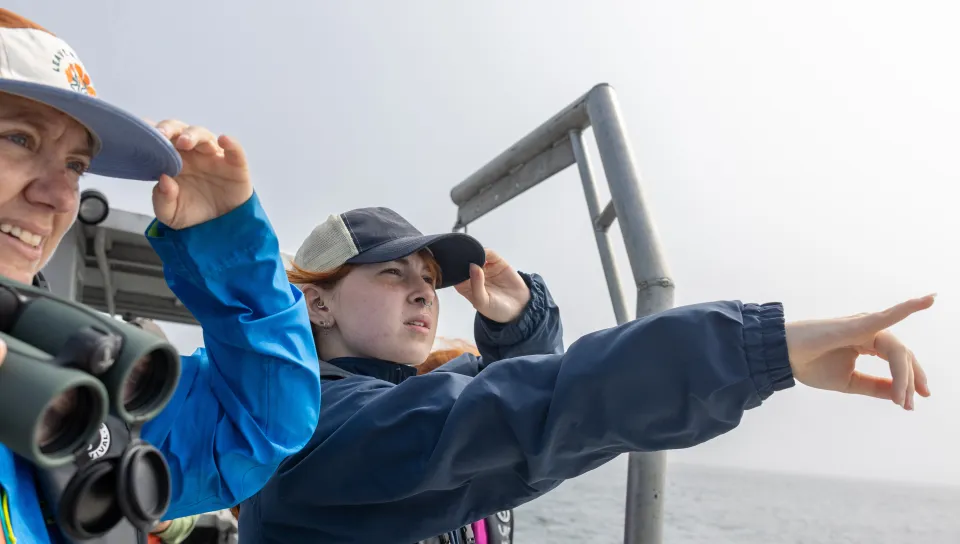
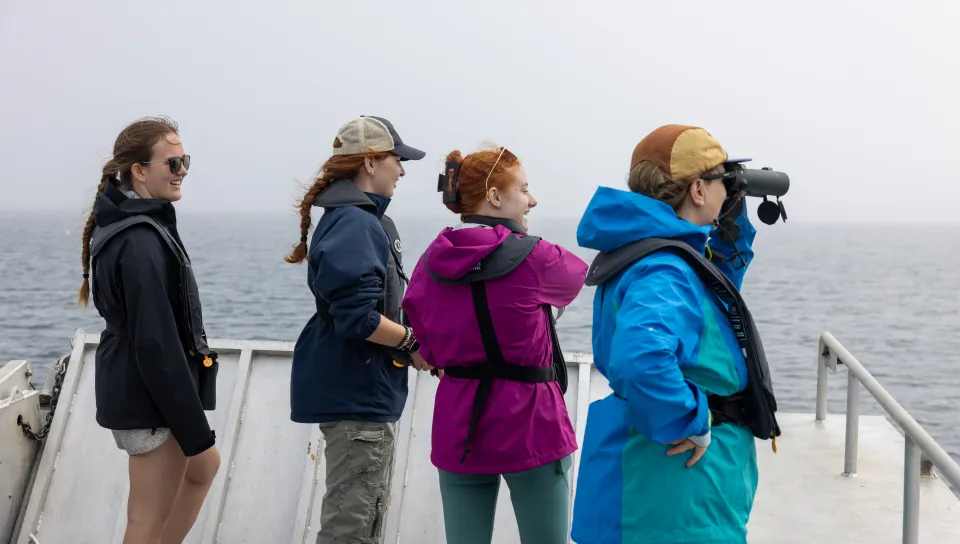
Her work became the foundation for a project through UNE’s Summer Undergraduate Research Experience (SURE) program, where she spent a summer conducting fieldwork, dividing the Gulf into transects and heading out on the water multiple times a week to collect data on the animals’ locations.
“There’s all this research on the larger whales, but there was nothing on smaller cetaceans,” she explained, noting that cetaceans is a term for marine mammals like whales, dolphins, and porpoises. “We needed to first figure out where they are before I could identify more about their behaviors.”
Caputo said Mickiewicz’s ability to work independently set her apart from the start.
“I gave her complex mathematical modeling to do on her own, with very little guidance,” said Caputo. “And she produced a high level of content. She is exceptional.”
The skills Mickiewicz built in the lab and through SURE also led to a competitive research internship in the Caribbean, where she and fellow UNE student Jillian Bender ’27, (Marine Science and Education), will monitor whale species in an entirely different ecosystem. The opportunity is part of a National Science Foundation-funded grant led by Jeremy Kiszka, Ph.D., an associate professor at the Florida International University.
Mickiewicz plans to continue her education through UNE’s accelerated master’s in marine science program with Caputo as her advisor. The internship this summer, Mickiewicz said, will also contribute to her master’s thesis.
Caputo said that Mickiewicz has emerged as a quiet but effective leader in the lab, organizing the lab’s social media calendar, assigning roles to fellow students, and checking in to keep everyone on track.
“She is really able to get the job done and be a leader in her own way,” Caputo said. “And she is one of the most curious students I’ve had in my lab — curious about the world, curious about the people in it.
“To me, that’s the most important quality a young scientist can have,” she said.
Mickiewicz said she has no regrets about her decision to transfer and hopes other students considering the same won’t let doubt hold them back.
“My time at UNE has helped me grow both academically and personally, and I’ve discovered unique opportunities that I don’t think I would have found elsewhere,” she said.