
Image

This website uses cookies to understand how you use the website and to improve your experience. By continuing to use the website, you accept the University of New England’s use of cookies and similar technologies. To learn more about our use of cookies and how to manage your browser cookie settings, please review our Privacy Notice.
As Grace Stults with Special Olympics Maine explained to a University of New England occupational studies class some of the latest assistive technology and adaptive equipment used by those with disabilities, the young man sitting to her right put a fine point on Stults's message that those who use such technology to speak because of intellectual disabilities still possess a keen understanding and interest in being part of the conversation.
Special Olympics Maine athlete Scotty Wentzell held up his iPad with a photo of him and Stults at a Christmas party, the same Christmas party Stults was telling a story about. Wentzell’s visual cue perfectly underscored Stults's advice that students in UNE’s Occupational Studies program employ not only new technology in their work, but also empathy, understanding, and patience when working with people with disabilities.
Stults came to talk on March 3 at UNE to Assistant Clinical Professor Christopher Delenick’s class about assistive technology and adaptive equipment as part of a unique panel discussion. She was joined by Wentzell, his mother, Lisa, and Special Olympics Maine athlete Annie Nee, who has intellectual disabilities and uses a wheelchair.
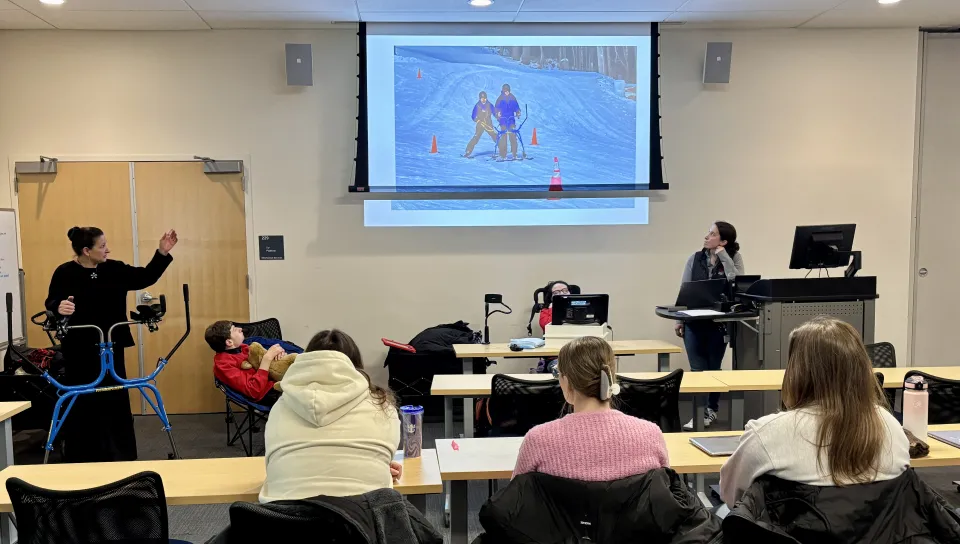
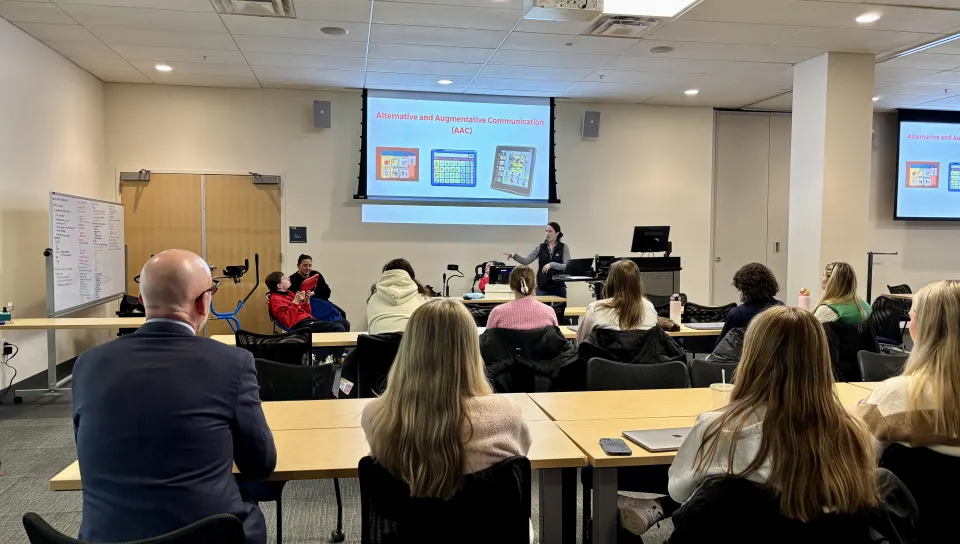
All four experts spoke about how those with intellectual disabilities can navigate an active and meaningful life with the help of assistive technology and adaptive equipment.
While Stults had spoken to Delenick’s class in the past, March 3 marked the first time she was joined by athletes with disabilities. The panel discussion was an idea Stults conceived of with Laurie Pearson, B.S.’20 (Occupational Studies), Special Olympics Maine’s Unified Schools and Wellness coordinator.
Delenick, O.T.D., OT/L, in UNE’s Westbrook College of Health Professions jumped at the idea.
“I can only do so much as an advocate and an ally to the community but having someone who truly has a disability and understands what that means for day-to-day life is huge. And nothing I can say can replicate what Annie can show us and what Scotty can tell us,” said Stults, Special Olympics Maine’s Health and Wellness Director.
Lisa Wentzell shared with the class how adaptive equipment has allowed her son to downhill ski, waterski, bicycle, and engage with his peers at school. Then she stepped aside as Scotty Wentzell introduced himself through a message they programed into his iPad using an app called GoTalk.
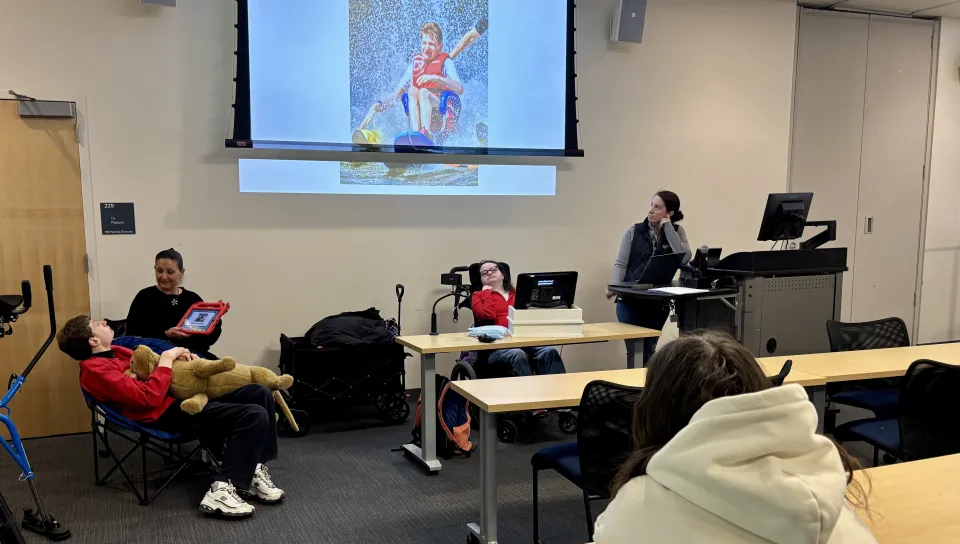
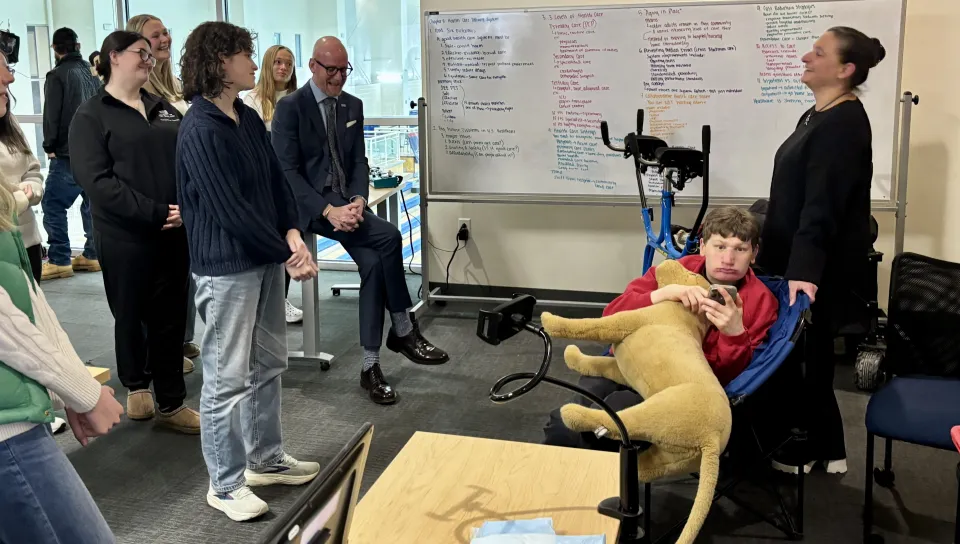
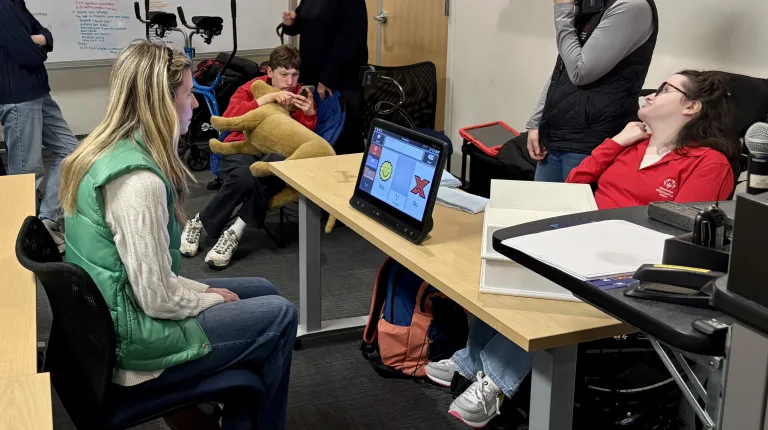
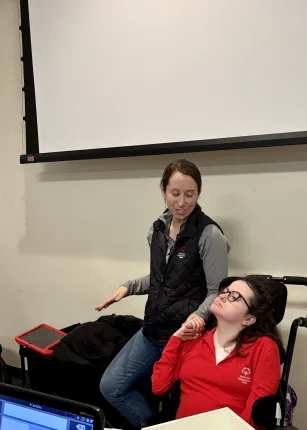
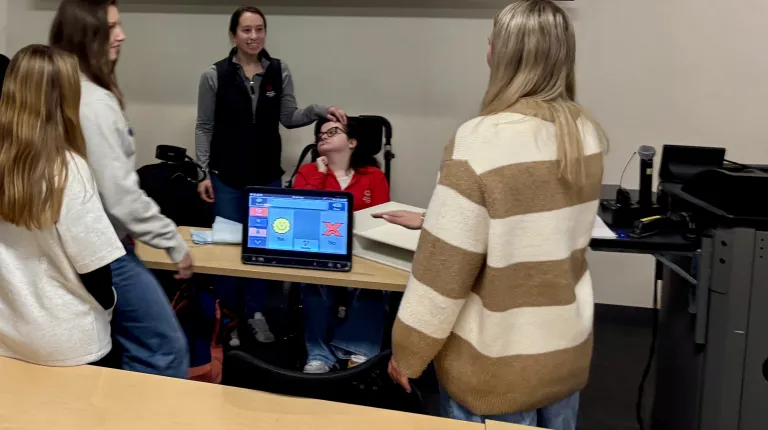
When Scotty pressed a button on his iPad, an automated voice greeted the students: “Hi, my name is Scotty Wenzell, and it is so nice to meet all of you. I love being able to participate in sports. And thanks to so many organizations — like the adaptive Special Surfers, the Portland Wheelers, and the Adaptive Outdoor Education Center — I do.”
Having this first-hand interaction with a person with disabilities who uses assisted technology enriched and elevated the learning in Delenick’s occupational studies class, said Maeve McNulty (M.S.O.T., ’29), a second-year undergraduate in the 3+2 track that will allow her to earn her bachelor’s and master's degree in occupational therapy in five years.
Getting to hear from not only the individuals who work at Special Olympics, but also from the caregivers, and the athletes is really, really helpful, especially for someone going into the profession.” — UNE student Maeve McNulty
“I think this is a really exceptional kind of experience to be able to see firsthand how these assistive technology devices impact these adults after we've been learning about assistive technology in class,” McNulty said. “Getting to hear from not only the individuals who work at Special Olympics, but also from the caregivers, and the athletes is really, really helpful, especially for someone going into the profession.”
Delenick echoed McNulty’s enthusiasm and then thanked the athletes and guests for sharing their first-hand accounts of how occupational therapists can help others by breaking down barriers through innovation — a goal at the heart of the UNE mission.
“We can watch videos or we can read about it in textbooks and articles, but talking to folks who are actually using the technology themselves is a different experience and it's a great one,” Delenick said. “I can't thank you enough for this. So, thank you.”