
About our Master of Science in Marine Sciences
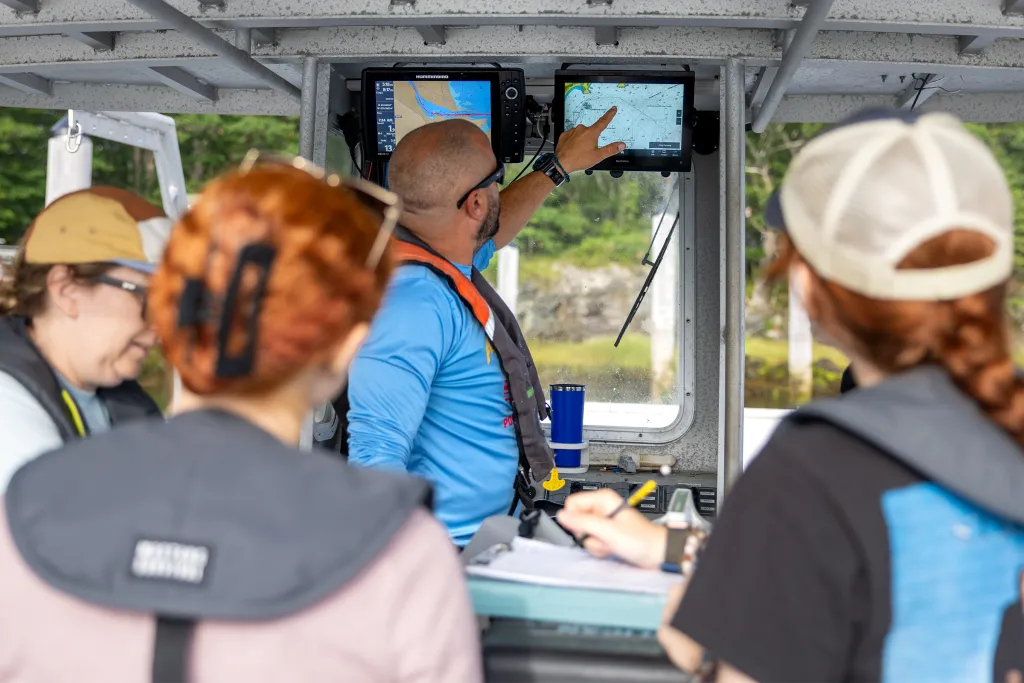
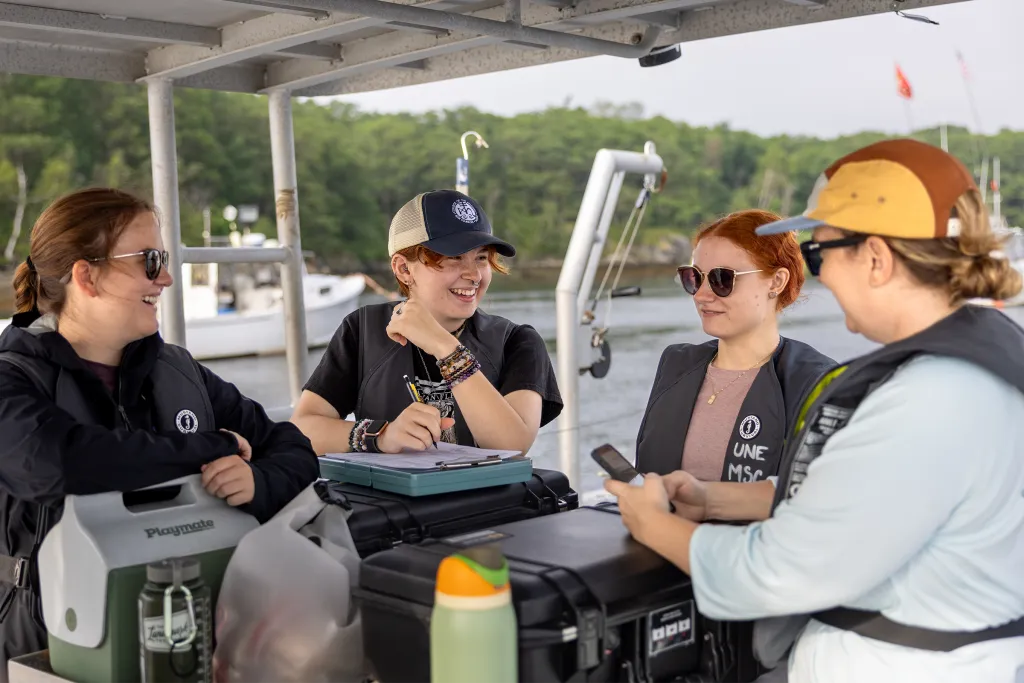
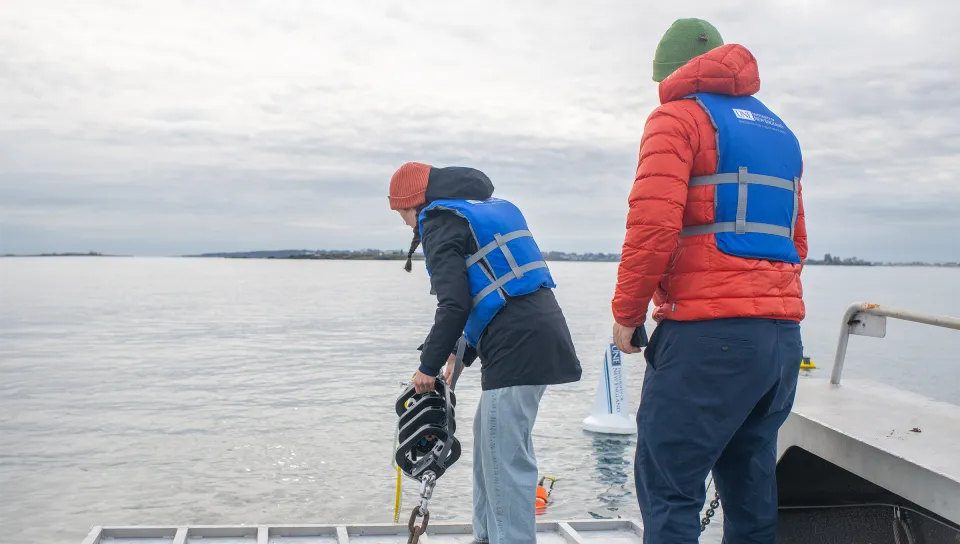
At UNE, our Master’s program in Marine Science provides students with a strong foundation in marine and coastal systems, paired with intensive training in scientific research. This program is designed to equip you with the skills and hands-on experience needed for careers in marine and environmental sciences or for the pursuit of doctoral study. We offer two pathways to completion: a Traditional Two-Year M.S. Track or an Accelerated B.S./M.S. Track. In either pathway, students work closely with a faculty mentor and benefit from access to cutting-edge research facilities, field-based learning opportunities, and UNE’s coastal location on our beautiful Biddeford Campus.
Traditional Two-Year M.S. Track
The Master of Science in Marine Science can be earned at UNE through a traditional two-year program, following completion of a bachelor's degree in a biology-related field. During this time, you will conduct original research and prepare a thesis on any of a variety of topics selected in consultation with your faculty advisor, who serves as your research mentor.
View the full M.S. in Marine Sciences curriculum in the academic catalog
Accelerated M.S. in Marine Science
If you are a current UNE undergraduate student, the UNE Accelerated M.S. in Marine Science track allows you to complete an undergraduate and a master's degree in just five years. To enroll in the accelerated program, you must be an undergraduate at UNE with a 3.0 overall G.P.A. and a 3.0 G.P.A. in all math and science courses, and you must receive sponsorship from a faculty member in the School of Marine and Environmental Programs who will serve as your thesis advisor. You can declare your intent to enroll in the program as early as the second semester of your sophomore year or as late as the second semester of your junior year.
View the full Accelerated M.S. in Marine Sciences curriculum in the academic catalog
Who Can Apply to the M.S. in Marine Sciences degree program?
To apply to our graduate Marine Sciences degree program, you must hold a bachelor’s degree from a U.S. regionally accredited institution or international equivalent.
M.S. in Marine Science Research
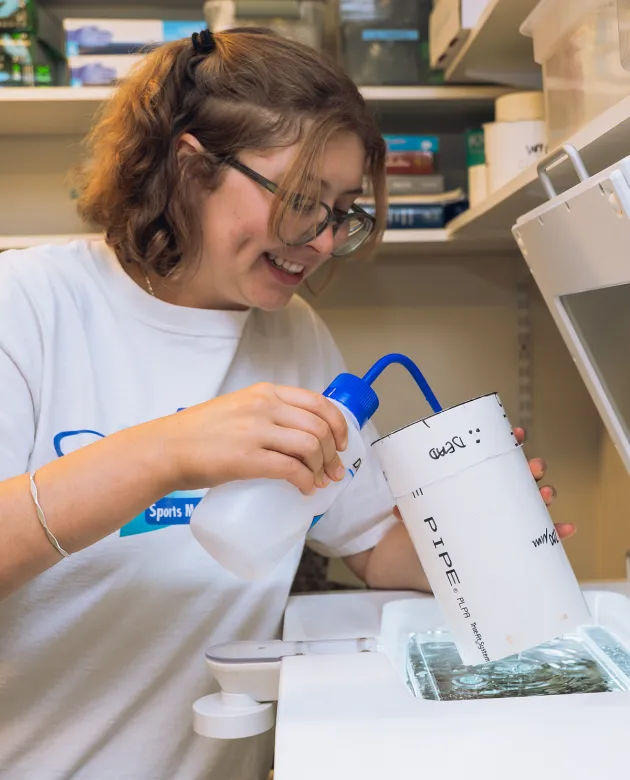
Regardless of which track you enroll in, you will engage in research with a faculty mentor, culminating in a publication-quality thesis. If you are applying to the traditional two-year M.S. program, you are highly recommended to identify faculty with whom you would like to work at the time you apply, and thus are strongly encouraged to contact faculty members directly early in the process to discuss potential research opportunities. If you are in the accelerated track, you identify a mentor during your B.S studies at UNE.
Marine Sciences Graduate Success
Whether they choose the traditional two-year track or the accelerated track, graduates of UNE’s M.S. in Marine Sciences program have gone on to pursue further education and fascinating careers, including
- Science Department Chair at Lakes Region Community College
- Water Resources Staff by the RI Dept of Environmental Management
- Ph.D. program in Neuroscience at the University of California Davis
- Research Assistant at the Mount Desert Island Biological Laboratory
- Medical Fellow at Hunter Pain Specialists
- Ph.D. program in Biomedical Sciences at the University of Buffalo
Publications
One of the benchmarks of graduate-level work is the publication of one’s research in a scientific journal. Below are examples of papers by our graduates:
Cusson AJ, Burkholder KM, Byron CJ, Grebe GS, Deveau AM. 2021. Impact of time of harvest and drying method on antimicrobial activity of Sacharina latissima against two Staphylococcus aureus strains. Applied Phycology 2(1), 80–88. https://doi.org/10.1080/26388081.2021.1996208
Dowling T, Travis SE, Morgan PA, Zogg GP. 2023. Can the marsh migrate? Factors influencing the growth of Spartina patens under upland conditions. Wetlands Ecology and Management 31:887-897. https://doi.org/10.1007/s11273-023-09958-9
Roese KHC, Ibrahim S, Cooper LA, Yahya AS, Kang D, Tirupathigari NR, LaRose KAJ, Houseknecht KL, Barlow DJ, Burkholder KM. 2025. Pyrogallol exhibits antimicrobial adjuvant properties against Staphylococcus aureus and Staphylococcus epidermidis. Journal of Applied Microbiology. 136:8. https://doi.org/10.1093/jambio/lxaf189
McParland A, Moulton J, Brann C, Hale C, Otis Y, Ganter Gl. 2021. The brinker repressor system regulates injury-induced nociceptive sensitization in Drosophila melanogaster. Molecular Pain. 17:17448069211037401. https://doi.org/10.1177/17448069211037401
Financial Aid at UNE
Finance your education through loans, grants, and scholarships. We are committed to making our Marine Science master’s degree program as affordable as possible.
Apply Today
Ready to begin your future in UNE’s M.S. in Marine Sciences program?