Image

This website uses cookies to understand how you use the website and to improve your experience. By continuing to use the website, you accept the University of New England’s use of cookies and similar technologies. To learn more about our use of cookies and how to manage your browser cookie settings, please review our Privacy Notice.
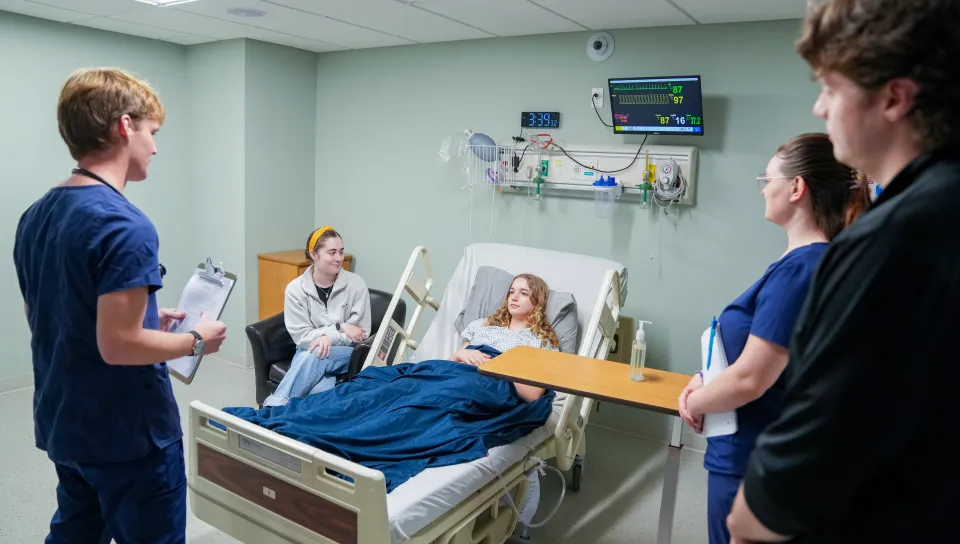
Students from the University of New England’s Westbrook College of Health Professions gathered on UNE’s Portland Campus for Health Sciences for a full-day pediatric simulation that put collaborative, family-centered care at the heart of the learning experience.
On April 17, nearly 110 students in nursing, physical therapy, and occupational therapy worked in interprofessional teams alongside child actors, ages 11 to 14, and parent actors to assess and treat patients in four acute care scenarios.
Held in UNE’s Interprofessional Simulation and Innovation Center, a state-of-the-art facility that models real-world interprofessional, collaborative clinical scenarios, 50 cases were completed across the day, each running approximately 30 minutes with two rounds of structured feedback: one with faculty and actors, one among the team itself.
“Health care is a team sport,” said Jackson Stone (’26), a fourth-year nursing student from Glastonbury, Connecticut, adding that the simulation reinforced what health care practice looks like across disciplines. “When I don’t have a specific answer for something, I can rely on experts to help in the care.”
The 37 nursing, 23 occupational therapy (OT), and 49 physical therapy (PT) students were joined by 12 patient actors and faculty, bringing the total participation to over 120 people.
“When working in a group, we were able to have an efficient flow, deliver excellent care and provide a combined well-rounded expertise from our three individual backgrounds,” Stone said.
For Rebecca Rogers (’27), a Master of Science in Occupational Therapy student from York, Maine, the experience offered something she said a classroom cannot replicate.
“Occupational therapy services don’t happen in a vacuum, and one of the biggest strengths we have is to connect with other health professions,” Rogers said. “I learned a lot more in this activity than just reading about their particular roles.”
Betsy Cyr, D.P.T., PT, DHSc, PCS, assistant clinical professor in UNE’s Physical Therapy program, helped launch the event six years ago and has led it in its current form for the last three years. She said the simulation is designed around scenarios that reflect real, acute care settings.
“If you were to walk into (a pediatric hospital), this is the stuff that’s happening with nursing, PT, and OT on the regular,” Cyr said of the different cases students have the opportunity to experience each spring. “Sometimes it’s more difficult than you think to work with a parent and a child together in that dynamic.”
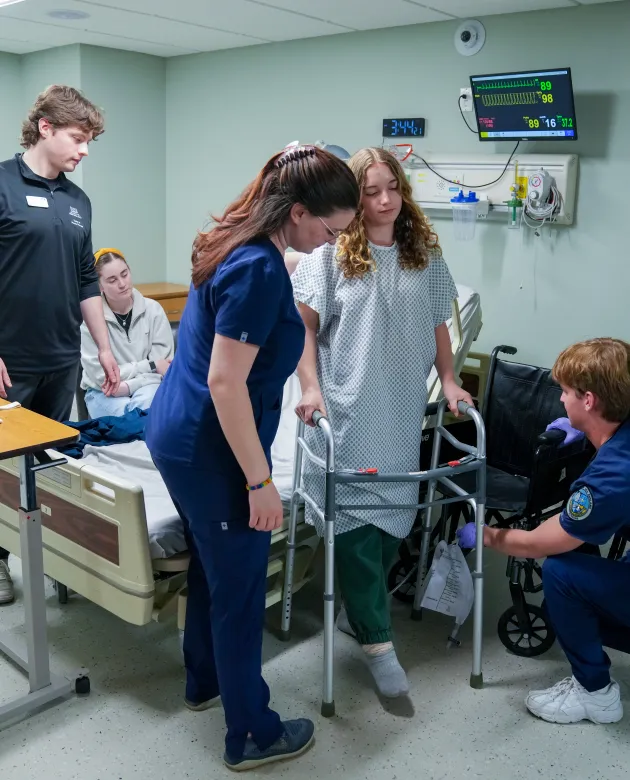
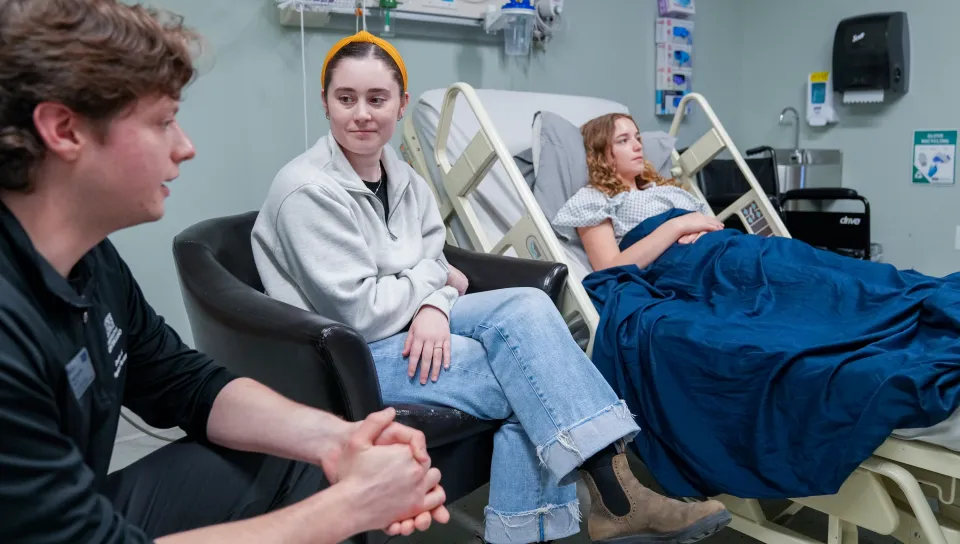
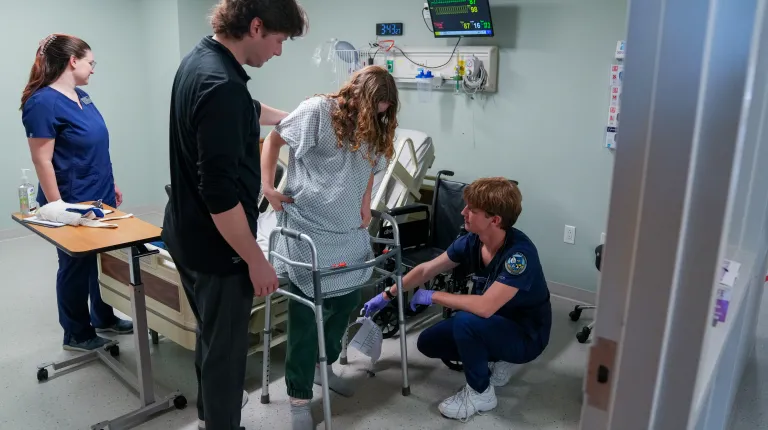
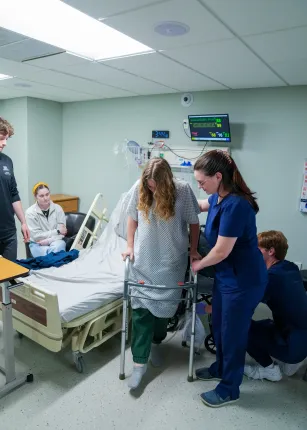
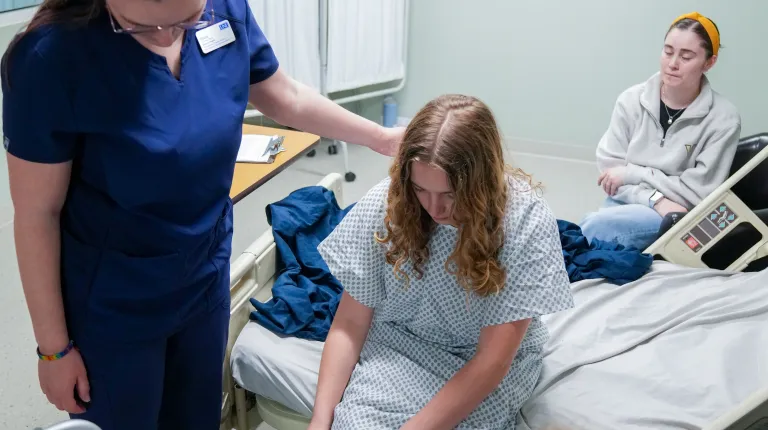
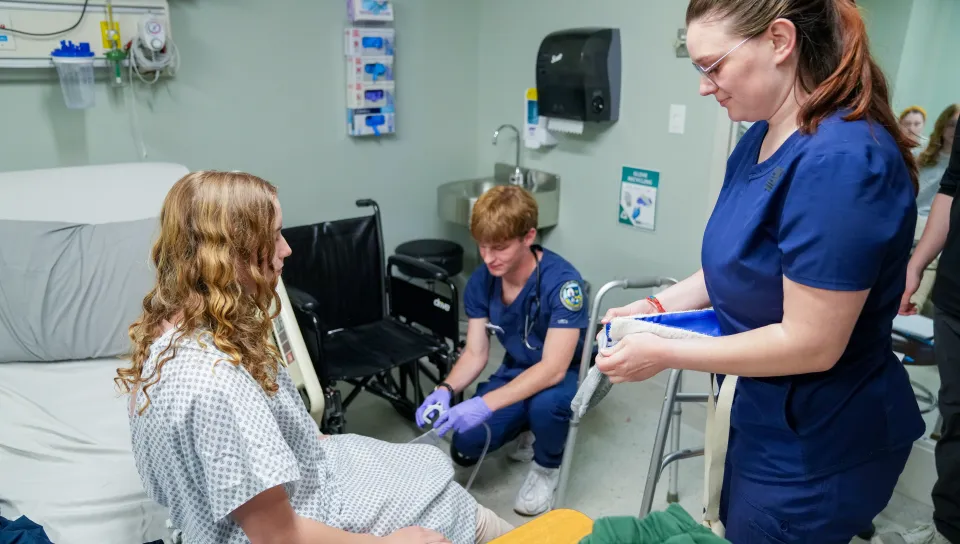
Each case placed students in an acute care situation, all modeled on documentation formatted to match a hospital setting. Teams take a patient and family history together, gather shared assessments including vitals and readiness for therapeutic intervention, and carry out discipline-specific care, such as transfer training for physical therapy students and adaptive dressing tasks for occupational therapy students, before debriefing together on how they functioned as a team.
Doctor of Physical Therapy student Nolan Ruprecht (’27), from Hermantown, Minnesota, said the interprofessional simulation lab was a factor in his decision to enroll at UNE.
“After visiting UNE, I knew that the simulation lab was a tool that would elevate my learning,” Ruprecht said. “Having the opportunity to practice my skills in an interdisciplinary environment has been extremely beneficial.”
What students leave the interprofessional center with goes beyond clinical skills, said Cyr.
“They are understanding that the other roles have just as much knowledge about what’s going on, that they really rely on each other to fill in the gaps,” she said. “We’re really looking at family-centered care and applying that in a way that gets students ready to do that in the real world.”