
Image

This website uses cookies to understand how you use the website and to improve your experience. By continuing to use the website, you accept the University of New England’s use of cookies and similar technologies. To learn more about our use of cookies and how to manage your browser cookie settings, please review our Privacy Notice.
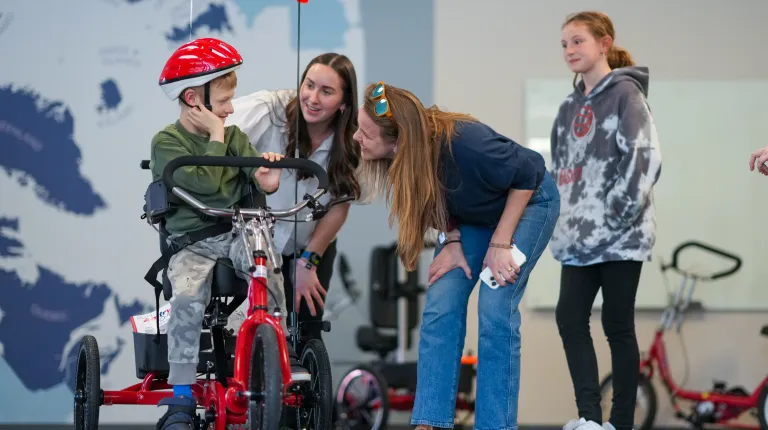
On Friday, April 10, University of New England students in the Maine Leadership Education in Neurodevelopmental Disabilities (LEND) program helped fit four people with disabilities with adaptive tricycles provided by the Maine Trykers on UNE's Portland Campus for the Health Sciences.
Maine Trykers, a nonprofit therapeutic bicycle program based at UNE, provides adaptive tricycles to children and adults with disabilities. Betsy Cyr, PT, D.P.T., an assistant clinical professor in UNE's Department of Physical Therapy and the Maine Trykers president, said the fitting process is more involved than simply handing over a tricycle — and also more meaningful.
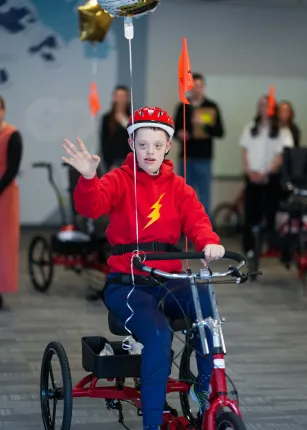
The team considers each recipient's medical history and functional needs before selecting and modifying a tricycle. Then they get to watch the sheer joy experienced when the recipient cycles around a UNE conference room cleared of tables and chairs.
"We're making sure that it's appropriate given their level of function so that they're going to be as independent as possible," Cyr said. "If they have uncontrolled seizures, there might be safety measures we recommend. If they don't have a lot of trunk control, there are different things that we’ll adapt and adjust so that the tricycles are safe for the riders."
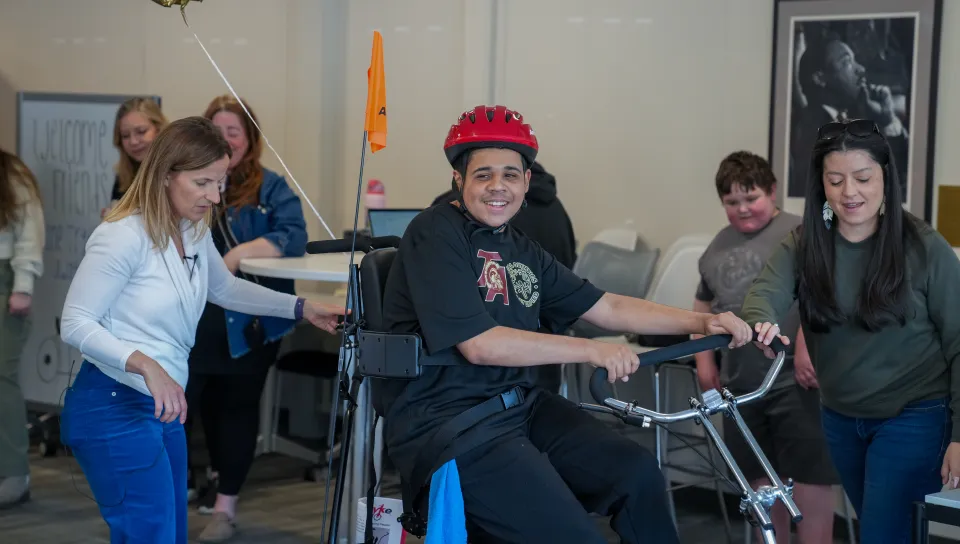
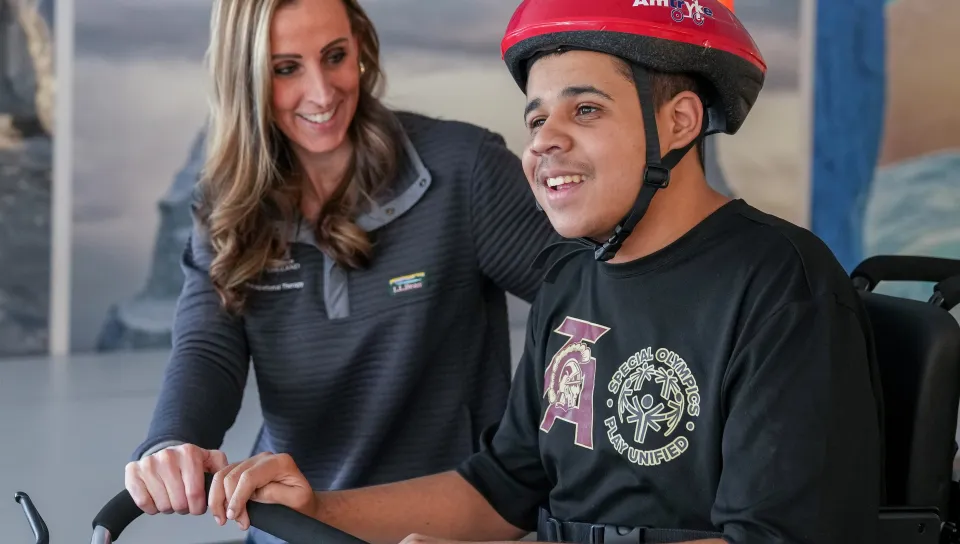
In all four sessions, the adaptive bicycle fittings ended in high fives, cheering, and smiles all around, since the experience, for a few recipients, was their first time riding a bike independently.
And, for the UNE students, it marked the first time they fitted a person with disabilities on a bicycle. The UNE students represented a host of health care professions programs, such as occupational therapy, physical therapy, and special education.
"This was an amazing experience," said Jared Benoit, a second-year student in UNE’s Master of Science in Occupational Therapy (M.S.O.T.) program. "There's a lot of customization to make it so the participants can get the most out of the experience and truly engage in riding their bikes."
For Bela Harnden, 23, of Cape Elizabeth, the tryke Benoit fitted him on represented something he had been working toward for years. Bela, who has Down syndrome, had tried a two-wheel bicycle and later a three-wheeled bicycle in recent years. But, after tipping over a year ago, he hadn’t gotten on a bicycle.
His mother, Susannah Harnden, who cycles regularly, said now her son and she can look forward to riding together.
"Bela's very active and he really wants to be going places and doing things independently," Susannah Harnden said. "We live in a community where he can cycle around. So, this is amazing. It's such a blessing."
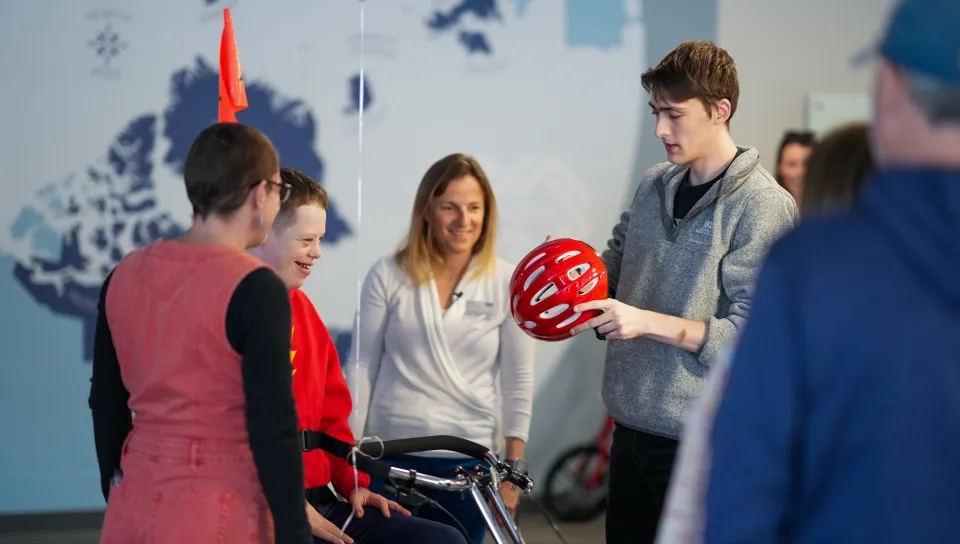
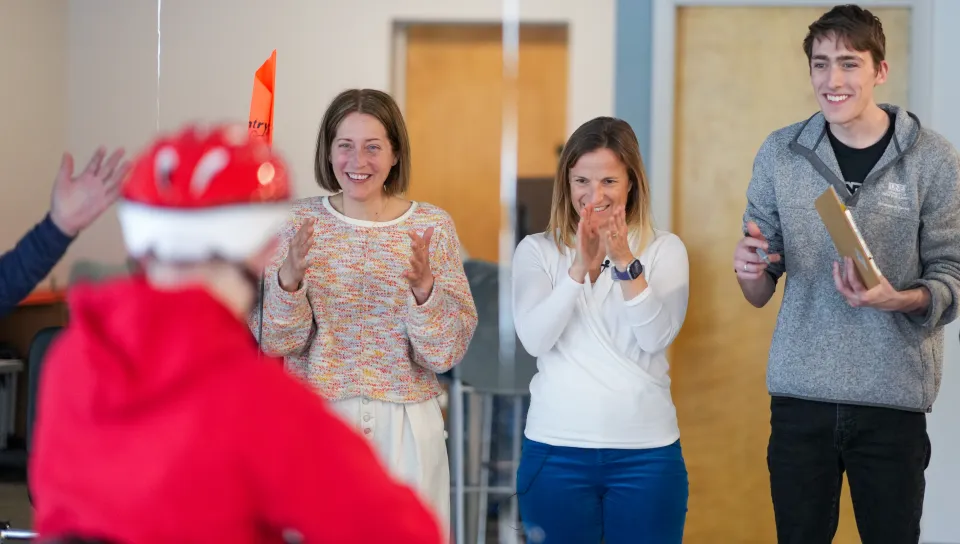
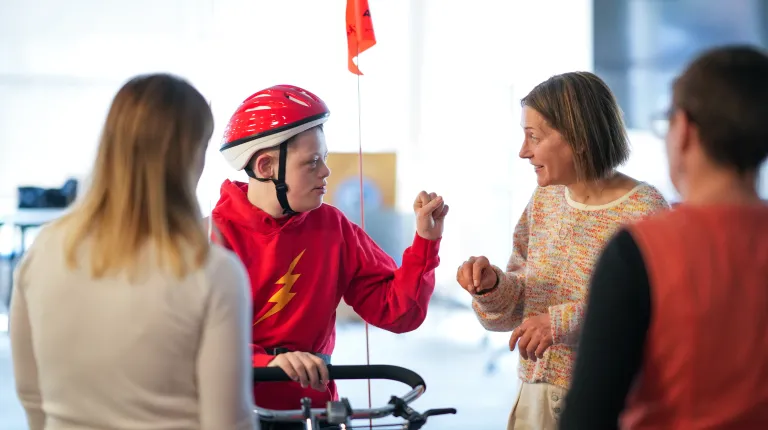
One moment stood out to Benoit: when he used some American Sign Language he knew to communicate with Bela during the fitting, and the two signed back and forth about Bela's excitement and plans to ride with his mother.
"When something's meaningful to a client, they really engage. It can be so magical to see,” Benoit said.
Since its founding at UNE seven years ago, Maine Trykers have placed nearly 20 participants on tricycles. The nonprofit works in partnership with the Maine LEND program, a federally funded interprofessional training initiative that draws participants at UNE from a range of health and related interdisciplinary programs, including occupational therapy, physical therapy, public health, nursing, special education, and psychology.
Maine Trykers also helps to fund the bikes through donations, grants, and community fundraising. The tricycles, made by Amtryke, a division of National Ambucs, range in price from roughly $600 to $1,800 and are rarely covered by insurance.
Cyr said demand has grown as more therapists in Maine have learned about the Maine Trykers program, and she hopes word continues to spread.
"I think as people find out, especially therapists in the community — because they know there's a barrier financially for a lot of families — the program will grow. Our wish list now is about four or five (tricycles) deep," Cyr said.